 United States ‘O, Jerusalem: Crossroads of Three Faiths’ – Various: Sonya Headlam (soprano), Aryssa Leigh Burrs (mezzo-soprano), Inbal Hever (mezzo-soprano), Edward Vogel (baritone), Daphna Mor (recorder, shawm, ney, vocals), Ronnie Malley (oud, accordion, vocals), Lucine Musaelian (vocals, viola da gamba), Apollo’s Singers, Apollo’s Fire / Jeannette Sorrell (conductor). Gartner Auditorium at the Cleveland Museum of Art, Cleveland, 10.4.2026. (MSJ)
‘O, Jerusalem’ is one of the crown jewels of Apollo’s Fire programming, made more pertinent than ever by current events. First created nearly a decade ago by music director Jeannette Sorrell, it has undergone some tweaks over the years while remaining consistent in its aim of humanizing the various cultures which have coexisted in that sacred city over the centuries. The program is divided up to emphasize the quarters into which the city was separated for hundreds of years during the Middle Ages. Cultures weren’t always at each other’s throats, the program tells us, and they had a warm regard for neighborliness. Such notions are reflected in the wide range of styles in the program, including Jewish, Muslim, Christian and Armenian selections in both folk and art music manifestations.
The program booklet is itself a work of art by Sorrell, gathering texts and translations with an in-depth essay that takes you into her thought process, which required using what we might call ‘adjacent’ music to fill in holes where we simply have little documentation about what music may have been heard in every quarter. She searches across times and regions to find the ripples that tie into this idea of Jerusalem as a central hub. In gathering these pieces and, as often as not, preparing her own performing editions, Sorrell’s program becomes a curated experience that ranges from devotion to despair and, ultimately, to a rousing celebration.
The show opened with a prologue entitled ‘O, Jerusalem’ which featured both musical selections and an excerpt from a Persian poem. Although it was not announced from the stage, Jeffrey Strauss, the scheduled baritone and a longtime Apollo’s Fire favorite, was ill and did not appear as billed in the program. This resulted in some changes not reflected in the printed booklet, but the ensemble has always been known for its acumen at rolling with sudden changes.
Part 2, ‘The Jewish Quarter’, included a dazzling, hammered dulcimer performance of the traditional Sephardic song ‘La Rosa enflorese’ led by Tina Bergmann. It was fascinating to watch her play and notice how her hands quiver like antennae just before she starts a virtuosic passage. Daphna Mor played her own lively arrangement for the ensemble of the Ladino folksong ‘Ija Mia’, alternating between playing recorder and singing. Sonya Headlam delivered the heartrending Ladino ballad ‘Nani, Nani’ with statuesque poise and artful phrasing without quite reaching into the desperate heart of this song where a mother sings to her child after learning that her husband, the child’s father, is faithless. Edward Vogel, an outstanding baritone, like Headlam had trouble leaving the artifice of classical training for the raw impact of the medieval Hebrew prayer ‘Tzur mishelo akhalnu’. Strauss had been originally slated to share this number with Vogel which, perhaps, would have helped. The set closed with the ensemble performance of the Iraqi piyyut text ‘Eli Eliahu’, featuring Mor on the shawm, joyously sounding out over the other instruments.
The last section before intermission was ‘The Christian & Armenian Quarters’ which opened with instrumental numbers from Falconieri and Rossi. Then came what proved the standout moment of the entire program. Lucine Musaelian, who had quietly stepped out of Apollo’s Singers and went backstage, returned with a viola da gamba and performed her own arrangement of the Armenian hymn ‘Havun, Havun’, accompanying herself on the gamba with a double bass drone support from the ensemble’s other Armenian-descended person, Sue Yelanjian. It felt like everything in the world stopped while Musaelian pulled us into the fervent prayer, delivered with an uncanny balance of grace and fearless intensity. Technique mattered less than burning passion, and the moment was searing. Her bio tells us that Musaelian is also involved in the Idrisi Ensemble, the Bellot Ensemble and the duo Intesa (all in London), and A Golden Wire (in New York City). She is surely one to watch. The set closed with a rousing performance of the Spanish cantiga ‘Santa Maria, Strela do Dia’.
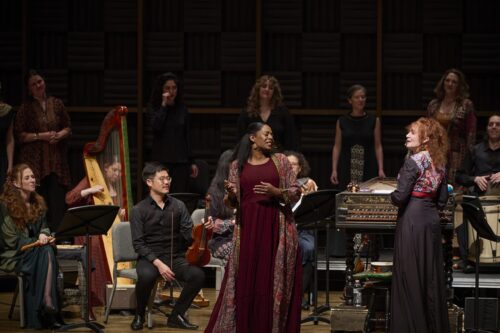
The second half started off with a muezzin prayer call delivered by Ronnie Malley from the corner of the stage. It would be nice to hear a moment like that in a more reverberant venue than the Cleveland Museum of Art’s serviceable but dry Gartner Auditorium, but the manner of springing it on the audience without warning is novel and effective. This set, ‘Mosque, Synagogue, & Cathedral’, was launched by mezzo-soprano Aryssa Leigh Burrs, who brought a dark intensity to the orthodox chant ‘Agni Parthene’. Inbal Hever’s mezzo probed the emotions of three chants that followed, as arranged by Ronnie Malley. Some plainchant from the choir led into a set of excerpts from Monteverdi’s Vespers of 1610, the kind of repertory that showcases Edward Vogel’s silky, suave baritone to gleaming effect, with the full ensemble building to a radiant peak.
‘The Arab Quarter’ was introduced by some personal memories by Malley (as Mor and Sorrell herself did in other parts of the program). Malley’s musings included a saying from his grandmother – ‘one who comes to you in peace is a good neighbor’ – with delightful sets of Arabic and Palestinian folk music to embody that warmth. The final section, ‘Neighborhood Celebration’, brought a group number (arranged by ensemble cellist René Schiffer) and an encore to close the evening festively. The program is a moving one about extending love across borders and divides, and one hopes its message is heard far and wide as Apollo’s Fire now tours with it throughout the US and to London.
Mark Sebastian Jordan
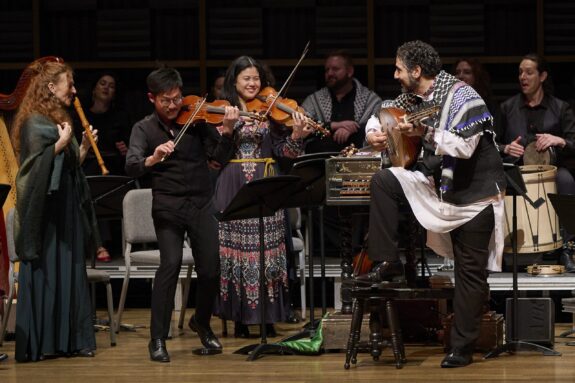
Featured Image: Daphna Mor (recorder), Alan Choo and Emi Tanabe (violins) and Ronnie Malley (oud) in ‘O, Jerusalem’ © Malcolm Henoch/AF