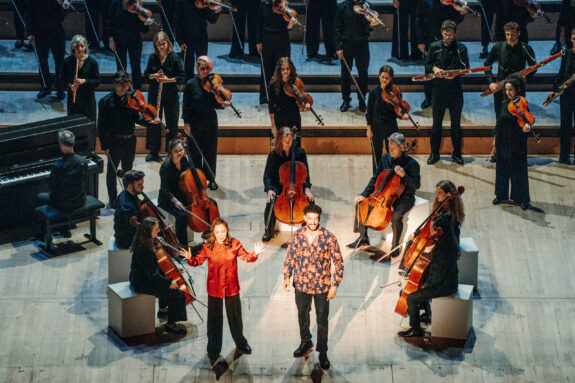
 United Kingdom Multitudes 2026 – Stravinsky, The Rite by Heart: Karl Queensborough, Sarah Twomey (actors), Aurora Orchestra / Nicholas Collon (conductor). Royal Festival Hall, London. 16.4.2026. (CSa)
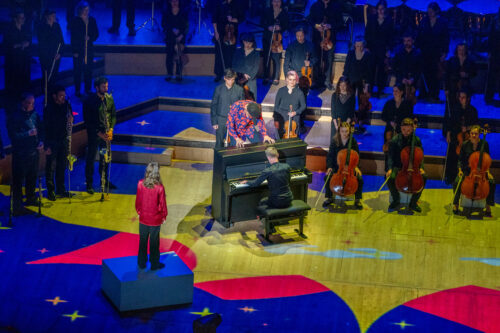
Stravinsky – The Rite of Spring
This year’s Multitudes Festival erupted into life with a vibrant and startlingly original production of Stravinsky’s Rite of Spring, performed from memory by the Aurora Orchestra under the baton of its Principal Conductor Nicholas Collon. This was to be the first concert of a series which promised to release the power of the classical repertoire to new audiences as well as regular concertgoers. Mark Ball, the Artistic Director of London’s Southbank Centre assured us to expect ‘a leap of faith and a new way of expressing music.’ The performance – a dramatic re-enactment of the Rite’s history – and as Collon put it, an ‘exploration’ of its ‘internal machinery’, also carried a special resonance, since it marked the 75th anniversary of the opening of the Royal Festival Hall which lies at the heart of London’s riverside arts complex.
The venue for this concert could hardly have been more fitting. The very purpose of the hall, designed immediately after the Second World War and constructed on the heavily bombed Southbank of the Thames as part of the Festival of Britain, was intended to democratise the arts, to educate and make culture accessible to all.
The Rite of Spring, commissioned by Sergei Diaghilev for his Ballet Russes was written between 1911 and 1913. A modernist work, its jagged rhythms, clashing harmonies and raw, almost primitive energy presaged the emergence of a new world order unleashed by the assassination of the Archduke Ferdinand and the destruction of the First World War. Unlocking the composition’s primal complexities for all listeners – not least the many schoolchildren in the audience – was a formidable task, but one which Collon and his band of actors and musicians accomplished with clarity and panache.
For Aurora afficionados, and those who had the good fortune to see last year’s BBC Prom where the Aurora explained, acted out and played the Fifth Symphony of Shostakovich (review here), the evening followed a familiar pattern. On entering the auditorium, one was greeted by an almost empty stage. Save for a few box stools, a couple of supine double basses and a row of timpani and drums stretched under the choir stalls, there were no music stands and no hint of the events about to unfold. Enter two accomplished actors Karl Queensborough and Sarah Twomey to narrate and inhabit the key roles. The story for the ballet – the idea of a solemn pagan rite: wise elders seated in a circle watching a young girl dance herself to death – came to Stravinsky as he was finishing The Firebird. Conversations, tensions and confrontations between Stravinsky, Diaghilev, designer Nicolas Roerch and the original choreographer Nijinsky, artfully recreated in Jane Mitchell’s brilliant script, were brought vividly to life. Diarised reminiscences were animated by the figure of the young composer (the pianist John Reid) seated at his upright, directing the number of chords he wanted repeated, or the speed at which he wanted them to be played.
Collon, an erudite and captivating teacher, dissected the complexities of the music section by section in a compellingly simple way, while instrumentalists, individually or in groups, emerged from the shadowy wings to play chosen extracts. A plaintive solo bassoon intoned the first eerie melody, a Lithuanian folk tune transformed into an ancient voice calling across an empty landscape, while beams of bright light – a galaxy of gliding stars – were artfully projected across the back of a darkened stage. A cluster of strings formed into a circle to hammer out the brutal repeated chords of the Augurs of Spring followed by a gaggle of shrieking, thrilling woodwinds. Simultaneously, Collon bound the audience into the music, guiding them to clap the interlocking rhythms underpinning The Dance of the Earth and hum the dense, shifting harmonies which announce The Glorification of the Chosen One. By the end of the concert’s first half, Stravinsky’s iconoclastic masterpiece had been anatomically deconstructed in a forensic but fascinating way, helping the audience to grasp its inner detail. A magnificent reconstruction came after the interval.
On the rostrum, Collon directed his 92 players with an economical and unadorned precision, unlike the more extravagantly expressive styles of conductors like Tilson Thomas or Nézet -Séguin. Having seen the pint-sized Stravinsky himself conducting the piece with the London Symphony Orchestra at the Royal Festival Hall in September 1962 in an extraordinarily controlled and understated way, one can confidently predict that he would have approved of Collon’s clear, disciplined approach. Like the 1962 concert, the result was a thrilling explosion of musical energy. Most of the players stood, and unencumbered by scores, captured the Rite’s combination of mystic beauty and brutal energy with utter conviction. Every department excelled, from spiky woodwinds and burnished brass to the febrile string sections led by Maia Cabeza and Jamie Campbell. The percussionists punctuated the performance with surgical precision, while the timpani (Antoine Siguré and Francesca Lombardelli) struck like a barrage of artillery fire.
Unlike Stravinsky, who at the end of the 1962 performance, responded to cries of encore by returning to the platform dressed in a long black overcoat, Collon asked who among the concertgoers had ever played in a performance of The Rite of Spring before? ‘There’s nothing more thrilling as being inside the orchestra’ he said, before his players fanned out into the auditorium to reprise The Glorification and Dance of the Earth. The audience went wild, but unlike the fabled riot at the Rite’s premiere at the Theâtre des Champs-Élysées in 1913, roared its approval unanimously. The reaction was hardly surprising. Put simply, music-making doesn’t come any better or more accessible than this.
Chris Sallon
Featured Image: Aurora Orchestra perform The Rite by Heart © Pete Woodhead
Creative Team:
Jane Mitchell – Concept, Script and Director
James Bonas – Director
Nathan Crossan-Smith – Associate Director
Anuoar Bruissel – Projections
Lili Warden – Lighting designer
Elliot Stradling – Lighting programmer