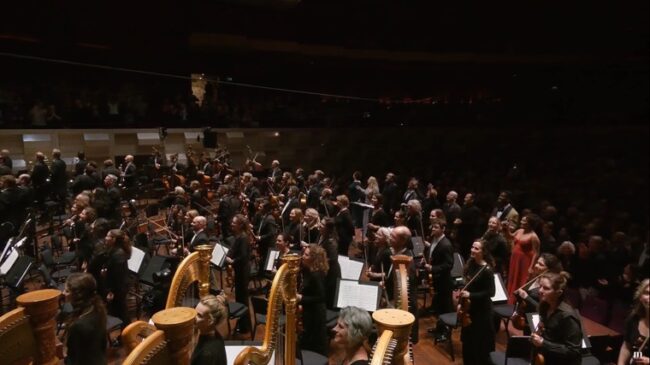
 Netherlands Wagner, Siegfried (concert performance): Soloists, Rotterdam Philharmonic Orchestra / Yannick Nézet-Séguin (conductor). Broadcast live – and available in replay on medici.tv – from de Doelen (Grand Hall), Rotterdam, 17.4.2026. (JPr)
Cast:
Siegfried – Clay Hilley
Mime – Ya-Chung Huang
Wanderer – Brian Mulligan
Alberich – Samuel Youn
Brünnhilde – Rebecca Nash
Erda – Wiebke Lehmkuhl
Fafner – Soloman Howard
Woodbird – Julie Roset
Like the Wagnerian equivalent of London buses while you can wait awhile for a new Siegfried, within weeks there can be two: The Royal Opera’s (review here) and now the concert performance by the Rotterdam Philharmonic Orchestra and honorary conductor Yannick Nézet-Séguin. This is a slowly-gestating, I presume, Ring cycle; though there is no news of a Götterdämmerung as far as I can see. Das Rheingold (that I missed) was in 2022 with Die Walkϋre in 2024 (review here). The casting has not been consistent with – in major roles – only Samuel Youn (Alberich), Wiebke Lehmkuhl (Erda), Soloman Howard (Hunding) and Brian Mulligan (Wotan) involved in previous instalments.
Based on what I saw in the cinema the recent Siegfried performances were over-praised and I believe – as I hinted at in my review – many British commentators on Wagner have just not experience enough of it to determine what is really good or bad. Some appear to have been in thrall to Barrie Kosky’s cleverness with his staging to want better from the singers. How many will see and hear this Rotterdam Philharmonic’s engrossing concert performance whether online or in Paris (April 19th), Dortmund (24th) or Baden-Baden (26th). They should do, because the only singer who was possibly better in London (apart from Howard and Lehmkuhl who also sang their roles there) was Christopher Maltman’s Wanderer. You would only be interested in other singers than those in Rotterdam if you regarded staging Wagner as something of a beauty contest, where appearance, and possibly acting, takes precedence over voice.
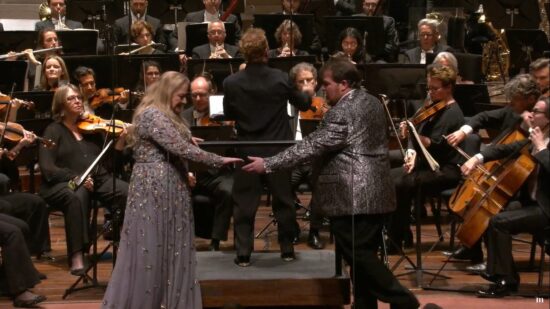
Of course, Siegfried – despite its series of confrontations (including Mime/Siegfried, Wanderer/Mime, Wanderer/Alberich, Mime/Alberich, Wanderer/Erda, Wanderer/Siegfried, Siegfried/Brünnhilde) – does not naturally lend itself to a concert performance with even less seemingly happening than it sometimes does on the stage. Fortunately, there were no scores on music stands with every singer confident of their part and only two chairs for singers to occasionally retire to (hopefully this will be the same for the London Symphony Orchestra’s Tristan und Isolde in July at the Barbican). I have seen no stage director assigned to this Siegfried – and I suspect most singers made it up as they went along – but if you have a vivid imagination it worked better than you would think. Even if you thought the absence of props and the miming made the goings-on just a little risible at times; you could glory in the resplendent sounds from the irrepressible Yannick Nézet-Séguin and his impeccable orchestra, with their frequent virtuosic solo contributions, as well as some wonderful full-throated, and particularly, musical singing. What was forgotten was to coordinate what the singers were wearing because it varied from Mime with leather jacket and black rehearsal clothes, to Siegfried in a silver brocade jacket with matching bowtie (dressed as if he was off to a cocktail party) and Brunnhilde in a steely-coloured gown with sparkling floral embellishments. Fafner was in a very suitable gold suit, the Woodbird in blood red, Erda in dark green, and the others mostly in black.
I always have believed Siegfried can be taken too seriously and suspect Nézet-Séguin agrees with that and it sounded as if he glossed over the moments of cruel ‘humour’ to emphasise the story’s more fairytale and incandescent ones in a reading which was animated, often joyful, luminous, rich in detail and avoiding unnecessary bombast. This was significant at the very end of Siegfried which can often get bogged down in its own self-importance. However from Nézet-Séguin, his two magnificent singers and the musicians there was immense elation and a genuine rapture which looked as if it brought the entire audience inside Rotterdam’s de Doelen as one to their feet for the long-lasting ovation.
The thunderous applause deservedly continued as all the singers returned to the platform: Ya-Chung Huang sings Mime in the Deutsche Oper Ring and – as with many of the singers – this experience showed. Huang’s Mime was cleanly sung and eschewed affectation yet all the character’s cowardice, frustration, malice and scheming was fully revealed. I am not sure whether Brian Mulligan – from some of his gestures – might have been slightly indisposed and I will give his Wanderer/Wotan the benefit of the doubt. Occasionally his baritone voice was under-pressure, but he sang eloquently, possibly too eloquently, at times. Mulligan’s experience is singing Alberich and indeed his Wanderer was more Schwarz-Alberich than Licht. There is much more to be read into this irritated, world-weary figure than Mulligan displayed. Please correctly if I am wrong but Samuel Youn (who I saw many times in Bayreuth) does not appear on the world’s opera stages as much as he once did, though Youn was the epitome of the snarling, bitter, ring-obsessed Alberich. Soloman Howard and Wiebke Lehmkuhl’s voices need no introduction as Fafner and Erda; Howard was brooding, menacing and ultimately resigned to his fate whilst Lehmkuhl was bewildered, accusatory, yet in the end, powerless. Julie Roset proved perhaps the purest-voiced Woodbird I have ever heard.
Clay Hilley came to prominence in the Deutsche Oper Ring cycles too and has sung at Bayreuth as Siegfried in Götterdämmerung (with one day’s notice) and subsequently Tristan. He is perhaps the most open-faced – and oddly likeable, character-wise – Siegfried since the heyday of the late and great Alberto Remedios. Hilley’s Siegfried is brash, unaware, belligerent, fearless, naïve, contemptuous and emotionally immature, and much else besides; all explored by some understated acting and making out he was forging and then wielding an imaginary sword (including slow-mo fighting), before later using it to remove Brünnhilde’s (non-existent!) helmet and breastplate. Hilley’s voice is not as lyrical as Remedios’s was, but his stamina is unquestionable and – in my opinion – he sings all the notes of the fiendish part with accomplished ease without resorting to shouting on pitch like Andreas Schager at Covent Garden.
The surprise of this Siegfried was Australian soprano Rebecca Nash, who sounded to me as if she could be one of the finest Brünnhildes most people will never hear of. She is a regular in her homeland and has sung at the Met in other roles but is little known in the UK and that is a shame. Nash is clearly a genuine Hochdramatische soprano and she has a youthful enough sound, and with fearlessly sustained high notes her character’s emotions run the gamut from awe-struck awakening, fear of mortality and violation, to reluctant surrender, joyful exuberance and genuine human passion.
The branding of Yannick Nézet-Séguin’s Metropolitan Opera in New York is ‘The Voice Must Be Heard’ and Rebecca Nash’s certainly deserves to be, as does Clay Hilley’s and most of this Siegfried cast.
Jim Pritchard
Featured Image: Soloists, conductor and the Rotterdam Philharmonic Orchestra © medici.tv