
 United Kingdom Elgar, Chaminade, Debussy: Nicola Benedetti (violin), Philharmonia Orchestra / Cristian Măcelaru (conductor). Barbican Hall, London, 16.4.2026. (AV-E)
Elgar – Violin Concerto (1910)
Chaminade – Callirhoë Suite (1887)
Debussy – La mer (1903-1905)
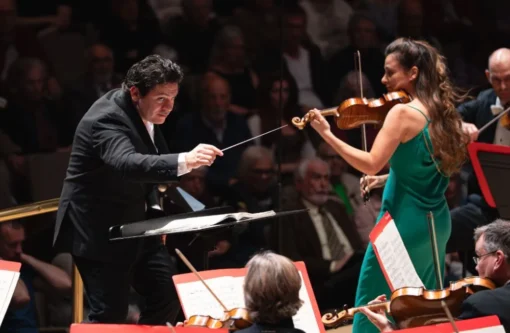
Along with the mammoth fifty-five minute Violin Concerto No.2 by Allan Pettersson, the fifty minute Violin Concerto by Sir Edward Elgar is arguably the most challengingly difficult to play in the fiddler canon. Nicola Benedetti literally ‘lives’ inside the Elgar Violin Concerto: an inward intimacy was the essence of her performance, yet she never sacrificed the scintillating technical command required to sustain its labyrinthine architecture.
The Romanian conductor, Cristian Măcelaru, was totally at ease in Elgar and at one with Benedetti, offering so much more than mere support. Indeed, because she played with such inner-reserve, she never stood-out ‘above’ the orchestra. I was watching the Philharmonia playing just as much as her; for the orchestration is as intricate, complex and multilayered as the solo writing.
I know it is a crass cliché to say her interpretation was ‘newly minted like hearing it for the first time’ – but it was true. As it is impossible to do full justice to her platinum playing, I can only offer you words which expressed her essence: intense, incisive, individual, iridescent, inspired, incandescent, impassioned, idiosyncratic, intuitive, imaginative, inquisitive, ineffable, infinite, immaculate, insightful, inimitable, intrepid, indestructible, illustrious, illuminating, invigorating, intoxicating, incinerating, imperious, incantatory, improvisatory.
Her reserved rendition was free from the customary maudlin-mourning, melting-melancholia; instead, she naturally navigated the mercurial moods of this sweeping score with weathered weight and enduring emotion. Where emotions were projected inward, she wore her heart where it belonged: in her body rather than on her sleeve.
Even in the most energetic passages, she maintained a coy and shy retreat of the soul — an evanescent energy and frisson flicker of the soul that ensured her surface brilliance never obscured the inner reflection at the work’s heart.
She handled the rampaging double-stopping and lightning-fast register shifts with a cool confident ease and sprite sparkle, turning what often feels like a technical hurdle into a quicksilver dialogue with the orchestra.
In the last movement, the benevolent Benedetti caressed the climactic cadenza, floating it with incandescent silvery silk shards accompanied by the strings’ unique ‘thrumming’ — that extraordinary pizzicato tremolando where the players use the soft flesh of their fingers to create a shuddering susurration of the soul. Elgar wrote in Spanish, ‘here lies enshrined the soul of…’ and throughout we heard that soul musing: this magical moment is one of the most memorably mesmerising in all music.
Out of this shuddering susurration arose a distilled pellucid luminosity, attuning an atmosphere that held the highly attentive audience spellbound; only to be displaced by apostatising applause.
Cécile Chaminade’s Callirhoë is loosely based on the Greek myth of a captive princess transformed into a statue by Venus. Chaminade is a name I was previously unfamiliar with, yet the music sounded uncannily familiar, a ransacking ragbag of recycled resonances. This petit-bourgeois scoliotic-score was a mélange of mediocre mimicry where the bravado of Bizet and the ostentation of Offenbach were pasted over the waltzing wallpaper of Waldteufel. After hearing it, I felt like a captive critic transformed into a block of bored basalt, praying for this pastiche to pass into permanent perdition.
Debussy’s La mer was a pristine and polished affair, sounding more like a sedate Serpentine stroll on a Sunday afternoon than a tempestuous Turner at the Tate on a Saturday morning.
The opening movement, De l’aube à midi sur la mer, lacked the subtle stirrings of a dawning day, and the second, Jeux de vagues, proved similarly slight; here the waves were played rather politely — sounding more like the ripples of a pond than the swell of the sea.
Yet, what was brilliantly articulated was the subtle cymbal playing, evoking the shimmering spindrift and luminous light glistening upon the crest of the sea waves; this was evocatively effulgent.
It was not until the finale, Dialogue du vent et de la mer, that I felt at sea, with a superb percussion section playing with incisive intensity – even if their brilliant bravado frequently drowned out the woodwind. What was seriously lacking throughout were the undernourished undercurrents of the throbbing double basses – the conductor simply ignored them, robbing the music of its essential gravitational weight.
Despite the conducting being all at sea, the well-drenched appreciative audience responded with waves of applause, seemingly swept away by the concluding tumultuous tidal wave.
This Sunday afternoon concert was supported by Lady Lipworth CBE in memory of her late husband, Sir Sydney Lipworth KC, former Chairman of the Philharmonia Orchestra.
Alexander Verney-Elliott