
 United Kingdom Various: Nigel Kennedy (violin and piano), Alec Dankworth (double bass), Peter Adams (cello). Brangwyn Hall, Swansea, 23.4.2026. (LJ)
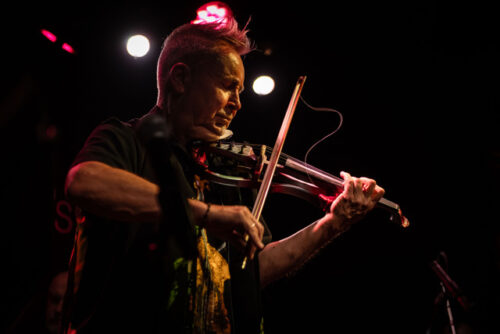
Nigel Kennedy entered the stage wearing his signature football jersey – this time the yellow Aston Villa away shirt. He began by introducing his fellow musicians (Alec Dankworth on double bass and Peter Adams on cello) as ‘right honourable and right phenomenal cats’, then saying ‘we’re on the verge of doing something’. He reminisced that he was last at Swansea’s Brangwyn Hall with the Hallé Orchestra some twenty years ago, adding that because there is ‘such a good acoustics in here’, the audience ‘will be able to tell if we’re sh**!’
Kennedy then picked up his electric violin to perform his arrangement of the Yellow Magic Orchestra’s Firecracker (1978). Aptly titled, this piece saw Kennedy morph from violinist into electric guitarist creating funky psychedelic sounds that had more in common with Eddie Hazel’s riffs as lead guitarist for Parliament-Funkadelic than with any classical violinist. When this opening piece ended, the audience expressed a mixture of surprise and excitement with two ladies whispering ‘I wasn’t expecting that’. This really sums up Kennedy. He does the unexpected and this is what makes him deserving of the epithet ‘virtuoso’.
It is well known that Kennedy’s identity as a violinist is bold, exciting, and deliberately un-fussy. If there any bookies predicted that this ‘Virtuoso Tour’ marking his 70th birthday on 28 December this year would constitute a more muted celebration of his musical life, his opening gambit proved them wrong. The concert as a whole was an example of, to use Kennedy’s words, three ‘cats’ at the top of their game, each working together in a highly organised way.
Kennedy, though seemingly laissez-faire, was in control of his trio, clearly guiding the dynamics, timing, and experimental direction of the improvisatory sections within each piece. Both Adams and Dankworth were on form, with Adams (principal cellist for the Brighton Phil and Oxford Phil) performing tenderly during Gershwin’s The Man I Love (1924) and Dankworth (son of saxophonist John Dankworth and Cleo Lane) drawing on his extensive experience playing alongside the likes of Dave Brubeck, Clark Terry, and Anita O’Day for the exciting improv sections during the encore (more on this later).
As this Swansea audience quickly gathered, Kennedy’s music-making pushes boundaries and asks questions. It is not ‘polished’, not because he is undisciplined (far from it, he begins his day practicing Bach for two-hours!), but because there is more texture, more soul, more meaning in the ‘unpolished’ way in which Kennedy performs. This is due to the fact that music is not solely beautiful; it can be rustic and jarring too. When listening to Kennedy, the audience could feel and hear these textures in the music in ways that highlight how ‘polished’ performances fall short.
Kennedy’s story is well known. He came from a family of musicians, attended the Yehudi Menuhin School of Music from the age of 7, and then studied at the Julliard School in New York. As a child he liked the idea of becoming a taxi driver, but his talent for and dedication to the violin meant that he was destined for a life on the road rather than behind the wheel.
His primary tutors were Menuhin (for whom he composed Solitude in 1996), Stéphane Grappelli, and Dorothy DeLay of whom Kennedy remarked that they allowed him space to discover his own approach to music-making. This space is, without question, original. For instance, whilst the music during this concert defied genre boundaries, the soundscape was unmistakably Kennedy’s. In Kennedy’s space there is a deep sense of harmony, an instinct to engage in call-and-response, and a compulsion towards flight over the more firmly rooted structures of notated music.
Some of the more elevated performances of the evening included Kennedy and Adams’s mesmerising duet for Johan Halvorsen’s Passacaglia and Sarabande in G minor with Variations on a Theme by Handel (1897) and Kennedy’s solo performance of Bach’s Chaconne from the Partita No.2 in D minor (1717-20). Technically these pieces are extremely challenging. Between them, they require rapid double, triple, and quadruple stops, awkward string crossings (including E-string to D-string triplets for the Bach), and a range of bowings (including spiccato, legato arpeggios, pizzicato, and ponticello for the Halvorsen). Aside from these technically challenging elements, both pieces require a deep emotional progression with Bach’s Chaconne, in particular, demanding solemnity, intellect, and passion in its D minor, sarabande-style deliberateness. When Kennedy finished performing this Chaconne, he simply said ‘that’s that’ before switching gears by playing Danny O’Keefe’s light and charming Good Time Charlie’s Got the Blues (1967) alongside Adams and Dankworth.
Whilst I do not doubt Kennedy’s abilities on piano, I was rather less taken by his performance of excerpts by Krzysztof Komeda and Ryuichi Sakamoto’s Merry Christmas, Mr. Lawrence (1983). But, with this concert lasting three hours, the variation provided by Kennedy on piano was welcome. It was also impressive to see him bowing with his right hand whilst playing the piano with his left hand! Perhaps the ideal scenario would be for the string trio to be joined by Piotr Wyleżoł for select pieces. Wyleżoł, a brilliant Polish jazz pianist, played on Kennedy’s albums SHHH! (2009) and A Very Nice Album (2009).
As readers will already be able to tell, true to Kennedy’s approach to programming, the music played during this concert defied genre boundaries. There was a synergetic bleeding of classical, jazz, folk, klezmer, rock, contemporary, baroque, the list goes on. Through this approach, Kennedy prioritised the cultivation of a complete soundscape over any narrow-minded pigeonholing that separates music into neatly arranged categories. For Kennedy, music became a language that breaks boundaries of classification. As such, the music he played possessed those undefinable and enriching qualities that include creativity, soul, and the imagination.
For example, during the encore Kennedy praised the enhanced creativity that comes with drinking pálinka (a spirit made in Hungary) and performed Vittorio Monti’s Csárdás (1904), which is a rhapsodic folk piece that depends heavily on rubato, dynamic changes, and artificial harmonics – Kennedy’s three specialities. During this piece, he broke-off into two jazz improvs with Dankworth: George Gershwin’s Oh, Lady Be Good! (1924) and Duke Ellington’s It Don’t Mean a Thing (If It Ain’t Got That Swing) (1931). Here, Grappelli’s influence on Kennedy was evident, with echoes from Grappelli’s 1972 live recording of Oh, Lady Be Good! at London’s Queen Elizabeth Hall (released by Fonior records) coming to the surface.
Many concertgoers may have been expecting something rather more classical (or, ‘notated’, to adhere to Kennedy’s precise wording when referring to distinct musical eras that include classical, baroque, romantic, etc.). They likely associate Kennedy with his 1989 recording of Vivaldi’s Four Seasons that saw him burst onto the international stage. Kennedy did not disappoint these audience members, performing ‘Summer’ from Vivaldi’s (who Kennedy called ‘the ugly boy’) infamous work with characteristically vigorous bowing, quicksilver runs, and percussive foot stomping.
Yet, these audience members can now also delight, as I once did, in the treasure-trove of recordings that followed, including two of my favourites: East meets East (Warner Classics, 2003) and Recital (Sony Music Entertainment, 2013). Just as each new Kennedy recording is a surprise in terms of its musical style, the pieces performed at this concert remained a surprise until the moment they were introduced and/or performed. There is no programme or website. Music is not categorised, listed, or billed; it is played live, different each time depending on the shared vibes between performers and audience. It is for this reason that Kennedy remains a musician who must be ‘seen and heard’ live. This Swansea audience certainly benefited from Kennedy’s ‘in the moment’ approach with him stating: ‘what a beautiful audience, with us for every note, cheers man.’ By the end of the second half, it was the audience who were giving the cheers with their own foot stomping and standing ovation.
As well as his displays of virtuosity on the violin, Kennedy has a magnetic stage presence, and this cannot be said of all virtuosos. He demonstrated that whilst beautiful music can be superficial, musicianship that communicates a full gamut of emotions can be transcendent. If I had to sum-up this indefatigable music-maker, I would say that he is quite simply a ‘top cat’. Indeed, Kennedy is a one-of-a-kind musician who plays with soul and grit in equal measure.
For readers interested in hearing Kennedy live, the ‘Nigel Kennedy: A Virtuoso Concert Performance’ tour will continue until 29 June. Tickets and information can be found by clicking here.
Lucy Jeffery
The Yellow Magic Orchestra – Firecracker (1978)
Nigel Kennedy – Solitude (1996); The Magician of Lublin (date unknown); When and Why (date unknown)
Bach – Chaconne from the Partita No. 2 in D minor, BWV 1004 (1717-20)
Danny O’Keefe – Goodtime Charlie’s Got the Blues (1967)
Gershwin – The Man I love (1924)
Johan Halvorsen – Passacaglia and Sarabande in G Minor with Variations on a Theme by Handel (1897)
Krzysztof Komeda – from Knife in the Water (1961)
Ryuichi Sakamoto – Merry Christmas, Mr. Lawrence (1983)
Antonio Vivaldi – ‘Summer’ from The Four Seasons (1718-23)
Vittorio Monti – Csárdás (1904)
Jimi Hendrix – Little Wing (1967)
I was at this concert and, in addition to the brilliant musicianship of course, really enjoyed the referneces to pálinka and Hungary (I was the one who cheered!) before the Csárdás was played. Having been brought up in Hungary, there is just something about csárdás that’s irresistible.