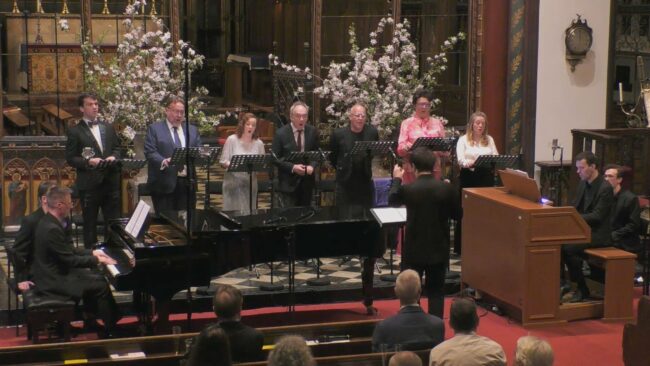
 United Kingdom Various, Maho Ishizaka, Peter Tranchell: Tom Winpenny (organ), Piers Lane, David Doidge (piano), Tasmin Little (narrator), Imperial College Chamber Choir (conductor: Jonathan Wikeley), cast of Twice a Kiss / Michael Papadopoulos (conductor). St Paul’s Knightsbridge, London, 18.4.2026. (AK)

Peter Tranchell –Tu es Petrus in fuga, Seven Pieces in Alphabetical Order, The Dog That Sat, No more of THEE and ME, Twice a Kiss
Maho Ishizaka – Tickle the Keys
Facilitated by the devoted team of The Peter Tranchell Foundation, high quality and utmost dedication were the hallmarks at this unusual concert. Surprise, in many dimensions, was also a significant element, at least for me.
Until now I have never heard of Peter Tranchell’s name, let alone any of his compositions. Talking to people prior to this concert – and even at the concert – it transpired that I was by no means alone in my ignorance. Yet, judging by this concert, Tranchell’s compositional output is more than worth attention and it is time to offer justice – sadly posthumously – to this neglected composer.
Peter Tranchell (1922 – 93) was a Cambridge university lecturer and director of Studies in Music at Gonville & Caius College. According to recent recollections of a Cambridge student at that time, Tranchell might have felt frustrated by the lack of true recognition for his compositions.
Professor Emeritus Richard Wistreich wrote to me: I knew Peter Tranchell when I was a student at Cambridge. He was quite a character, but I think a disappointed man because his music had not been recognised for its high quality. I’m pleased it will finally be getting some recognition.
Professor Wistreich emphasised that he was sharing his own personal memories with me, he never had any discussion with Peter Tranchell about the topic.
The first surprise at this concert was the high quality of the music we heard. Some of Tranchell’s music was written with his students as well as colleagues in mind but this did not mean any compromise with quality.
Tu es Petrus in fuga (the third movement from the organ sonata written for Peter Le Huray in 1958) gave a taste of Tranchell’s solo organ music as well as presented the somewhat hidden organ of the beautiful and welcoming St Paul’s Knightsbridge church. I am never comfortable with only selected movements from any composition but, on this occasion, economy with time was necessary. On the other hand, the organ’s four-level keyboard, organist, music and even the page turner (who at times manipulated the organ stops) were shown on two large screens on each side of the relatively narrow church. Where else can audiences encounter such luxury?
Tranchell’s Seven Pieces in Alphabetical Order (1947, revised 1960) is for solo piano but with seven animals in mind, each apparently allocated to a specific note in Hindu music: C Peacock, D Rainy season bird, E Goat, F Crane, G Cuckoo, A Frog, B Elephant. Performed with relish and virtuosity by Piers Lane, I could not help occasionally thinking of Saint Saens’s Carnival of the Animals and Prokofiev’s Peter and the Wolf because of animals but also because of the quality of the music. Seven short witty poems – possibly by Tranchell himself or by a mystery lady called Mrs Helen Dray – can accompany the music. The narration this time was presented by famed violinist Tasmin Little. Tasmin was a surprise, not only because she is known as a top violinist but because she was not listed in the excellent, extensive and unusually thorough twenty-four-page programme notes (by John Gwinnell). Tasmin Little is a sensitive artist, whether on the violin or as a narrator, so the short gaps between the piano pieces and narration are likely to have been caused more by technical issues than by interpretative choice.
Two Tranchell choral pieces (The Dog That Sat and No more of THEE and ME) were performed by the Imperial College Chamber Choir conducted by Jonathan Wikeley.
The choir greatly surprised me: their skills, dedication, discipline and musicality could serve as an example to many professional choirs and music college ensembles. The Dog That Sat (1967, re-arranged 1976) is an unaccompanied a cappella composition yet the ICCC choristers kept the pitch throughout. They also matched the excellent pianist Piers Lane in the romantic No more of THEE and ME (1978) perfectly.
To promote Tranchell’s name and compositions, The Peter Tranchell Foundation arranges annual composition competitions. The 2025 competition required a piece no longer than 6 minutes and to be set for piano and organ, which is the instrumental combination which Tranchell used for Twice a Kiss. The winner of the competition was the Japanese Maho Ishizaka with Tackle the Keys. The composition seems to have made most of the piano-chamber organ combination, but I am not sure if the somewhat louder organ left room for the organist to hear both instruments as clearly as I heard both of them. However, the sight of two largish instruments with two players in all but each with his own page turner, added visual drama to the tackling of the keys.
Twice a Kiss was a great surprise all round. Composed for seven soloists, piano and electric organ, it was written for Peter le Huray and St Catharine’s College to be performed in Cambridge in June 1955. The work was revived by another set of Cambridge students in 1982 when Christopher Purves sang the part of Honeywood, a role now (over forty years later) repeated by Purves at this concert.
On one hearing, Twice a Kiss proved to be lovely and witty music to listen to as well as splendid entertainment. It is specified as operetta and, indeed, I would happily place it next to some of those by Gilbert and Sullivan. The plot – written by Cambridge undergraduate Maurice Holt in 1955 – is silly, funny but with some emotional depth; at no time was I bored during the almost one-hour long piece. Apparently, for some of the music Tranchell used twelve-tone technique but I was too busy having a good time to notice such device.
The cast for our Twice a Kiss was luxury casting with a luxury conductor. Soprano Jennifer France was a marvel to behold, while contralto Hilary Summers together with bass-baritone Henry Waddington and tenor James Gilchrist represented the highest possible world standard. Bass-baritone Christopher Purvis clearly owned the part and made the most of this occasion.
Conductor Michael Papadopoulos was introduced to the audience as ‘an up and coming’ conductor. For me, Papadopoulos is definitely up. Highly musical and fully committed to any music score he conducts; his skills should secure an ongoing satisfying carrier for him. Two years ago I heard him conduct a wonderful musical performance of Handel’s Acis and Galatea (review here); this time Papadopoulos proved again his wide-ranging abilities.
The five Trustees of The Peter Tranchell Foundation – and some of their family members – were fully engaged in producing this Tranchell evening, right up to and including the concert. They turned pages, wrote programme notes, conducted the ICCC, managed the surtitles, served drinks, and tackled less visible aspects. It is a labour of love and well-deserved justice for Peter Tranchell as well as a shining example of what true trusteeship should aspire to.
Agnes Kory
Featured Image: Twice a Kiss performance conducted by Michael Papadopoulos
Twice a Kiss – Peter Tranchell (concert performance): David Doidge (piano), Tom Winpenny (organ) / Michael Papadopoulos (conductor)
Cast:
Knipp – Daniel Gilchrist
Susan – Sophie Bevan
Sarah – Hilary Summers
Lady Asymptote – Jennifer France
Sir Robert Asymptote – Henry Waddington
Sir Peter Parallel – James Gilchrist
Mr Honeywood – Christopher Purves