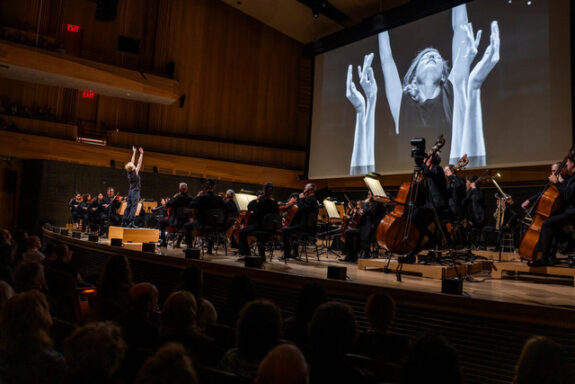
 United States R. Strauss, Poulenc: New York Philharmonic, Barbara Hannigan (soprano, conductor). David Geffen Hall, New York, 23.4.2026. (RP)
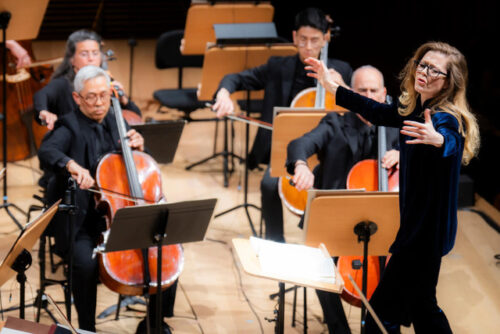
R. Strauss – Metamorphosen
Poulenc – La Voix humaine
As unusual program pairings go, the combination of Richard Strauss’s Metamorphosen and Poulenc’s La Voix humaine ranks high. There is little to link the two works, save for their deep introspection and penetrating emotional depths. That suffices to make them ideal vehicles for Barbara Hannigan to infuse with intensely personal interpretations, as she did in this concert with the New York Philharmonic.
Strauss composed Metamorphosen in 1945 when German cities had been reduced to rubble and the theaters where he found fame had been destroyed. Scored for 23 solo strings, it is generally regarded as Strauss’s elegy to a vanished world with little if any light to pierce the darkness. Under Hannigan’s baton, Metamorphosen was not a seamless, mournful expression of despair, but percolated with complex, conflicting emotions, including hope. The latter was totally in keeping with Goethe’s theory of metamorphosis, in which rebirth contains seeds of the past, and it served as Strauss’s inspiration for the piece.
Hannigan probed those moments of hope in the performance with fascinating results. Out of the ashes of the opening measures, concertmaster Frank Huang’s solos soared, confidently propelling the music forward. Hope was evident there, as well as in shorter spurts that lightened the mood, albeit briefly. Intense, tragic, hollow sounds from the cellos followed, which portended catastrophe, with the final measures becoming the equivalent of a musical void. It was pure Hannigan, wrenching every drop of emotion out of every note in the score.
Soubrette is not Hannigan’s go-to mode. As a singer, she specialized in operas such as Berg’s Lulu, George Benjamin’s Written on Skin and Ligeti’s Le Grand Macabre. Elle in La Voix humaine, Poulenc’s one-act monodrama based on Jean Cocteau’s play, is cut from the same operatic cloth as the others. It features a woman on a one-sided, often interrupted, phone call with a man presumed to be her lover. She hurls abuse at the telephone’s failings, as vehemently as many do at AI today.
Hannigan, however, inserts the possibility that he doesn’t exist and the call is perhaps pure delirium, rather than a desperate plea to the man who is abandoning her. Those clicks and ensuing silences may be only in her head.
There is a hurdle to jump in embracing Hannigan’s dual role as performer and conductor in this performance, but it is not a high one. It is the novelty of the situation, more than its impact and success, that gives pause. One can’t help but think that Cocteau, who was a film director as well as a writer, would embrace the entire affair, especially Clemens Malinowski’s video artistry and Etienne Démoulin’s sound engineering, which subtly enhanced the presence of Hannigan’s voice. Poulenc’s opinion is open to discussion.
La Voix humaine is an opera, and a one-person show at that, so even in a more conventional format the singer would be at the center of everything. Hannigan just upped the ante by conducting the piece as well. The latter was achieved through a carefully conceived and choreographed performance in which every gesture had a purpose, either to cue the orchestra or express an emotion. More often than not, her movements achieved both ends: Hannigan’s arms, hands and fingers were as expressive as her voice and face.
If heard on a recording, Hannigan’s performance would be staggering, purely in vocal and dramatic terms. Her slender soprano expresses confusion, anxiety, desperation and, at times, a seductive, kittenish playfulness tinged with ferocity. The camera heightens the experience by either zooming in to amplify the intensity or retreating to capture her ballet-like movements.
Vanity is left at the door when every line and pore on Hannigan’s face is projected on the screen. If employed in a stage performance in an opera house, such close-ups are often intrusive. Here, they intensify the impact of what amounts to a high-wire act which perhaps only Barbara Hannigan can perform.
Rick Perdian
Featured Image: Barbara Hannigan performing Poulenc’s La Voix humaine with the NY Phil © Chris Lee