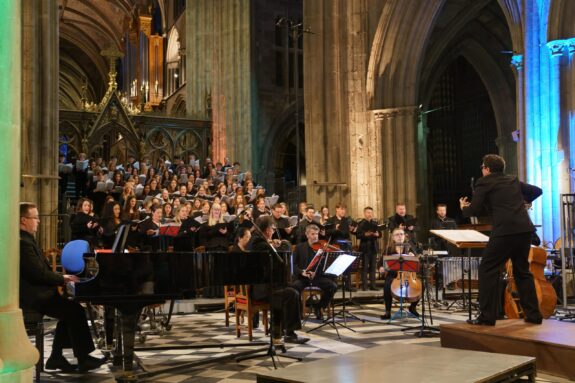
 United Kingdom Various, Five Beacons of Light: Youth Choral Worcs, Sonoro, Michael Higgins (piano), English Symphony Orchestra string quintet and percussion / Neil Ferris (conductor). Worcester Cathedral, 25.4.2026. (PC)
Lauren Hawkesworth – Freedom (poem)
Bob Chilcott – Five Days that Changed the World
Cheryl Frances-Hoad – Five Beacons of Light (world premiere)
Under the heading, ‘Five Beacons of Light’, at Worcester Cathedral the London-based professional chamber choir Sonoro, Youth Choral Worcs, consisting of over a hundred students and teachers from Worcestershire secondary schools, pianist Michael Higgins and principals and players of the English Symphony Orchestra were brought together, all under the direction of Neil Ferris. The title was taken from a major, new 50-minute cantata commissioned by Sonoro and composed by Cheryl Frances-Hoad to a text by Di Sherlock and the first performance of this variegated, wide-ranging piece crowned the programme.
Proceedings began with a non-musical item in the form of a recitation by current Worcestershire Young Poet Laureate Lauren Hawkesworth of her poem, Freedom. Key to the verse was the first-person protagonist’s inspiring ability to gain independence, think afresh and forge a new self. These ideas of taking the lead and shaping the future were pertinent to matters raised by the two choral works that made up the rest of the bill of fare. Hence, as well as being thought-provoking in its own right, Freedom also served as a spoken prologue to the ensuing music.
There followed a fluent and polished account of Bob Chilcott’s Five Days that Changed the World. These settings for upper voices, mixed choir, piano and timpani of five poems by Charles Bennett were commissioned by Sing UK, predecessor to Youth Choral Worcs, for the 2013 Worcester International Festival of Young Singers. Each of the five movements highlighted a defining moment in human history. The first feted the invention of the printing press on 29 March 1455 and the performers conveyed the excitement of this important innovation with their lively, driving rhythms and sharp accents. By contrast, the second movement, which marked the abolition of slavery on 1 August 1834, was hushed and calm, the choir proceeding in assured counterpoint, often over rising arpeggiated figures in the piano’s left hand. Inspired by the first powered flight on 14 December 1903, the central movement was delivered impulsively and without inhibition, capturing the giddy thrill of daring to take to the skies. The following appreciation of the discovery of penicillin on 28 September 1928 was much more lucid and straightforward, the singers finding an expressive intensity to the climactic phrases, ‘Sometimes what you’re looking for will find you, Sometimes what seems wrong was right all along’. A tribute to the first man in space on 12 April 1961, the final setting was graced by a delicate and airy reading of its often imitative vocal writing and the closing, gentle piano chords and timpani roll sent the music out, wonderingly, into the ether. This confident and poised rendering of Five Days that Changed the World conveyed the sense of awe and marvel suggested by the text and vividly realised Bob Chilcott’s evocative treatment of the words.
The concert ended with the world premiere of Cheryl Frances-Hoad’s Five Beacons of Light, a cantata for youth choir, mixed adult choir, piano, percussion and string quintet that celebrated the residents of, and communities linked to, four UK lighthouses – Bell Rock, Bishop Rock, Les Casquets and Haulbowline. Di Sherlock’s sharp and judicious libretto compared the lighthouses’ time honoured function of protecting people from the perils of the sea with the present-day situation where the sea is threatened by humanity because of man-made climate change. At the sturdy root of the piece was the fifth beacon – young people, whose strong beliefs and fresh approach opens up the possibility of thoughtful and more accountable interactions with our seas.
Cheryl Frances-Hoad’s gloriously colourful and directly communicative score brought to vibrant life these various characters and situations. Her gleefully eclectic music recalled Bach’s B minor Mass in the stately prologue, ‘When we are Ghosts’ and elsewhere in the piece there were instances of the composer drawing rich inspiration from Gilbert and Sullivan operatic numbers, sea shanties, Japanese traditional modes and Frech salon music, among other sources. This inclusive, all-embracing attitude was complemented by an enterprising use of vocal resources. The four lighthouse ballads called for soloists to play the part of protagonists ranging from engineers Robert Stevenson and James Walker to Adèle Foucher, wife of Victor Hugo and Ann Hougre, wife of lighthouse keeper Louis Hougre, and groups of singers to assume the role of parliamentarians, artificers and lighthouse keepers, while in ‘The Ballad of Haulbowline’, the adult choir took on the character of the lighthouse itself. A similarly inventive approach was adopted in the deployment of instrumental forces, with expressive, idiomatically conceived solo passages for piano and individual stringed instruments arising at crucial junctures. Memorable, imaginative contributions from an array of percussion included eerie flexatone glissandos, a wind machine whipping up a storm and the hollow rattle of loose coins shaken in in tin, while the gripping ‘The Scream of the Anthropocene’, was accompanied by its own exclusive kit, featuring cowbell, tambourine, vibraslap and triangle. The effect of such variety and versatility was cumulative as well as immediate and by the time the synoptic and climatic coda arrived with combined voices declaiming ‘We are Light! We are Rock! We are Ocean!’, the collective power of the score’s different elements seemed to peak in those full-throated, concluding cries of hope for the future.
All the musicians gave of their best in a compelling performance of great energy and vibrancy. Conductor Neil Ferris was exemplary in his supportive handling of disparate forces, convincing choice of tempo for each section of the work and firm architectural grip of a large-scale, multifaceted musical structure. Five Beacons of Light provided a memorable pinnacle for the evening’s events, while the absence of an interval between each item added an appropriate sense of urgency and momentum to the prevailing call to break new ground and effect change.
Paul Conway
Featured Image: Neil Ferris conducts Five Beacons of Light at Worcester Cathedral © Michael Whitefoot Photography