
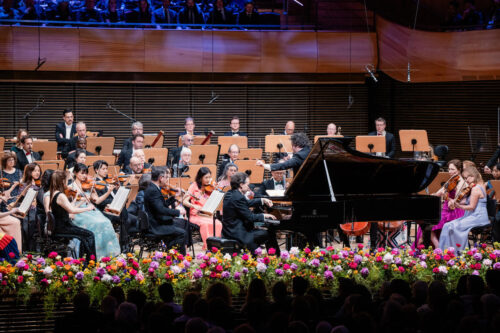
 United States Various: Evgeny Kissin (piano), New York Philharmonic / Gustavo Dudamel (conductor). Wu Tsai Theater, David Geffen Hall, New York, 28.4.2026. (ES-S)
Mussorgsky – Selections from Khovanshchina: Prelude (Orch. Shostakovich); ‘Dance of the Persian Slaves’ (orch. Rimsky-Korsakov)
Scriabin – Piano Concerto in F-sharp minor, Op.20
Encores: Scriabin – Mazurka No.3 in E minor, Op.25; Tchaikovsky – Natha–Waltz No.4, Op.51
Stravinsky – The Firebird Suite (1919 version)
Encore: Tchaikovsky – The Nutcracker: Pas de deux
For its spring gala, the New York Philharmonic presented a full Russian program under Music and Artistic Director Designate Gustavo Dudamel, tracing an historical arc from Mussorgsky through Scriabin to Stravinsky. The three works revealed underlying continuities across otherwise divergent musical languages in their handling of pacing, sonority and in their use of orchestral color as a structural element.
The excerpts from Khovanshchina by Modest Mussorgsky established a soundworld defined by sustained textures and carefully regulated pacing. The Prelude, heard in the orchestration that Dmitri Shostakovich prepared for his completion of the opera, unfolded with restrained clarity, its lines allowed to emerge without excessive coloring. Dudamel avoided pronounced shaping, favoring continuity over contrast as the music expanded gradually from its opening stillness. The emphasis on control and blend was consistently maintained, though the reluctance to introduce sharper inflection occasionally left the music confined to a relatively limited expressive range.
For the ‘Dance of the Persian Slaves,’ Dudamel turned to the orchestration by Nikolai Rimsky-Korsakov, whose more saturated palette and refined surface detail offered a different perspective on the material. Yet even here, the performance remained measured. The undulating rhythms were carefully contained, and the layering of instrumental color was balanced with precision so that the music unfolded through subtle shifts in sonority rather than through contrast or propulsion. The result emphasized atmosphere more than gesture, maintaining continuity with the Prelude while only intermittently suggesting the more sensuous potential of Rimsky-Korsakov’s scoring.
Alexander Scriabin’s Piano Concerto in F-sharp minor shifted the focus to a more fluid interplay between soloist and ensemble, where continuity was shaped through line and harmonic motion. Composed in 1896 when Scriabin was in his early twenties, this seldom-performed work stops short of the more daring explorations of his later piano writing. At the same time, it avoids the more demonstrative rhetoric associated with late-Romantic concertos by Tchaikovsky or Rachmaninov. There is no extended cadenza, no structural reliance on bravura display; the piano writing remains inward.
Evgeny Kissin approached the first movement with a focused palette. The opening descending figures were shaped through a soft, singing tone, with sparing use of rubato that did not disrupt the continuity of the line. Dudamel kept the orchestral texture transparent, avoiding any weight that might obscure the piano’s more introspective discourse. The balance between soloist and orchestra remained carefully judged, the accompaniment providing support without directing the musical argument.
In the second movement, the chorale-like theme in muted strings established a stable frame, within which the piano’s arpeggios tempered the music’s forward motion. Kissin maintained a consistent scale throughout the variations, allowing contrast to emerge gradually, with no marked shifts in character. The emphasis remained on continuity of line and color, even as darker inflections briefly surfaced.
Only in the finale did the performance expand outward. The perpetual-motion figuration and syncopated accents called for a more explicit display of virtuosity, which Kissin delivered with unforced clarity. The energy of the closing pages, prepared by the reserve of the earlier movements, felt cumulative.
Two encores followed, neither of them virtuoso showpieces. Scriabin’s Mazurka No.3, Op.24 and Tchaikovsky’s Natha-Waltz No.4, Op.51 formed a fitting coda to Evgeny Kissin’s subtly colored presence throughout the evening.
In the intermission-less program, Gustavo Dudamel approached The Firebird Suite by Igor Stravinsky (in its 1919 version) with an awareness of the score’s contrasts – sharply differentiated colors and abrupt shifts in rhythm and register – while maintaining a clear sense of proportion. As the work progressed, clarity of texture was maintained, with orchestral color emerging as the primary organizing element. In the ‘Princesses’ Round-Dance (Khorovod)’, the Philharmonic’s woodwinds sustained a finely balanced, blended sonority, while in the ‘Infernal Dance’ the brass entered with rhythmic precision and sharply defined attacks, lending the music its necessary edge. Larger tuttis were shaped with attention to balance, allowing inner detail to remain audible even at full volume. The ‘Berceuse’ unfolded with a controlled stillness, its pacing preparing the final apotheosis, which sounded as a transformation of earlier material into a more public, declarative form.
The orchestral encore, Tchaikovsky’s Pas de deux from The Nutcracker, marked a turn toward lighter fare without departing from the evening’s Russian focus. Shaped with similar attention to balance and clarity, it offered a graceful close to the gala.
Edward Sava-Segal
Featured Image: Gustavo Dudamel conducts the New York Philharmonic © Chris Lee
We were there. Very exciting evening, even without a blockbuster concerto from Kissin. His encores highlighted his light touch.
As for The Firebird, the NY Phil was at its best: woodwinds and brass pitch perfect while Dudamel balanced rhythmic changes perfectly. The final coda was thrilling! Yes, Nutcracker encores – without the patter of ballet shoes. Wonderful!