 Spain R. Strauss, Salome: Soloists, Orchestra Comunitat Valenciana / James Gaffigan (conductor). Palau de Les Arts Reina Sofía, Valencia, 9.5.2026. (JMI)
Production:
Director – Damiano Michieletto
Sets – Paolo Fantin
Costumes – Carla Teti
Lighting – Alessandro Carletti
Choreography – Thomas Wilhelm
Cast:
Salome – Vida Miknevičiūtė
Jochanaan – Nicholas Brownlee
Herod – John Daszak
Herodias – Michaela Schuster
Narraboth – Christopher Sokolowski
The Page – Lioba Braun
This great Richard Strauss opera has returned to Valencia where it was last seen 16 years ago. That performance was conducted by Zubin Mehta, then music director of the Palau de Les Arts, a position he shared with another great conductor, Lorin Maazel. On this occasion, we witnessed a superb performance of Salome led by James Gaffigan which was in no way inferior in quality to 2010. On the contrary, it offered noteworthy aspects in every respect: musical, vocal and scenic.
The production is one that premiered at La Scala in Milan in 2021 and was revived two years later; it is now owned by the Bari Theater Petruzzelli where it was performed in 2023. The stage direction is by Damiano Michieletto, and his work was effective with a few minor details to overlook. The drama is brought into the present which only affects the costumes, and the transposition is almost imperceptible.
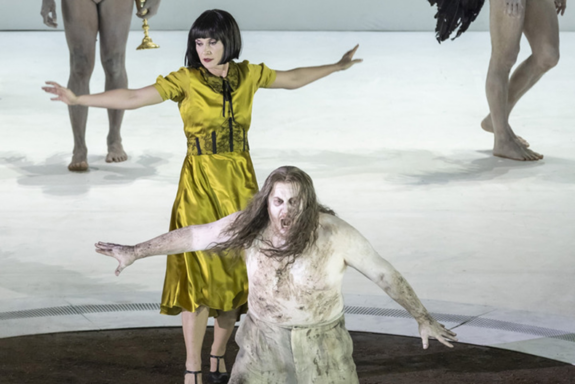
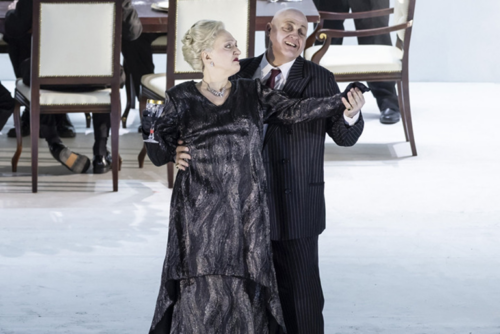
There is a single set: a large hall with two side walls that are always black and a dining room at the back where Herod and Herodias entertain their friends. In the middle is a large well from which Jochanaan emerges, accompanied by winged figures representing death. The Jewish debate unfolds with great dynamism, but I don’t know why they all end up in their underwear. This also happens to Herod: his promises of gifts to Salome inexplicably lead to him appearing in his underwear. The ‘Dance of the Seven Veils’ takes place with Salome surrounded by dancers who carry her, and it is quite attractive. Overall, one can say it is a solid production with some forgettable minor details.
In my opinion, conductor James Gaffigan had the great triumph of the evening, as has been the case in the previous operas he has led here. Salome can be challenging, and Gaffigan’s work was impeccable from beginning to end, with excellent collaboration from the Orquestra de la Comunitat Valenciana. I hope that his appointment as director of the Houston Grand Opera does not prevent us from enjoying his conducting here in the future.
The role of Salome was sung by Lithuanian soprano Vida Miknevičiūtė who is a true force of nature on the stage. Her movements are spectacular, and her interpretation of the ‘Dance of the Seven Veils’ was breathtaking. In terms of acting, her quality is undeniable. Vocally, however, she is not on the same level – her voice sounds too metallic and somewhat light for the role. I prefer a more dramatic voice and can’t help but think of Nina Stemme.
Nicholas Brownlee has a powerful voice, and he sang the part of Jochanaan with great intent. I believe he is one of the best possible interpreters of the prophet today. Herod was tenor John Daszak who has become a regular interpreter of Salome’s stepfather. He did well, but I prefer a Herod with a lighter voice like Gerhard Siegel’s.
Herodias was sung by mezzo-soprano Michaela Schuster who performed well although her voice lacks the freshness it had a few years ago. Tenor Christopher Sokolowski was well-suited to the role of Narraboth.
José M. Irurzun
Featured Image: Vida Miknevičiūtė (Salome) and Nicholas Brownlee (Jochanaan) © Arts Fotografía