
 United Kingdom Various: Hilary Hahn (violin) Tom Poster (piano). Wigmore Hall, London, 13.5.2026. (CSa)
Ravel – Violin Sonata No.2 in G
Tixier – Ressemblance
Bun-Ching Lam – Solitude d’automne
Debussy – Violin Sonata in G minor; La fille aux chevaux de lin
Lili Boulanger – Nocturne from 2 Pieces for Violin and Piano
Fauré – Violin Sonata No.1 in A, Op.13
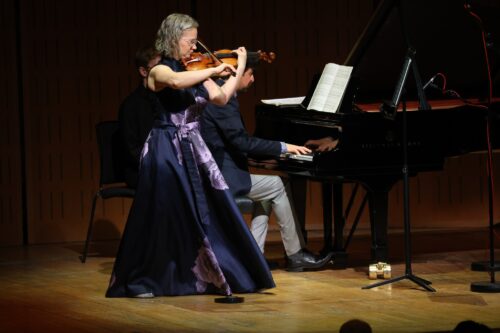
The American violinist Hilary Hahn and the British pianist and composer Tom Poster were last seen partnering in London back in 2023, in a multi-stranded programme of twentieth and twenty-first century American music. Making a welcome return to Wigmore Hall they presented a fascinating arc of French or French-influenced chamber music from the last decade of the nineteenth century to the present day.
Although the works in this concert were not presented in strict chronological order, Ravel’s refined jazz-inflected Violin Sonata No.2 in G, written in the 1920’s and premiered by George Enescu and the composer himself on the piano, was an excellent place to start. Hahn’s famed clarity of tone and impeccable bowing technique combined perfectly with Poster’s fluid improvisational style to give the opening Allegretto a cool elegance, and an understated, finely articulated beauty. The heart of the sonata, a second movement entitled Blues, reflected Ravel’s fascination with American jazz which he had encountered for the first time in Paris. Here Hahn and Poster, conjuring a louche nightclub atmosphere, used Ravel’s smoky harmonies, languorous sliding portamentos and syncopated rhythms to great effect. An explosive, sparkling finale, executed with almost surgical precision, proved the perfect segue to the second item on the programme: a world premiere of Ressemblance by Scott Tixier.
Tixier, a French-born classically trained jazz violinist, now lives and works in New York. Recognising the bridge between the formal classical music tradition and jazz, he has inherited the legacies of Stéphane Grappelli and Django Reinhardt – founders of the Hot Club de France and – and redefined their improvisational, recognisably pre-war French ‘gypsy jazz’ swing into something more contemporary and international. Tixier describes Ressemblance as ‘a single continuous movement built from a series of transformations’ which ‘moves through a series of contrasting environments’. Fusing the impressionistic soundworld of Debussy and more strident modern jazz harmonies, the work’s subtleties were given voice in a sensitive performance which at times seemed almost to float across the auditorium.
The strict boundaries between classical composition, improvisation and jazz were again challenged in Solitude d’automne – a short, atmospheric piece by Chinese born, New York based composer Bun-Ching Lam. Her artistic and musical affinities include Debussy, and it was fitting that Hahn and Poster chose the French master’s last violin sonata in G minor to end the first half of the recital. Written in 1917 when Debussy was dying of cancer, the work’s shifting moods, fragmented melodies and constantly changing canvas of colours were reflected in a responsive and richly textured reading. Violin and piano engaged in what at times seemed like an almost spontaneous conversation. The opening Allegro, playful one moment and melancholy the next, was followed by a capricious, playful Intermède and a soaring Finale marked Très animé which shimmered and danced ecstatically.
After two delicious amuse-bouches: the fleetingly beautiful miniature La fille aux cheveux de lin from Préludes Book 1 by Debussy and a rarely played Nocturne from 2 pieces for Violin and Piano by Lili Boulanger, came the main item on the second half’s menu: Gabriel Fauré’s sweeping Violin Sonata No.1 in A. Written between 1875 and 1876, its very French lyricism and elegant simplicity has been described as ‘the Gallic Aesthetic’ and has become one of the most admired violin sonatas of the late Romantic era. Fauré’s mentor Saint-Saëns claimed that one could find in it ‘everything to tempt a gourmet: new forms, daring modulations, unusual tone colours and unexpected rhythms …a magic [which] floats above everything’.
Hahn and Poster’s account achieved a perfect balance between lyrical freshness and technical prowess. A fervent energy of almost symphonic breadth characterised the first movement Allegro and contrasted sharply with the tender intimacy and introverted melancholy of the Andante. An elfin light Allegro vivo was followed by an agile, impassioned and ultimately triumphant final Allegro.
After a recital of such range, generosity and brilliance, most musicians would have closed the piano lid, packed away the violin, and taken their final bows. Yet these two exceptional artists had two more encores to give: Lili Boulanger’s No.2 Cortège from her Two Pieces for Violin and Piano and Cécile Chaminade’s Sérénade espagnole. Hopefully their final notes were intended not as a goodbye but merely as an au revoir.
Chris Sallon