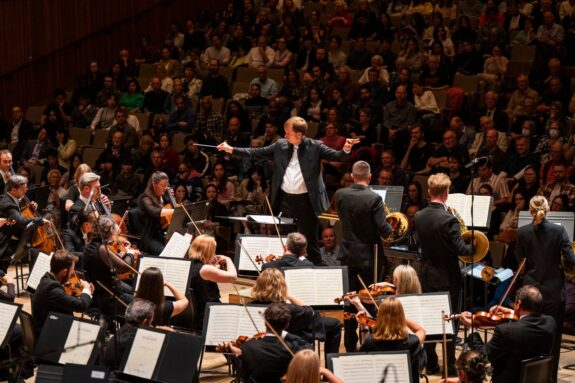
 United Kingdom Rachmaninov, Hisaishi, Scriabin: Royal Philharmonic Orchestra / Vasily Petrenko (conductor). Royal Festival Hall, London, 5.6.2026. (AV-E)
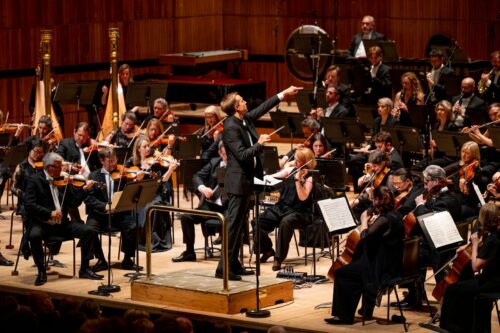
Rachmaninov – Isle of the Dead (1909)
Joe Hisaishi – Concerto for 3 Horns and Orchestra (2020)
Scriabin – Symphony No.3, The Divine Poem (1904)
The Royal Philharmonic Orchestra’s final Royal Festival Hall concert of the season began with a characteristically engaging introduction from the vehement Vasily Petrenko, who described the programme as music of ‘extremes’ — extreme emotions, extreme colours, extreme passion, even extreme ego. Framing Rachmaninov and Scriabin as childhood friends who diverged into radically different artistic identities, Petrenko characterised Rachmaninov as inward and introverted, turning towards the ‘inner core of the soul,’ and Scriabin as outward and extroverted, driven by an expansive, quasi-philosophical sense of perception and creative selfhood. Delivered with critical humour and incisive clarity, it provided a precise framework for the programme that followed, in which Rachmaninov’s introspective lyricism, Hisaishi’s rhythmic and textural hybridity, and Scriabin’s ecstatic orchestral expansion was positioned as a distinct form of musical extremity.
Petrenko elucidated: ‘Alexander Scriabin was totally different: an extrovert with an ego bigger than the world’s, imagining a music of cultural Armageddon in which listeners are transformed or excluded. His thinking folds in Nietzsche and post-Nietzschean ideas of perception — that the world exists only through being perceived, and that in perceiving one another we are effectively creating reality itself. In the Divine Poem, these ideas are translated into sound as a continual act of self-creation and expansion.’
Against this insightful framing of inward reflection and outward projection, Rachmaninov’s Isle of the Dead opened the programme proper, its brooding stillness and tidal unease evocatively establishing unsettling undercurrents.
Vasily Petrenko had his fingers firmly on the pulse of death in Rachmaninov’s Isle of the Dead, drawing the listener into a brooding underworld surrounded by turbulent waters before it finally receded into an unsettling stillness.
The opaque opening emerged with a measured, menacing reserve, unfolding in a serene yet disquieting stillness. As the music meandered on, its sense of stability began to erode and capsize. Petrenko’s buoyant gestures became increasingly expansive, his arms moving with a swaggering, lilting grace as though navigating an unseen current between the living and the dead.
The Royal Philharmonic’s lower strings established the work’s rocking 5/8 pulse with a dark, grainy depth of tone, driving its gradual forward motion. Petrenko maintained a secure architectural line, allowing tension to accumulate without premature emphasis. Fragments of the Dies Irae emerged from the orchestral texture, growing steadily more insistent, while the brass brought a sombre weight and authority to Rachmaninov’s funereal landscape.
The central climax was superbly judged; Petrenko paced the long build up with complete assurance. The RPO responded with incisive intensity, deep string sonorities underpinning gleaming brass and sharply etched woodwind detail. Even at the height of the tumult, clarity of texture remained intact, with the conductor maintaining firm structural control.
Following this climax, Petrenko resisted any temptation to exaggerate the aftermath. The music withdrew, its pulse returning in a more distant, spectral form. What had been a physical journey became an impressionistic fading, the orchestra dissolving into hollowed stillness as the final sonorities receded, leaving the music suspended between sound and silence as silence reclaimed the hall, before applause broke out.
Currently the RPO’s Composer-in-Association, Joe Hisaishi’s Concerto for Three Horns and Orchestra (2020) provided a striking contrast, assembled from a mish-mash of post-modernist clichés drawn from post-minimal and American symphonic idioms, with echoes of Steve Reich, John Adams and Leonard Bernstein, yet without consolidating into a distinctively unique compositional voice.
The first movement, Crossing Lines, was dominated by pulsing irregular rhythms and a restless, compulsive forward drive. A constant stream of rapid writing, sharply articulated and frequently displaced, was punctuated by offbeat accents that destabilised the rhythmic flow, creating a tense, unstable propulsion that constantly threatened to unbalance itself even as it surged forward. For all its preposterous propulsion, the energy felt urgent but curiously directionless, as though momentum itself had become the point rather than arrival.
The second movement, The Scaling, offered a more unsettled soundworld. What began as a meditative exchange between the three horns — Alexander Edmundson, Ben Hulme and Katy Woolley — gradually disintegrated into fragmented gestures and extended vocalised effects, including unusual ‘sing-playing’ techniques that blurred human and alien sounds.
Hisaishi’s nondescript scoring kept the three soloists persistently exposed in fragmented exchanges that highlighted both their clarity and the strain of separation from the orchestral fabric. I sensed a degree of audience detachment, the work’s splintered minimalist scoring registering a distinctly nervous unease.
The final movement, The Circles, returned to rhythmic energy but with a more referential quality. Gestural writing and syncopated patterns suggested echoes of post-minimal American orchestral writing and Broadway-inflected drive, yet despite its surface energy and colour, the movement never quite coalesced into a unified statement, remaining a sequence of engaging but ultimately disconnected ideas that left little lasting structural imprint and failed to register in memory. From the ridiculous, now to the divine.
Alexander Scriabin’s Symphony No.3, The Divine Poem, unfurled as a vast, rapturous surge of sensuous sensations, eroticised eruptions, and perfumed pulsations, enticing an absorbed audience into mesmerised abandonment.
The opening unfolded with expansive exuberance. Petrenko shaped the music in long arcs, allowing its energy to accumulate organically rather than through abrupt surges. Rhythms were sharply profiled but never rigid; the orchestra responded with richness of tone and clarity of detail.
In Voluptés, the performance took on a sensuous, immersive quality. Long-breathed paragraphs unfolded with warmth and poise, harmony constantly shifting in a haze of transformation. Strings glowed with saturated richness, while woodwind lines emerged with delicate precision, creating an atmosphere of suspended intensity.
Jeux Divins brought the symphony to its climactic culmination. Petrenko balanced vast orchestral forces with clarity and control, sustaining a powerful sense of direction throughout. The music rose in waves of intensity, the orchestra responding with increasing brilliance and weight.
As Scriabin’s vivacious vision reached its amorous apex, the brass blazed with volcanic voluptuousness, crowned by sonorities of radiant splendour, with an all-engulfing elemental impact of incandescent intensity. The final peroration swept through the full hall with ferocious force, bringing members of the audience to its feet in a well-won standing ovation.
It is a great shame that Barbirolli, Bernstein, Munch, Monteux, Mravinsky, Toscanini, Klemperer, Koussevitzky, Reiner and Szell never recorded Scriabin’s Symphony No.3. Fortunately, the performance was recorded by BBC Radio 3 for broadcast on Tuesday 14 July 2026 at 7.30pm, and will be available to stream for 30 days afterwards on BBC Sounds.
Alexander Verney-Elliott
Featured Image: Vasily Petrenko conducts the RPO in Joe Hisaishi’s Concerto for 3 Horns and Orchestra © Sarah Louise Bennett/RPO.