 United Kingdom NTLive’s Les Liaisons Dangereuses (by Christopher Hampton based on the novel by Pierre Choderlos de Laclos): Filmed (directed by Ollie Gardner) during its run at the Lyttelton Theatre at London’s Royal National Theatre and now in cinemas from 25 June. (JPr) ****
The 1988 Les Liaisons Dangereuses film was notable for introducing the world to the enduring talents of Glenn Close, John Malkovich, Michelle Pfeiffer, Uma Thurman, Keanu Reeves and director Stephen Frears. What I remembered of it did not suggest a plot that chimed in with 2026 sensibilities. Les Liaisons Dangereuses is set in pre-revolutionary Paris where the Ancien régime (the French nobility) is inordinately-wealthy, decadent, idle and as a result bored. The women ‘entertain’ themselves by weaponising desire and seduction in mind games and battles of will as something to amuse themselves, seek revenge, gain power or otherwise enhance their reputation and assert some dominance in the strictly patriarchal society.
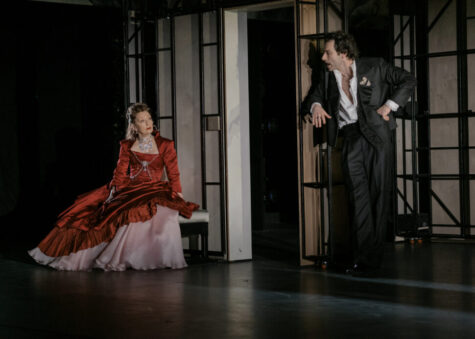
The Marquise de Merteuil’s central vendetta is against the Comte de Gercourt, a former lover, who discarded her for a fifteen-year-old virgin (Cécile de Volanges) ‘fresh’ from a convent. To punish him, she devises an elaborate scheme to ruin Cécile’s reputation and virtue before their marriage. Merteuil exclaims to co-conspirator Vicomte de Valmont how she ‘was born to dominate your sex and avenge my own.’ Earlier Valmont had said ‘I thought betrayal was your favourite word’ to which she replied ‘No, no… “cruelty”. I always think that has a nobler ring to it.’ This perfectly summed up everything about the manipulative Merteuil during Christopher Hampton’s 1985 play (adapted from Pierre Choderlos de Laclos’s 1782 novel). Lesley Manville gives an excellent portrayal of an older, composed, calculating, ruthless, though increasingly jealous – when her plans go awry and real love rears its ugly head – Merteuil.
I was more ambivalent about Valmont who is challenged by Merteuil to also pursue the married and notably virtuous Madame de Tourvel and ruin her reputation too. He would win back Merteuil’s affection as a result and return to her bed. Valmont’s rapacious instincts appear to arise from some deep-seated insecurity requiring the constant validation of his ‘toxic masculinity’ to enhance his reputation among his peers. Something that is very 2026.
Indeed for Hampton his play ‘speaks so directly for us today’ because ‘what in the 1980s seemed to be about the so-called “me generation”, about institutionalised selfishness and refusal to acknowledge any responsibility, has today shifted in focus to take in the repulsive concept of “post-truth”, where the most brazen lies are endlessly repeated until they’re believed; where the boundless greed and appetite for exploitation exhibited by the international super-rich is indulged until it seems absolutely normal; and where individuals can be cancelled for reasons justifiable or unjustifiable until the implacable gods of the internet appear to be sated. By describing the underbelly of the aristocracy of pre-revolutionary France so truthfully, Laclos struck a chord that, as he hoped, has resounded down the centuries. When we hear it and recognise it because it is all around us.’
I would prefer to avoid too many spoilers in case you are not aware how the play ends but it is important to perhaps celebrate that Merteuil and Valmont get what they deserve. You will see how all their machinations ultimately backfire on them and as their complex and cynical game intensifies, their alliance dissolves into a bitter rivalry, which leads to emotional ruin, genuine heartbreak, and mutual destruction.
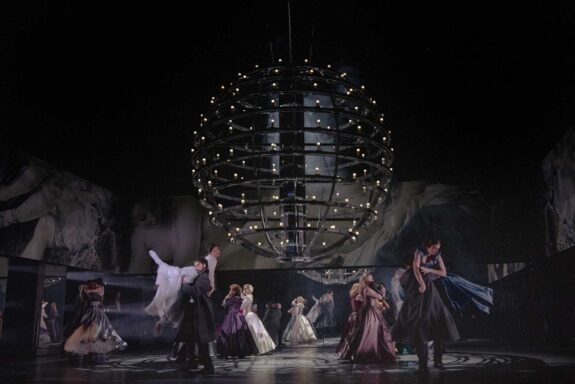
British theatre director Marianne Elliott returned to the National Theatre for the first time since her 2017 Angels in America and with set designer Rosanna Vize has created a rather spare, abstract and atmospheric production. It appears to be set at times in a hall of mirrors as a reflection of the narcissism of the leading characters; the work of erotic artists is wrapped around the walls above the mirrors and apart from Merteuil’s bejewelled scarlet (!) gown it all has a slightly sepia-infused palette and is rather dark. Initially there are just three chairs and then the various salon, drawing room, bedroom, corridor and outdoor scenes get a few mobile components moved about on the stage to suggest the settings. Often above – and sometimes revolving – is a huge ‘mirror ball’ apparently comprised of 144 tiny LED candles.
Aidan Turner – before Poldark and now Rivals – made his name as a vampire in the BBC TV series Being Human. Employing an accent not entirely English nor his own Irish I could not get Count Dracula’s pursuit of a loyal wife, Mina Harker, out of my mind. As Turner’s charismatic and loathsome – in equal measure – predatory Valmont ensnared first Cécile and then Tourvel (with fatal consequences) I was expecting him to bite their necks as he invaded their personal space. There was something gloriously Shakespearean in Turner’s mental unravelling in the second-act ‘It’s beyond my control!’ scene before he realises how duplicitous Merteuil is, even if his voice now had totally retreated back to the Emerald Isle.
There is an intriguing opening to that second act which through some of Tom Jackson Greaves’s stylised movement has Merteuil dressing while Cécile undresses awaiting Valmont’s arrival. Elsewhere there is much ensemble contemporary dance into which Turner’s Valmont, for one, was actively involved, which mostly represented the inner turmoil of the characters, or the French society’s larger involvement in the ongoing story. Perhaps rather over-used these interludes were best when we saw Tourvel praying for guidance and ‘prey’ to several male avatars of Valmont who return later to ravish Cécile. Jasmin Kent Rodgman’s minimalist, yet haunting, vocal score enhances the dramatic tension at significant moments.
There are significant contributions from the rest of the cast: Hannah van der Westhuysen brilliantly conveys Cécile’s initial wide-eyed innocence and later her fortitude; it is Monica Barbaro’s Tourvel who engenders our utmost pity for her conflicted character’s travails and she does this is in a very believable way; Darragh Hand is equally convincing as Cécile’s guileless – and exploited by Merteuil – music teacher and suitor, Chevalier Danceny; and the principal cast is completed by Cat Simmons as Cécile’s caring and concerned mother and Gabrielle Drake as Valmont’s conspiratorial aunt.
In a post-#MeToo world the plot of Les Liaisons Dangereuses may not be to everyone’s taste, but it proves a compelling theatrical – and now a cinematic – experience. Something not to be missed for the performances of Lesley Manville and Aidan Turner if nothing else.
You can find your nearest screening at NTLive.com (here).
Jim Pritchard
Featured Image: The cast of Les Liaisons Dangereuses © Sarah Lee
Cast:
Marquise de Merteuil – Lesley Manville
Vicomte de Valmont – Aidan Turner
Cécile de Volanges – Hannah van der Westhuysen
Madame de Tourvel – Monica Barbaro
Madame de Volanges – Cat Simmons
Madame de Rosemonde – Gabrielle Drake
Chevalier Danceny – Darragh Hand
Major-Domo – Ali Goldsmith
Azolan – Sharif Afifi
Émilie – Lucia Chocarro
Adele – Amy Macken
Father Anselme – Curtis Angus
Julie – Nandi Bhebhe
Society Dancers, Maids and Footmen – Ishmail Aaron, Charlotte Avery, Liz Ewing, Georges Hann, Spike King, Dianté Lodge, Katie Lusby, Aisha Naamani, Bryony Pennington
Creatives:
Director – Marianne Elliott
Set designer – Rosanna Vize
Costume designer – Natalie Roar
Choreographer – Tom Jackson Greaves
Composer – Jasmin Kent Rodgman
Lighting designer – James Farncombe
Sound designer – Ian Dickinson for Autograph
Intimacy director – Ingrid Mackinnon
Fight director – Sam Lyon-Behan
It was a brilliant production overall and looked fabulous on-screen. The chemistry between the two leads was absolutely electric.