 United States Blossom Music Festival [6] – Sibelius and Prokofiev: Simone Lamsma (violin), The Cleveland Orchestra / Tabita Berglund (conductor). Blossom Music Center, Cuyahoga Falls, 15.8.2026. (MSJ)
Sibelius – Finlandia; Violin Concerto in D minor, Op.42
Encore: Hindemith – Finale from Violin Sonata No.6
Prokofiev – Suite No.2 from Romeo and Juliet, Op.64b
The big question for a violinist playing Sibelius’s Violin Concerto is usually thought to be: should you emphasize the stinging drama of the piece or the otherworldly lyricism? Simone Lamsma’s answer to both questions is a fiery ‘Yes!’, judging by her intense but skillfully balanced performance in this concert. It was a remarkable opportunity to hear her range in a piece that is about as distant from the elegant, urbane world of Saint-Saëns’s Violin Concerto No.3 as can be. That was the piece with which Lamsma made what I believe was her Cleveland debut three years ago, or at least it was the first time I had encountered her work. What stood out then was that Lamsma was clearly doing more than just playing notes. She had a feel for the essence of the work and used that to focus her performance so that the work was always moving toward that essence which, in the case of the Saint-Saëns, was tenderness.
The essence of the Sibelius concerto is far more desperate, and Lamsma had her eye on the work’s dark heart no matter how breathtakingly sweet she made moments of passing lyricism. This did not preclude moments of sheer ferocity. After the big orchestral tutti passage in the middle of the first movement, there is an extended solo passage for the violin with minimal accompaniment, so stark as to be virtually a cadenza. In many performances, frankly, the solo passage comes as a bit of a letdown after the orchestral outburst. And when conductor Tabita Berglund handled that part with true fire, I was worried for a moment about what might come after. But when the moment arrived, Lamsma used a slower-than-normal portamento slide up to the first high note which sounded for all the world like the yelp of a wounded beast and that terrifying intensity never flagged through the whole solo. The slow movement was achingly delicate without losing its forward flow and the finale sizzled at a brisk tempo. That may seem like mixed metaphors, but it captures the nature of Lamsma’s uncanny balance: blazing hot and icy cold at the same time. The audience refused to let Lamsma go after such a commanding performance, and she eventually returned to play the hard-driving finale from Paul Hindemith’s Sixth Violin Sonata as an encore, a wonderful chance to hear some music by a composer who isn’t played much these days.
In her Cleveland Orchestra debut, Tabita Berglund was no less commanding, making the orchestral part an essential player in the concerto. She opened the first half with the same composer’s tone poem Finlandia, a sure-fire crowd pleaser. I am not sure what, if anything, Berglund knew about the acoustics of the Blossom Pavilion before coming here but it turns out that Finlandia is perfect for the epic acoustics of the hall, which is far more reverberant than the orchestra’s main home in Mandel Hall at Cleveland’s Severance Music Center. The orchestra has made a virtue of the intimate acoustic at Severance by using it to focus their chamber-music-like clarity and inner cohesion. With that poise, the orchestra can relish the big sound at Blossom without losing that inner clarity. Berglund unleashed the brass and percussion for the big climaxes but wisely drove the machine forward with a light grip on the wheel, letting the orchestra show their stuff without trying to conduct every detail.
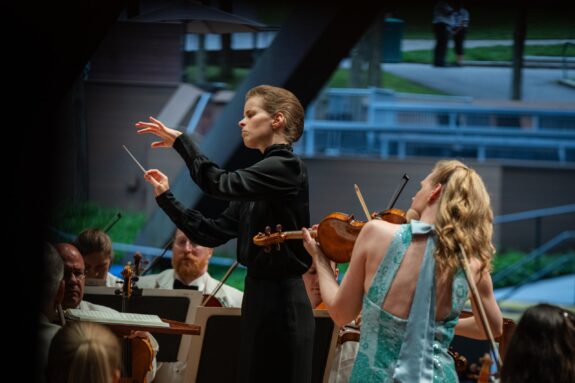
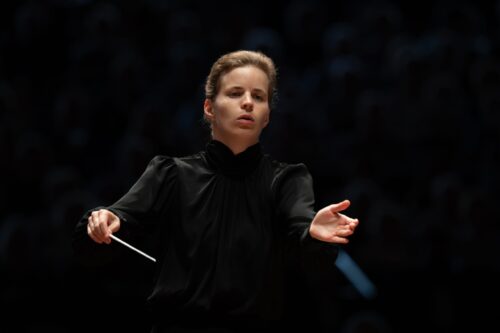
Berglund showed what she wanted with her baton – and got results – in the Suite No.2 from Prokofiev’s music for the ballet Romeo and Juliet. The opening ‘Montagues and Capulets’ combines the Duke’s condemnation of the feuding families from Shakespeare’s famous story with the brooding dance of the knights, portraying the looming threat of violence that underpins Romeo and Juliet’s doomed romance. For the Duke’s proclamation, Berglund took her time, making sure that the full chords roared. The music of the knights lunged aggressively but Berglund also indicated with her baton where she wanted certain notes to be held to full duration and then cut off abruptly, which the Cleveland strings executed precisely, giving those passages an even more aggressive edge than usual.
The faster moments – ‘Young Juliet’ and the later ‘Dance’ – were daringly quick though never so fast as to lose clarity and poise. ‘Romeo and Juliet Before Parting’ and the closing ‘Romeo at Juliet’s Grave’ brought blazing intensity: like the Sibelius, of such fierce coldness it burned. Through it all, Berglund was laser-focused on the music. Indeed, her demeanor coming on the stage was a breath of fresh air after a string of conductors this summer who spent a lot of time thanking the audience, beaming at them and holding their hearts while thanking them and so forth. Berglund came out, nodded to the crowd and got down to work. This directness and the shrewd skill she displayed makes one want to hear her in a wider range of works. There are undoubtedly good reasons why the Bergen Philharmonic has named her principal conductor while two more major orchestras (the Detroit Symphony and the Dresden Philharmonic) have named her principal guest conductor. She’s worth further exploration.
Mark Sebastian Jordan
Featured Image: Simone Lamsma in the Sibelius Violin Concerto with conductor Tabita Berglund and the Cleveland Orchestra © Aireonna McCall-Dubé/TCO