
 United Kingdom Edinburgh International Festival 2026 [6] – J. S. Bach, Six Cello Suites: Alisa Weilerstein (cello). Usher Hall, Edinburgh, 22.8.2026. (GT)
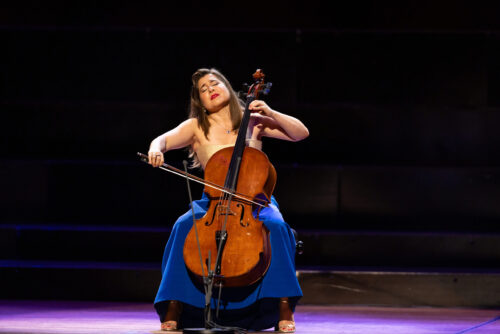
This was the second of three concerts on a day devoted to J. S. Bach, and this recital of the Six Cello Suites attracted a good audience in the expansive auditorium of the Usher Hall. The American cellist has been developing a major career in the last decade, and just six years ago, she recorded all the Bach cello suites, gaining great reviews. It is a significant challenge to play solo chamber pieces in the vastness of the Usher Hall, but for the intimacy of the instrument, this recital may have been musically ideal for the Queen’s Hall. For my ears, the acoustics were ideal in the stalls, but I doubt listeners in the Grand Circle would have caught the quieter passages.
In the opening First Suite in G major, Weilerstein captured the solemnity and magisterial nuance of the Prelude, and her musicianship continued in the refinement of the Allemande and in the vigorous Courante, followed by the majesty of the Sarabande, and the vivacity of the Gigue. Wilfred Mellers called the Cello Suites as if ‘a man has created a dance of God’, and this affinity with heaven was firmly present. The Second Suite, in the minor key, embraced deep, almost philosophical feelings in the graceful characterisation by Weilerstein, while in the Allemande, she created a richly intense tone, and there was a transcendent, yet dance-like mood in the Courante. There was a sense of great wisdom mixed with reflection in the Prelude of the Third Suite, leading to the most sensitively exquisite playing in the American’s playing; she made it seem as if this was as it should be in this music. The Fourth and Fifth Suites were sublime in their magical phrases that took us away into a different world of pensive and darkly introspective emotions mixed with the playfulness of the Gavottes and the Bourrées.
Throughout, Weilerstein produced a rich tone sometimes heard at a low dynamic, yet with immaculate intonation and effortless phrasing. In the Sixth Suite, she created a stately mood through her intricate bowing; this often sounded as if from another world, and the imagery was broken only by playful, upbeat chords. Sometimes, one could see the pleasure in her playing noticeably in the vivid optimism of the Courante, and in the heavenly Sarabande in its almost martial slowness, and the spirit of her performance, embellished by great artistry, was at times mesmerising. The Gavotte was uplifting and was almost as if we were part of a village festival with its bucolic mood. The Gigue brought the journey to an end, closing on a hopeful, yet reflective tone. This was a wonderful recital of one of the greatest works ever written, and Alisa Weilerstein was rewarded with a standing ovation – a rare accolade in a chamber recital here in Edinburgh.
A distraction at this concert was the glare of the yellow lit-up banner behind the organ, telling the audience that this was part of the Edinburgh International Festival. The banner was distracting during the whole recital, especially if you were in the stalls looking up at the cellist with its bright glare behind. Often, I was forced to simply look away from the performer or just close my eyes. This arrangement is also being used at the Queen’s Hall, and one wonders why the organisers think this is a good idea, apart from for official photos of the event. It is completely unnecessary in my opinion, but thankfully, it didn’t upset the concert.
Gregor Tassie