
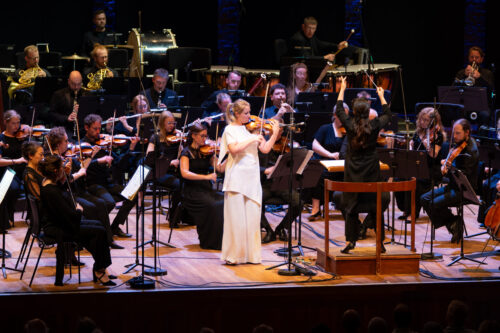
 United Kingdom Kodály, Deborah Pritchard, Mendelssohn: Harriet Mackenzie (violin), BBC Philharmonic Orchestra / Sora Elisabeth Lee (conductor). Snape Maltings Concert Hall, Suffolk, 26.8.2026. (PC)
Kodály – Dances of Galánta
Deborah Pritchard – Nightingale (world premiere)
Mendelssohn – Symphony No.3 in A minor, Op.56, ‘Scottish’
Providing a highlight of the Britten Pears Arts Summer at Snape series, this colourful programme of works given by the BBC Philharmonic Orchestra and conductor Sora Elisabeth Lee made a strong impact. At the heart of the concert was the first performance of a new violin concerto inspired by artwork and birdsong, framed by two evocative orchestral pieces, the first a set of Hungarian folk dances and the second a symphony that resulted from a trip to Scotland made by a German composer in the late 1820s.
Kodály’s Dances of Galánta made a lively and attractive opening item. The slow introduction was distinguished by warmly expressive orchestral phrasing and a characterful clarinet cadenza. The following dances were crisply articulated and sharply characterised. Grandeur and spirit were both much in evidence in this polished and buoyant account.
Harriet Mackenzie joined the BBC Philharmonic for the premiere of Deborah Pritchard’s violin concerto, Nightingale (2026). This is the final work in a triptych of concertos the composer has written for Mackenzie inspired by the art of Maggi Hambling, whose Nightingale night series of paintings was projected onto a screen above the players throughout the performance. Hearing the song of the nightingale in a Sussex woodland was another stimulus for the composer when writing her new piece.
The soloist was very much at the centre of Nightingale. After a brief orchestral passage set the scene with sonorous low percussion, rising string lines and swirling harp and celesta, the solo violin entered with florid statements, accompanied by harp swirls, perhaps an allusion to the previous piece in the concerto trilogy, Edge, which features violin and harp soloists. More urgent and intense material contained brass calls and woodwind figures, but the focus of attention was the solo violinist’s intricate and ornate utterances, beautifully rendered by Mackenzie. After a still and eloquent central, cadenza-like section in which the soloist gave out expressive, arpeggiated phrases over a pedal bass, the closing section, signalled by the entry of woodwind was brightly scored, with the violin in high register. At one point surrounded by a halo of strings, the soloist recalled ideas from the opening section and the concerto closed on solo violin trills as the music slowly faded away. Majestic and radiant in equal measure, this enchanting new concertante work received an elegant and beguiling first performance, warmly received by a highly receptive audience.
After the interval came an alert and swift rendering of Felix Mendelssohn’s ‘Scottish’ Symphony. After a brooding introduction, the opening movement was full of energy, with a strikingly intense storm sequence. The following scherzo was vigorous and fleet-footed, while the Adagio slow movement had nobility and poise. An energetic finale was crowned by an imposing, major-key coda. Eliciting an enthusiastic response from the audience, this was a bold and superbly played reading that brought the evening’s music-making to an immensely satisfying conclusion.
Paul Conway
Featured Image: Violinist Harriet Mackenzie and the BBC Philharmonic Orchestra conducted by Sora Elisabeth Lee © Britten Pears Arts