
 Germany Elgar, Tchaikovsky: Berlin Philharmonic Orchestra / Kirill Petrenko (conductor). Philharmonie Berlin, 21.8.2026. (AB)
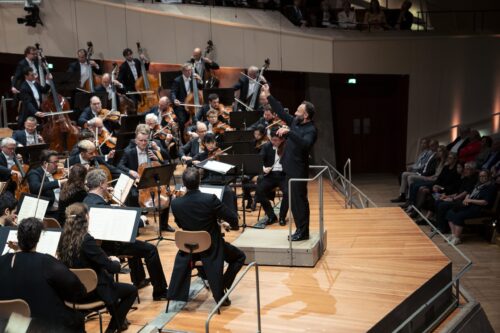
Elgar – Variations on an Original Theme, Op.36 – Enigma
Tchaikovsky – Symphony No. 4 in F minor, Op.36
Berlin was not quite ready to return to work: the school summer holidays had not even ended, yet the Berlin Philharmonic and Kirill Petrenko were already back in the Philharmonie to open their 2026/27 season. And what an opening night it was.
At first sight, the pairing of Elgar’s Enigma Variations and Tchaikovsky’s Fourth Symphony might look almost suspiciously safe. Both are popular and well known, yet neither is remotely lightweight. Both happen to be Op.36, their principal tonal worlds – G minor and F minor – lie just a whole tone apart, and both were written by composers who knew what it meant to stand slightly outside the comfortable centre of society: Elgar as a largely self-taught Catholic in Protestant Britain, Tchaikovsky as a homosexual man in Tsarist Russia. Biography, then, inevitably plays a part in any approach to these works.
Elgar came first, and almost immediately something rather wonderful happened. Instead of inflating the opening into late-Romantic grandeur, Petrenko let the music breathe, shaping phrases with enormous care while making the whole thing sound entirely natural. The result was extraordinary transparency, at moments almost like chamber music, with carefully dispositioned tempi that never hurried through a phrase or musical thought.
The familiar Berlin richness of the strings was present, of course, but richness hardly begins to describe the range of sound they produced: weight without opacity, warmth without heaviness, and pianissimos so delicate that at times the music seemed to hover in the hall rather than travel through it. Individual voices remained audible, and the orchestra could move from velvet to something approaching silver within a single phrase.
In B.G.N. (Variation XII), Bruno Delepelaire’s cello solo emerged naturally from within the texture – private, ardent and beautifully shaped – while in Nimrod (Variation IX) Petrenko wisely refused to treat the music as an emotional emergency button. The great climax was built with almost unnerving patience, making its eventual arrival all the more overwhelming.
I lived in Britain for more than ten years and heard the work there countless times, yet rarely have I found a performance quite so moving. This was lucid and transparent Elgar, while still preserving the warmth and humanity at the heart of the work. The refinement of the execution bordered on perfection, and one can only hope that this recording will eventually be released officially.
After the interval, Petrenko applied essentially the same principle to Tchaikovsky’s Fourth, except that the temperature rose by several degrees. His particular gift in this repertoire – starting with the famous recording of the Pathétique at the beginning of his Berlin tenure – is to strip away the inflated rhetoric, sentimental lingering and thick layer of emotional icing that can so easily accumulate around Tchaikovsky without losing any of the feeling underneath. Quite the opposite: once the music is no longer constantly being told how tragic it is, it becomes considerably more unsettling.
The opening Fate motif was hard and stoical, more fact than theatrical gesture, and from there Petrenko kept the pulse alive, resisted indulgence and exposed details that disappear in heavier performances. Even at considerable volume, the texture retained air.
Albrecht Mayer’s oboe began the slow second movement with wonderfully unforced eloquence, while the pizzicato Scherzo became a demonstration of astonishing orchestral reflexes, impulses darting through the ensemble with almost nervous-system precision.
Most astonishing of all, however, was the Finale. The tempo was ferocious. At moments, the orchestra seemed to be operating beyond the normal laws of orchestral physics – something between a Formula One qualifying lap and a controlled explosion, with the slightly alarming suspicion that Petrenko still had another gear available.
And yet this was no empty sprint. Virtually everything remained audible: inner voices registered, rhythmic figures retained their shape, the strings never dissolved into a blur, and the brass could blaze without turning the texture into noise.
Apart from the musical experience, watching the interaction between orchestra and conductor is tremendous fun: even amid Tchaikovsky’s pandemonium at this extraordinary speed and precision, there was time for visible delight when a phrase landed exactly as intended, including an almost high-five gesture by Petrenko towards the horns.
Despite the frenetic applause at the end, this approach will surely not please everyone. It stands almost at the opposite pole from the Karajan-Berlin tradition of saturated sonority and monumental sweep. But if one admires Tchaikovsky not merely for his melodic abundance but also for his command of harmony, texture and symphonic architecture, the result is exhilarating.
Berlin heard this pairing only once before the orchestra took it on its festival travels to Salzburg, Lucerne, Edinburgh and finally the BBC Proms in London, ahead of the Berlin Philharmonic’s wider international touring later in the season. If one happens to live within travelling distance of any remaining performance of this programme, there is really only one sensible recommendation: Go!
Andreas Bücker
A breathtaking critique of an extraordinary opening night in Berlin. Being there live in the Philharmonie was a privilege, and this review provides a brilliant, masterfully crafted x-ray of Petrenko’s vision. From the understated emotional depth of ‘Nimrod’ to the thrilling energy of Tchaikovsky’s Fourth, every nuance is captured with immense clarity and elegance. What Andreas Bücker describes is truly sensational — it is deeply rewarding to read music criticism backed by such profound musicological precision and intellectual depth. A brilliant piece of writing.