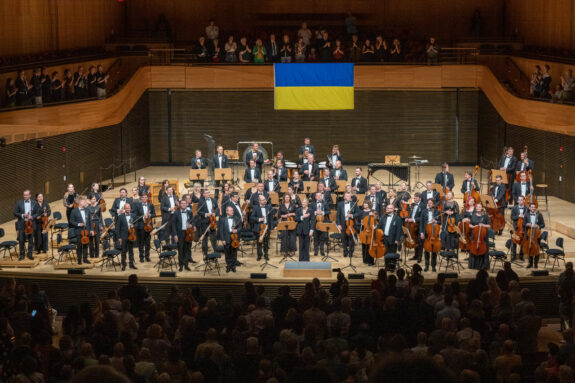
 United States Ukrainian Freedom Orchestra 2026 Invincible Tour [1] – Various: Lise Davidsen (soprano), Ukrainian Freedom Orchestra / Keri-Lynn Wilson (conductor). Wu Tsai Theater, David Geffen Hall, New York, 25.8.2026. (RP)
Maxim Kolomiiets – Suite from The Mothers of Kherson
Richard Strauss – Four Last Songs
Beethoven – Symphony No.7 in A major, Op.92
Encore: Yuri Shevchenko – We Do Exist! (Ми є!)
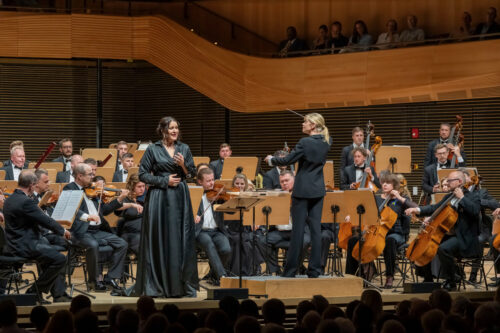
The Ukrainian Freedom Orchestra’s 2026 Invincible Tour, its fifth international summer tour, concludes in New York after concerts in Warsaw, London, Amsterdam, Hamburg and Dublin. The principal works are Beethoven’s Seventh Symphony and Verdi’s Requiem, complemented by Bohdana Frolyak’s Gloria, a new work dedicated to those who have died defending Ukraine. New York, the only city on the tour to host two concerts, had the additional draw of soprano Lise Davidsen singing Richard Strauss’s Four Last Songs and Maxim Kolomiiets’s Suite from The Mothers of Kherson.
Canadian-Ukrainian conductor Keri-Lynn Wilson founded the UFO in 2022 in response to Russia’s invasion of Ukraine and conducted all the concerts on this year’s tour. The orchestra brings together leading musicians who are members of Ukrainian orchestras, Ukrainian musicians who are refugees abroad and Ukrainian members of established European orchestras. Its principal purpose is cultural advocacy and the preservation and projection of Ukrainian artistic identity, but its charitable efforts are equally noteworthy.
Maxim Kolomiiets’s Suite from The Mothers of Kherson opened the first concert. A Ukrainian composer and oboist, Kolomiiets writes richly colored, dramatically charged music that draws on Ukrainian musical traditions while engaging with contemporary subjects, most notably the war in Ukraine and the abduction of Ukrainian children. The orchestral suite is drawn from his opera The Mothers of Kherson (with a libretto by George Brant), a joint commission of the Metropolitan Opera and Teatr Wielki–Polish National Opera. The story is inspired by the real experiences of Ukrainian mothers who traveled behind Russian lines to retrieve children forcibly taken from them. The opera will receive its world premiere in Warsaw on 16 October 2026.
In the three-movement suite, Kolomiiets distills the opera’s emotional arc – fear, grief, struggle, love and ultimately hope – into a continuous musical narrative of cinematic scope. The music combines contemporary orchestral writing with Ukrainian folkloric elements and striking orchestral color, and it opens with the roll of the timpani and the ominous growl of the contrabasses. A lullaby, the opera’s principal theme, recurs throughout, returning with particular poignancy in the closing section where concertmaster Marko Komonko played it with great sensitivity. Oboes brought to life Kolomiiets’s superb writing for an instrument with which he is intimately familiar. Soaring brass anthems alternated with intense rhythms and battle calls that conveyed danger and urgency before the work ended with a bang, hope ultimately prevailing over despair.
Strauss’s Four Last Songs have been a core component of Davidsen’s concert repertoire for nearly a decade. For the uninitiated, the size of her voice astounds. But for those who have followed her career, this performance was exceptional for the control she exerted over her remarkable instrument. Hers was a carefully sculpted interpretation in which volume was subservient to emotion. Most impressive was the soprano’s sensitivity to text and the long, spinning phrases that crested effortlessly.
Davidsen displayed those qualities from the start in a ravishing, introspective ‘Frühling’. In ‘September’, she sang its repeated soaring melismatic figure with effortless radiance. The emotional impact was intensified by a burnished horn solo that seemed to answer and prolong the song’s evocation of fading summer light, set against the warm, glowing orchestral colors Wilson drew from the orchestra.
The apex was ‘Beim Schlafengehen’, notable for Davidsen allowing the full proportions of her voice to emerge in its long, rhapsodic phrases, to which Komonko’s shimmering violin provided a luminous, silvery counterweight. Here, Wilson drew some of the most transparent and sensuous playing of the evening from the orchestra. ‘Im Abendrot’ found Davidsen lyrical and reflective, climaxing magnificently on the phrase ‘Ist dies etwa der Tod?’ (‘Is this perhaps death?’). Wilson conducted the final orchestral passage with the utmost sensitivity, guiding the horns, woodwinds and strings into an ending of luminous stillness.
Beethoven’s Seventh Symphony is renowned for its buoyant, life-affirming qualities, in which gravity is continually transformed into movement and movement into joy. There were exquisite crystalline passages in the first movement’s slow introduction, the solemn Allegretto and the lyrical Trio of the Scherzo. The lasting impression, however, was of the rhythmic drive Wilson instilled in the performance, especially in the first movement’s Vivace and the explosive finale. The Seventh is a symphony in which rhythm is at least as important as melody, and under Wilson’s baton its force was ever-present, expressing not mere joy but resilience, hope and ultimately triumph.
The sole encore was We Do Exist!, Yuriy Shevchenko’s 2014 paraphrase of the Ukrainian national anthem for solo violin and strings. Shevchenko (1953–2022) was a prominent Ukrainian composer known for his neo-Romantic, neo-Impressionist style. Lyrical and hymn-like, the work received an especially affecting performance from Komonko who played its extended solo with beauty and deep feeling.
Rick Perdian
Featured Image: Keri-Lynn Wilson (conductor) and the Ukrainian Freedom Orchestra © Richard Termine/Met Opera
It is incredible how music goes on with war, and folks still perform so brilliantly. Music is magic! Thank you for the review.