
 United Kingdom Clandeboye Festival 2026 [1] – Various: Michael McHale (piano), Ellen Jansson (piano), William Curran (clarinet), Sinéad O’Halloran (cello), Killian White (cello), Mairéad Hickey (violin). Clandeboye Estate, County Down, Northern Ireland, 24.8.2026. (RB)
Holmès/R. Schumann/Liszt – Three Love Songs arranged for Solo Piano
Brahms – Clarinet Trio in A minor, Op.114
Tchaikovsky – Piano Trio in A minor, Op.50
The Clandeboye Festival takes place every year in the beautiful surroundings of the Clandeboye Estate near Bangor in Northern Ireland. This year the festival has reached a significant milestone; it is celebrating its 25th anniversary. This concert featured contrasting works from the second half of the 19th century.
The concert opened with three love songs arranged for solo piano. The first two were arrangements by pianist, Michael McHale, who performed the set while the third was Liszt’s famous arrangement of Robert Schumann’s Widmung. McHale’s arrangement of Augusta Holmès’s Évocation d’amour the feelings of Romantic longing and ecstatic devotion in the song. The piece rose to a heady climax and McHale’s filigree decoration was exquisite. The arrangement of Clara Schumann’s Sie liebten sich beide had a sincere, touching quality. I was less convinced by the performance of Widmung where McHale’s use of rubato sounded a little forced and stilted.
Ellen Jansson, William Curran and Sinéad O’Halloran joined forces for Brahms’s Trio for Piano, Clarinet and Cello. The work was inspired by the composer’s encounter in 1890 with the clarinettist, Richard Mühlfeld, who inspired Brahms to write the Clarinet Trio, the Clarinet Quintet, and two Clarinet Sonatas. All the pieces share an autumnal, introspective character typical of Brahms’s late style. The Clarinet Trio is an extraordinarily intimate, dark‑hued, and emotionally complex work. The instrumental combination was unheard of at the time, and Brahms uses the unusual ensemble to explore colour, melancholy, and lyrical warmth.
There was much to admire in this performance from the three players. O’Halloran opened the work with a gorgeous soulful melody before engaging in intensely poetic interplay with Curran’s clarinet. Jansson kept the piano textures light and transparent and injected rhythmic momentum into the movement at key points. The Adagio second movement is one of Brahms’s most sublime creations and it received a ravishing performance here. The composer’s contemporaries commented that the clarinet and cello sounded as if they were ‘in love with each other’ and that great love affair was very much in evidence in this performance. The waltzing third movement was gracefully executed and Curran’s yodelling effects in the Trio were a delight. There was some fine playing in the finale, although the music sounded a little subdued and underpowered. I would have liked to hear more of the driving Hungarian rhythms and gypsy fire.
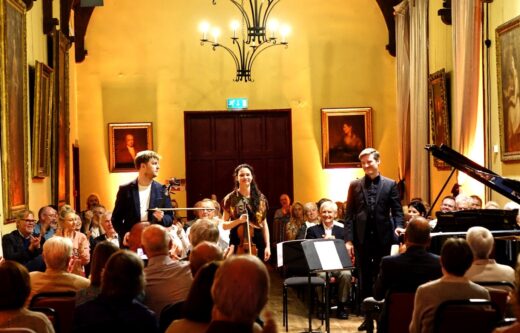
In the second half, McHale returned to the stage with Mairéad Hickey and Killian White for a performance of Tchaikovsky’s Piano Trio in A minor. The work was written in 1882 following the death of the pianist, Nikolai Rubinstein. The latter was a close friend, mentor and champion of the composer. The Trio is subtitled À la mémoire d’un grand artiste (‘In memory of a great artist’), a reference to Rubinstein. The piano part is particularly demanding, and the work is long and constructed on a grand symphonic scale.
The three players brought a symphonic breadth and rich sonorities to the opening movement. Hickey and White introduced the haunting main theme in exemplary fashion; Tchaikovsky’s long melodic lines passed seamlessly between them. They brought a raw emotional intensity to the elegiac melody and captured the grand sweep of the music. McHale rose to the technical challenges with virtuoso aplomb and negotiated his way deftly through the dense chordal textures and octaves. The shifts in mood and texture and the charged emotional outbursts were handled well.
The balance and interplay between the players in the second movement were excellent and McHale did well to ensure the virtuoso piano writing did not drown out his string partners. The variations were beautifully characterised: I enjoyed McHale’s high voltage virtuoso playing in the third variation, the interplay between the strings in the fourth, the delicate music box effects in the fifth and the sparkling lush ballet textures in the waltzing sixth variation. It is good practice to leave a short a gap between variations, particularly in a work of this length but my one quibble with this performance was that the gaps were sometimes a little long and this had the effect of breaking the broader narrative arc. As the movement progressed the concentration of the three players never flagged. The voicing of the fugal variation was admirably clear while the mazurka was stylish and well executed. The transition to the elegiac music of the opening and the closing funeral march had a sombre inevitability about it. McHale final chords on the piano brought Rubinstein’s funeral procession into view and ushered the movement to its solemn conclusion.
Overall, this was a first-rate concert featuring excellent playing from all the players.
Robert Beattie