
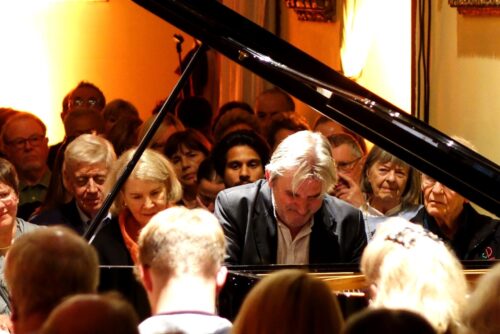
 United Kingdom Clandeboye Festival [2] – Tchaikovsky, Prokofiev Mussorgsky: Barry Douglas (piano). Clandeboye Estate, County Down, Northern Ireland, 26.8.2026. (RB)
Tchaikovsky – The Seasons, Op.37a, Nos. 1,2,6,10 & 12
Prokofiev – Ten Pieces from Romeo and Juliet, Op.75 (selection)
Mussorgsky – Pictures at an Exhibition
Barry Douglas’s recital at this year’s Clandboye Festival focused on Russian music. Douglas has a distinguished track record performing this repertoire and he has recorded all the pieces on the programme.
Douglas opened with a selection of pieces from Tchaikovsky’s The Seasons. The work dates from 1875 when the magazine editor, Nikolay Bernard, commissioned Tchaikovsky to write one short piano piece for each month of 1876. Bernard supplied titles and poetic epigraphs for each piece. These miniatures reveal Tchaikovsky’s gift for melodic charm and atmospheric storytelling as well as providing a snapshot of Russian rural life and seasonal moods.
Douglas conjured a rich, warm sound from his Steinway for this performance, and I was struck by his intricate layering of textures and strong use of orchestral colour. He brought a wonderful sense of intimacy to January: At the Hearth and I particularly liked his handling of the florid filigree figurations. February’s Carnival provided an immediate and striking contrast. Douglas adopted a muscular approach to this piece and seemed to relish the driving, punchy rhythms. He adopted a nice flowing tempo in June’s Barcarolle and was careful not to make the piece overly sentimental. While there was much to admire here, I wondered if he was missing an opportunity to make more of the soaring cantabile lines and the extraordinary colour changes that one hears, for example, in Pletnev’s astonishing performance. I preferred Douglas’s performance of October’s Autumn Song. He captured perfectly the poignancy and sorrow of the piece, and the middle section was particularly affecting. Douglas brought a cultivated balletic grace and charm to December: Christmas reminding the audience of the connection between this work and Swan Lake, which was written at the same time.
Prokofiev wrote his Ten Piano Pieces from Romeo and Juliet after the full ballet score was rejected by the Bolshoi and the Kirov due to anxieties after the Pravda attack on Shostakovich. He reshaped and adapted the original ballet score to exploit the full pianistic resources of the concert grand. The ten movements form a sequence of sharply characterised scenes, mixing dances, portraits and dramatic tableaux.
Douglas opted to perform six of the ten movements in this recital. He infused the opening Minuet with sarcasm and mock pomposity as he vividly captured the arrival of the guests at Capulet Hall. In the portrait of the young Juliet, he moved seamlessly from light, dizzying scales to energetic textures and more reflective dreams of love. In Masks Douglas succeeded in throwing his audience off balance with his biting accents and offbeat syncopation. He unleashed the full power of the concert grand in the famous Dance of the Knights, injecting the piece with majesty and menace. The portrait of Friar Laurence provided a quiet interlude before the quick witted and reckless Mercutio came to the fore. Douglas’s performance of Mercutio was a pianistic tour de force and he did a brilliant job capturing the reckless, volatile nature of the character.
In the second half Douglas turned his attention to Mussorgsky’s Pictures at an Exhibition. This is one of his signature pieces, and his recordings of the set have received high critical acclaim. Mussorgsky composed the suite in a burst of creative energy over three weeks in June 1874. He was inspired to write the work after visiting a memorial exhibition of works by his friend, the artist and architect Viktor Hartmann, who had died suddenly in 1873.
This performance showed Douglas at the top of his game. He was clearly thinking of the piece in orchestral terms and harnessed the full power of the piano to create orchestral sonorities. In the opening Promenade he evoked bell-like sonorities, creating a link with the bells at the end of the piece. He imbued the various transformations of the theme with extraordinary colours. He moved from the more reflective iterations of the theme to the eerie ghostly atmosphere in the catacombs. The portraits were vividly drawn. Gnomus was menacing and unpredictable and, not unlike Ravel’s ‘Scarbo’, seemed to vanish in a puff of smoke. Douglas brought a silky legato touch to the haunting melody in Il Vecchio Castello and the scene of the troubadour singing before the medieval fortress came vibrantly to life.
Douglas did a marvellous job conjuring up the fantastical scene in The Ballet of the Unhatched Chicks although the dynamics in the Trio section could have been quieter. The heaviness of the lumbering ox cart was conveyed brilliantly in Bydlo and I loved Douglas’s realisation of the scene as the cart moved into the distance. The contrasting portraits of Samuel Goldenberg and Schmuyle were artfully drawn and the audience were left in no doubt about the social standing and power dynamic between the two individuals. Douglas gave an incendiary performance of Baba Yaga: he played the rapid-fire octave jumps at a very rapid, almost dangerous, tempo. This portrait of Baba Yaga was fierce and dangerous and not to be trifled with. The pealing of bells resounded through the Clandeboye Banqueting Hall in the Great Gate of Kiev (unlike the current Russian administration, Mussorgsky had enormous respect for this great city!). Douglas injected enormous tonal weight and power into Mussorgsky’s final chords capturing the monumental character of the scene and bringing the set to a triumphant conclusion.
This was a wonderful recital and a great way to celebrate the 25th anniversary of the Clandeboye Festival.
Robert Beattie