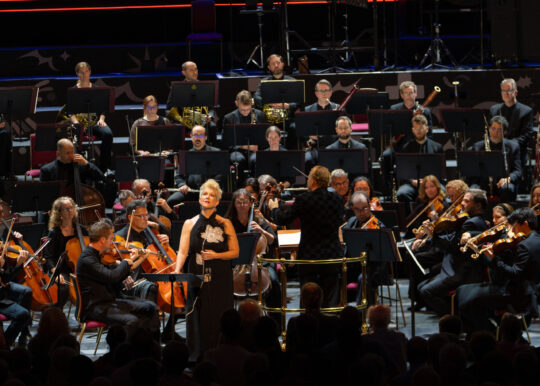
 United Kingdom BBC Proms 2026 [22] – Saariaho, Mahler: Joyce DiDonato (mezzo-soprano), The Met Orchestra / Yannick Nézet-Séguin (conductor). Royal Albert Hall, London 27.8.2026. (JR)
Saariaho – Lumière et pesanteur
Mahler – Rückert-Lieder; Symphony No.4
Finnish composer Kaija Saariaho died in 2023, so it was apposite to hear one of her very short orchestral pieces, Lumière et Pesanteur (darkness and light) to start this concert, the second by The Met Orchestra making their debut at the BBC Proms under their Metropolitan Opera music director Yannick Nézet-Séguin. The piece had been a gift to fellow Finn Esa-Pekka Salonen in 2009 and is a standalone instrumental adaptation of the eighth station from Saariaho’s oratorio La Passion de Simone. The piece explores ethereal, fragile textures before building, albeit rather briefly, into resonant brass swells. The orchestra is very large indeed and features three percussionists playing crotales (antique cymbals), gongs and vibraphone. Harp, glass chimes and celesta all add to the luminescence. It is a slow piece; a fascinating, glistening soundscape, all over in the blink of an eye (seven minutes actually).
The rest of the concert was dedicated to the music of Gustav Mahler. His Rückert-Lieder were composed just after Mahler completed his Fourth Symphony. Amazingly, each song was composed in one day and orchestrated the next day. The five songs are not of equal quality, which can probably be said of many a song cycle.
The soloist was the star American diva Joyce DiDonato, in a stunning black and diamanté dress. Her mezzo-soprano voice did not disappoint, sadly the acoustics of the hall did: much of the Royal Albert Hall could hardly hear her I suspect, and her German diction was often unclear.
The start of ‘Blicke mir nicht in die Lieder’ (‘Look not at my songs’) was unsteady to begin, it took a few bars for conductor and soloist to sync. The German – as suggested – was rather inaudible, and the song over almost before it began. ‘Ich atmet’ einen linden Duft’ (‘I breathed a delicate fragrance’) was much more successful, DiDonato relaxed and we all revelled in this more charming, fragrant song. ‘Liebst du um Schönheit’ (‘If you love for beauty’) allowed DiDonato to open up her voice which helped audibility. Her magnetic stage presence and hand movements added to her appeal.
‘Um Mitternacht’ (‘At midnight’) would have benefitted from a much larger voice than DiDonato commands. The Albert Hall is a vast space to fill and, with hindsight, Nézet-Séguin should have opted for a different programme. This concert might have been appropriate, perhaps, for a late night Prom, such was the lack of tension in much of the music. Their first Prom – all Richard Strauss – the previous night (Mark Berry’s review here) was the more energetic and forceful of their two – especially the end of Salome – and Nézet-Séguin had probably wanted a contrasting programme.
‘Ich bin der Welt abhanden gekommen’ (‘I am lost to the world’) is the most gorgeous song of the cycle, heartbreakingly, achingly beautiful. It was the music that best suited Nézet-Séguin. The opening cor anglais (Pedro Díaz) was gloriously played. Nézet-Séguin held on at the end to allow the beauty of the score to sink in before allowing applause. The audience had been rapt.
After the interval, Mahler’s Fourth Symphony: the composer described it to the German pianist and conductor Julius Buths as his ‘persecuted step-child’ of a symphony. Compared with all his other symphonies, it is small scale Mahler; without bombast, without wit, and some might say lightweight.
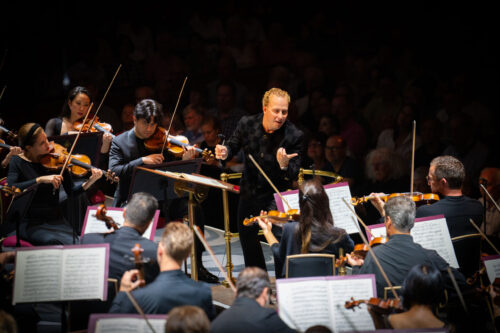
Nézet-Séguin relished the beauty which permeates the score, at the expense of the faster sections which he tended to rush. The orchestra were clearly thrilled to be on a stage rather than consigned to the pit of an opera house. I have to say that, whilst they are undoubtedly one of the top opera house orchestras, they are – taken as a whole – not really a match for a top symphony orchestra. Their principals showed they are of the highest quality but string sound was generally somewhat thin and without bloom. There was evidence of much rehearsal, so technical quality was high; there were few flaws.
Nézet-Séguin took the slow movement extremely slowly and I am afraid it reminded me of the critic who once saw a Wagner performance conducted by the late Sir Reginald Goodall at the London Coliseum when he compared the excessively slow tempi to a radio with its battery running out. The faster passages were hard to control by Nézet-Séguin after such extreme lethargy. The ending was, it must be said, achingly beautiful, a rival to the Adagietto of Mahler’s Fifth.
DiDonato, seated next to the horn section, delivered the final ‘Himmlische Leben’ in heavenly fashion, diction and audibility reasonable, top notes and slides gorgeous.
Nézet-Séguin was clearly enamoured with the Proms audience and with Joyce DiDonato and chose to end his concert with more Mahler, ‘Urlicht’ from Mahler’s Second Symphony. DiDonato rose to the occasion.
John Rhodes
Featured Image: Joyce DiDonato (mezzo-soprano) and The Met Orchestra conducted by Yannick Nézet-Séguin © Pete Scalzitti
I thought it was terrific from my choir seating area, close to the orchestra and Joyce DiDonato stunning performance.
Either I’m not a musical critic of any worth or the above review is way off the mark, I suspect the former is probably the case!