
 Germany Puccini, Tosca: Soloists, Children’s Chorus and Chorus of Theater Lübeck. Philharmonic Orchestra of Hansestadt Lübeck / Stefan Vladar (conductor). Theater Lübeck, 6.9.2026. (DM-D)
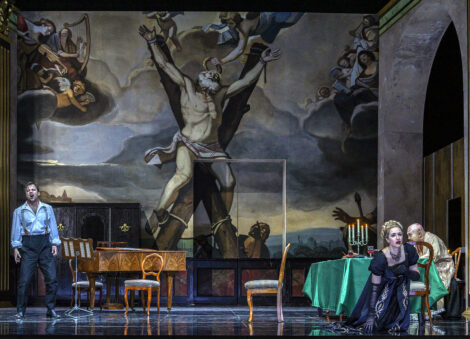
This production, by Dietrich W. Hilsdorf, who has been directing across Germany and beyond for decades, was launched at the end of Theater Lübeck’s 2025/26 season for a few performances and is now back in the repertory for the bulk of its scheduled performances. The programme provides a detailed account of the biographies of the main characters, written by Hilsdorf, based on real people of the times and moulded to fit the opera’s plot. The first act was fairly conventional, within a set and with costumes inspired by Italian history, both beautiful and functional. There was much emphasis on Personenregie, based on, or in relation to the assumed character biographies, between Tosca and Cavaradossi, Cavaradossi and Scarpia, and Scarpia and Tosca, and for the Sacristan thoroughly enjoying an occasional bite from a large sausage. This material was dense and very interesting.
Sadly, I did not understand the directorial direction from Act II onwards, and I was not keen to find out from interviews with the director or reviews based on that: events on the stage need to speak for themselves, without the help of production notes, interviews or existing discussion. At the start of Act II, the set was a vast office in Scarpia’s palace, with a table with chairs around it placed (crammed, rather) into the right-hand corner of the stage, towards the front, with the rest of the stage empty, apart from a piano also used to write on, further back but also to the right of the stage. Angelotti and Cavaradossi sat at that table right from the beginning of Act II, Angelotti to the right, Cavaradossi with his back to us, and there was a chair for Scarpia on the left. Angelotti had fresh marks of bloody torture (in addition to the older ones he already had in Act I), and Cavaradossi also showed signs of torture when he turned round enough for us to see him. Further torture happened on stage, executed by a stereotypical torturer who would not have been out of place in a black and white crime and horror B-movie – big, burly, with ill-coordinated movements, profusely sweating, with blood-stained hands that were probably never washed, filthy, matted thinning hair, and imbecile grin. He extinguished several (fake) cigarettes on or in various parts of Cavaradossi’s face and stuck two large food sticks far into his ears. Tosca’s presence at the torture events rendered some of the lines of the libretto meaningless. There was no point in her asking Cavaradossi whether they were still torturing him when she was standing next to him being tortured, and no point in his response that they were not.
The rest of the opera took place in the same environment: Scarpia remained seated where he had been stabbed by Tosca, at one point coming back to life, apparently, for a dreadful burst of laughter which briefly irritated Tosca; the soldiers who shot Cavaradossi had assembled in front of a large door into that room, which was opened wide, the shots were fired, and the doors closed again. At the end, Evmorfia Metaxaki as Tosca jumped through the closing curtain, remaining stationary in a posture with body bent at the hip, with torso and head as close as possible to the legs, with arms held out, hands on the floor, for support, all in a spotlight, which snapped off on the last bars of the music.
Fortunately, the music of this production was very good indeed. General music director Stefan Vladar approached the score with a well-judged balance of robust, elegant and emotional emphases. He also demonstrated a keen awareness of the acoustics of the venue and the needs of his singers.
Evmorfia Metaxaki’s voice impressed with very marked, clear contours. Strong breath control allowed her to engage in long legato lines; her singing was consistently beautiful across registers, and compared with other sopranos approaching this particular role, she did not place much emphasis on launching musical lines in a rather subdued mode to achieve even more attention on the crescendo bloom of the voice. Konstantinos Klironomos (Cavaradossi) has developed even more strength in the lower register since I last heard him; this allowed him to sustain the middle and higher registers of the voice with less pressure of breath and much more ease, which in turn allowed the exposed high notes to ring out in a more rounded way than before. Gerard Quinn brought many years of experience to the role of Scarpia, opting for beautiful, sonorous singing even in passages where colleagues in the role sometimes make the sounds ugly to express the character’s evil nature. The minor roles were expertly sung by further members of the resident company who would also be cast and excel in leading roles, which added to the strong overall musical side of this production.
Daniel Meyer-Dinkgräfe
Production:
Director – Dietrich W. Hilsdorf
Set designer – Dieter Richter
Costume designer – Nicola Reichert
Lighting designer – Falk Hampel
Dramaturgy – Jens Ponath
Chorus director – Jan-Michael Krüger
Children’s chorus director – Gudrun Schröder
Cast:
Tosca – Evmorfia Metaxaki
Cavaradossi – Konstantinos Klironomos
Scarpia – Gerard Quinn
Sacristan – Steffen Kubach
Spoletta – Noah Schaul
Angelotti – Changjun Lee
Sciarrone – Viktor Aksentijević
Floria – Ronja Stroh