
 United States Various: Isabel Leonard (mezzo-soprano), San Francisco Symphony / Fabien Gabel (conductor). Davies Symphony Hall, San Francisco, 8.11.2026. (HS)
Vincent d’Indy – Istar
Ravel – Shéhérazade
Debussy – ‘Le jet d’eau’
R. Strauss – Symphonic Fantasy on Die Frau ohne Schatten
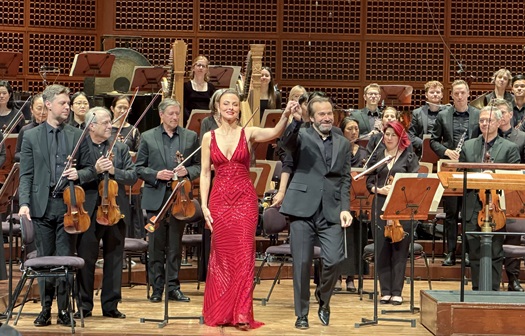
For fans of languid legato, San Francisco Symphony’s Sunday afternoon program offered the warmest of embraces. All four pieces moved at unrushed paces and created a slowly revolving kaleidoscope of orchestral color. That was most true in Ravel and Debussy songs that featured mezzo-soprano Isabel Leonard whose luxurious voice and ability to trace melodies of any length reached the sublime.
In dedicating the performance to the orchestra’s longtime conductor laureate Herbert Blomstedt, who died last week at the age of 99, bassist Stephen Tramontozzi read a sweet tribute to Blomstedt. He quoted a letter that the conductor sent him, praising the orchestra’s current excellence. Though timely, the program itself was oddly unlikely in that Blomstedt favored more serious-minded fare than this program’s suggestive narratives and lushness.
Visiting conductor Fabien Gabel, a fixture in the orchestral scenes of Vienna and Paris, made the music glow with leisurely tempos and subtle balances in Ravel’s Shéhérazade and Debussy’s ‘Le jet d’eau’. The opener, Vincent d’Indy’s Istar, and especially the closer, Richard Strauss’s Symphonic Fantasy on Die Frau ohne Schatten, expanded impressively on stories centered on the thoughts of fictional and exotic women.
The three Shéhérazade songs allude to the famous fairy tale of a captive woman who uses her wits to devise 1001 stories to stave off her sultan captor, but from a very different angle than in more well-known versions. Unlike Rimsky-Korsakov’s fascination with action, the semi-erotic, highly perfumed poetry of Tristan Klingsor explores the more sensual side of the story. Ravel applies luxurious music to the sounds and rhythmic shapes of the words.
The first song, ‘Asia’, focuses on the narrator’s obsession with visiting Persia, India and China and her desire to experience every exotic image she could mention, from floating minarets to ‘men dying of love’. Even the final line of the poem, ‘raising my old Arabian cup to my lips’, reflects the sultry way she presents her stories for the sultan more than the specifics of the tale.
Leonard found the fascination at the core of that song, and the wistfulness of the next movement, ‘The enchanted flute’, which conjures a lover’s flute from afar as she watches the sultan sleep. Associate principal flute Blair Francis Paponiu wound through the soft textures of the orchestral music sinuously. ‘The indifferent one’ completed the three songs with the narrator describing the physical, if effeminate, attractiveness of the man in her bed. Leonard laid out the vocal lines with a sort of well-tempered passion.
Debussy’s ‘Le jet d’eau’ sets a poem by Baudelaire that plays on the moonlit musings of a besotted lover encouraged by a nearby fountain. The music echoed the languor of the Ravel songs but with Debussy’s lush harmonies and textures. Leonard’s sound fit the intent perfectly.
Vincent d’Indy’s Istar, a brief tone poem on the Babylonian deity of fertility, sexual love and war, made for an appropriate orchestral prelude to the songs, even if the music was not quite on the same level.
However, the Strauss fantasy that occupied the second half of the concert harnessed the power and majesty of a fairy tale more deeply than in the preceding songs. Gabel made the music flow with depth, its climaxes coming with slow buildups instead of acceleration.
This was storytelling in German style, turning from one episode to the next in a tour of the opera’s Wagner-like score built on leitmotifs. By coincidence, it is the third recent example of fashioning big symphonic works from an opera. A new suite on Strauss’s Der Rosenkavalier headlined the San Francisco Opera orchestra’s concert last week (review here), one day after John Adams’s Doctor Atomic Symphony reached intense heights with this orchestra.
The differences are instructive. Rosenkavalier strung together generous samples of key moments where the orchestra’s music painted pictures of memorable scenes. Doctor Atomic focused on musical elements of three key moments to expand into new directions in well-developed symphonic movements.
In a way, Strauss split the difference in these approaches, focusing on the opera’s various leitmotifs that underline Die Frau ohne Schatten’s fantastical story of an emperor’s wife unable to have children until she finds her missing shadow. The music ranges from a heavy-handed opening in the low instruments to quiet passages of family goodness, a good deal more varied than the French music in the first half.
The climactic final pages were especially rewarding as they built to a towering sonic climax that showed off the thrilling sound of a symphony orchestra in full cry. The soft coda ended, as the opera does, on a satisfying and beautifully scored lullaby.
Harvey Steiman