
 United Kingdom Bernstein, Mahler: Esther Yoo (violin) Philharmonia Orchestra / Marin Alsop (conductor.) Royal Festival Hall, London. 19.11.2026. (CSa)
Bernstein – Serenade, after Plato’s Symposium
Mahler – Symphony No.6 in A minor
Leonard Bernstein was a passionate and influential champion of Gustav Mahler’s work and was single-handedly responsible for reviving it in the USA after the Second World War. He regarded Mahler, who like himself was a composer and a conductor, as something of a kindred spirit. ‘It’s like being two different men locked up in the same body,’ he once said of his muse. Such was Bernstein’s devotion to Mahler, that he reportedly had a copy of the score of the Fifth Symphony placed across his heart and buried with him – a rather poignant testament to his lifelong musical obsession with his musical hero. In Mahler’s music he doubtless found a reflection of his own spiritual restlessness and emotional extremes. Bringing them together in the same programme made for an intriguing starting point to the Philharmonia Orchestra’s concert under the baton of Marin Alsop, but affinity is one thing; equality is quite another. If Bernstein recognised something of himself in Mahler, the pairing of his Serenade, after Plato’s Symposium with Mahler’s Sixth Symphony exposed a rather less comfortable relationship between them. Bernstein’s work was thin gruel beside the Mahlerian feast that followed.
Berstein’s Serenade, after Plato’s Symposium is a five-movement meditation on love, inspired by Plato’s increasingly drunken dialogue around a dinner table with a succession of notable classical Greek philosophers and playwrights. Written in 1954, the work has moments of considerable beauty, flashes of rhythmic brilliance, and passages of West Side Story-style exuberance, but is somewhat uneven. Esther Yoo’s violin engaged skilfully in animated conversation with the strings in the first movement and continued to narrate Plato’s encounters in the demanding central sections with admirable virtuosity. She gave a wonderfully sensuous account of the Adagio, and a sprightly rendition of the jazz-inflected fourth movement (‘Agathon’) but collectively, the potpourri of musical styles employed by Bernstein, from angular neo-classical Stravinsky to lushly romantic Broadway, paled against the towering emotional and symphonic architecture of Mahler’s Sixth. Yoo’s choice of the Sarabande from Bach’s Partita No.2 provided a well-judged conclusion to the concert’s first half.
Over 100 players assembled after the interval to give a completely compelling account of a work nicknamed ‘The Tragic’, a composition of ‘monstrous dimensions’ as Mahler described it, and a curiously dark response to the happiness he experienced shortly after his marriage to Alma and the birth of ‘Putzi’ his eldest daughter, in 1902. Was he perhaps so acutely aware of the fragility of happiness, and so fearful of what he cherished most, that its shadow already haunted his music?
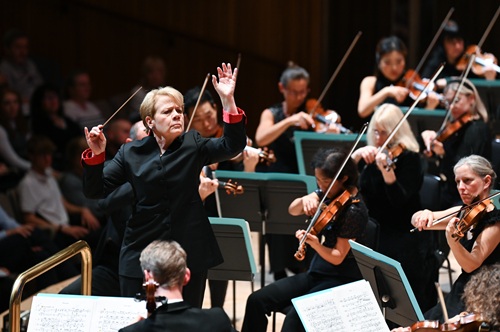
From the first bars of the opening Allegro energise, Alsop, a diminutive general in complete command of her forces, led the premonitory, relentless march of jackbooted soldiers. Seemingly prophetic in its dark foreboding, Mahler appeared to anticipate a world at war and the end of the old European order. Cutting through the militant gloom cast by the cellos and double basses, the sumptuous Philharmonia violins heroically led by Zsolt-Tihamér Visontay and backed by sensitively restrained horns and offstage cowbells, offered short-lived pastoral calm and a brief moment of euphoria in the shape of ‘Alma’s Song’ – a passionate tribute to Mahler’s new wife. The Scherzo, tense and mocking, unfurled with rumbling strings, sinuous winds, braying brass punctuated by clattering xylophone all of which added a ghoulish almost infernal quality to the movement. A radiant Andante – sweeping swathes of warm strings and Alpine pure flute playing from Samuel Coles and his colleagues offered momentary respite before the cataclysmic Finale. Alsop’s incisive, metronomic righthand beat imposed unerring precision from her players while her ever-imploring left hand unleashed passages of tremendous energy and moments of Wagnerian drama, pushing the orchestra to the limits of its expressive and technical capacity. Section balance was perfect. Gathering momentum, Alsop helped us traverse Mahler’s vast, turbulent musical landscape. Then came the two enormous and brutal hammer blows of fate, struck on this occasion by Principal Percussionist Paul Stoneman wielding a gigantic mallet. They seemed to extinguish every glimmer of hope, leaving us in a desolate wasteland of shattered dreams. And yet, as the final notes faded, the audience erupted in an ecstatic ovation. It was as if Mahler’s attempt to confront such darkness had kindled a flicker of faith.
Chris Sallon