
 United States The Beatles and Ethan Iverson (composers), Mark Morris (choreographer), Pepperland: Dancers of Mark Morris Dance Group, Mark Morris Dance Group Music Ensemble. The Wallis Annenberg Center for the Performing Arts, Beverly Hills, 16.5.2025. (JRo)
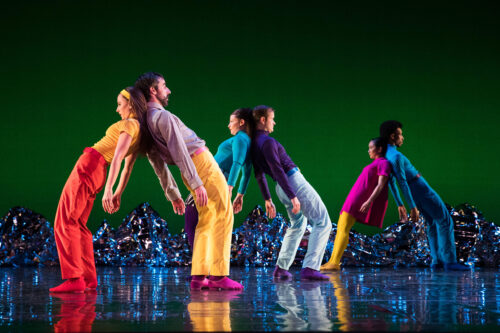
Mark Morris’s Pepperland, which premiered in 2017, commemorates the fiftieth anniversary of the release of Sgt. Pepper’s Lonely Hearts Club Band album. It is awash with color, music, light and pleasing choreography and seems to have all the ingredients for an exuberant night of dance, and yet the production feels curiously flat. The dancers beam and cavort in their sixties inspired costumes of brilliant contrasting colors that were so fashionable in the decade; but their movements often feel mechanical, never achieving the freedom that the album so explicitly embraced in 1967.
Rather than using the Beatles album, Ethan Iverson composed both original music and rifts on some of the album’s well-known pieces, evoking jazz, cabaret, ragtime and contemporary classical music. The score, as performed by an ensemble of talented musicians, is eclectic and much of it is appealing. Clinton Curtis sings with a sweet-voiced tenor, and the theremin adds the suggestion of a soprano voice to the score.
This would make for engaging listening at one of LA Phil’s ‘Green Umbrella’ concerts of new music, but as a danceable score, it creates a far more neutral mood than the subversive and buoyant melodies of Sgt. Pepper. Morris’s strict adherence to the music’s tempo and often literal interpretation of the lyrics is antithetical to the feeling of endless possibility which the album inspired in the youth of its day. Movements often have a clocklike precision: hands beat time to the music, windmill arms circle, feet march, bodies strut. In ‘Woke up, fell out of bed’, the gestures simulate the lyrics, as they often do elsewhere in the choreography.
However, as performed by the excellent company with meticulous care, there are some charming sequences. In one, dancers, facing forward, jump at a tilt with one leg bent sideways at the knee and one arm extended, reminiscent of childhood stick puppets. Morris’s ballet vocabulary is present: pirouettes, jetés and chaîné turns (albeit flat-footed) intermingle with popular dance forms. I understand his use of sixties’ dances – the twist, monkey, frug, jerk. What is perplexing is why he devotes a sequence to ballroom dance: are these the parents of sixties’ teens?
Allusions to the older generation abound (The Beatles often referenced the British Music Hall tradition). Not only does Morris give us ballroom dance, he also intersperses the Charleston, dance marathons of the nineteen-twenties and thirties, vaudevillian chorus lines and Charlie Chaplin’s Little Tramp. Unfortunately, it comes off as a bit forced, and I found myself longing for the spontaneity of Twyla Tharp, a choreographer who combines the rigor of classical ballet steps with the release of the body as it relaxes into the jazzy gestures of everyday life.
To George Harrison’s ‘Within You Without You,’ the literalness of the choreography reverberates with today’s more mainstream appeal of mindfulness and Buddhism. As a monkish figure in sunglasses sits on the floor, a male dancer behind him enacts a simulation of Tai Chi. It is very tongue-in-cheek – perhaps it is the addition of the sunglasses that seems to spoof Harrison’s lyrics rather than honor them.
The effective set design by Johan Henckens consists of a line of metallic rocks at the rear of the stage that resemble Andy Warhol’s mylar pillows deflated and battered. Vivid lighting by Nick Kolin in the bright palette of the florescent light sculptures of Minimalist artist Dan Flavin, who was active at the time of the album, is as much an aspect of the set as the rocks. Lighting turns the rocks into a moonscape and then magically into a city skyline.
Though the past was evoked in Morris’s Pepperland, there was also an off-kilter sense of the present – a present that is trying to loosen its technological chains and return to a freer time. In that sense, the nostalgia was keenly felt.
Jane Rosenberg
Featured Image: Mark Morris’s Pepperland (Boston 2019) © Robert Torres
Production:
Sets – Johan Henckens
Costumes – Elizabeth Kurtzman
Lighting – Nick Kolin
Dancers: Mica Bernas, Karlie Budge, Kara Chan, Zack Gonder, Kyle Halford, Colin Heininger, Sarah Hillmon, Courtney Lopes, Dallas McMurray, Alex Meeth, Sloan Pearson, Brandon Randolph, Robert Rubama, Christina Sahaida, Billy Smith, Joslin Vezeau, Noah Vinson
Musicians: Clinton Curtis, Jacob Garchik, Ethan Iverson, Chris McCarthy, Sam Newsome, Rob Schwimmer, Vinnie Sperrazza
I couldn’t agree more with this review!
Thanks for your acknowledgement.