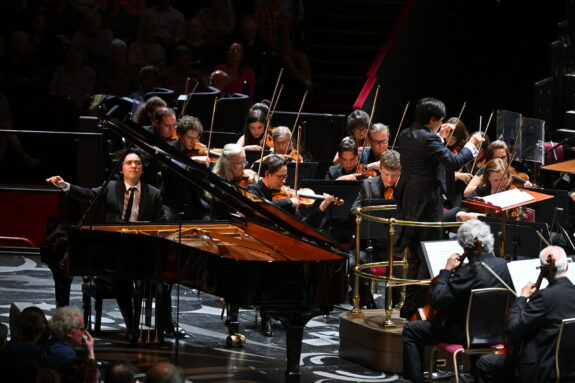
 United Kingdom BBC Proms 2025 [8] – Adams, Rachmaninov and Berio: Yunchan Lim (piano), BBC Singers, City of Birmingham Symphony Orchestra / Kazuki Yamada (conductor). Royal Albert Hall. London, 1.8.2025. (CSa)

John Adams – The Chairman Dances
Rachmaninov – Piano Concerto No.4 in G minor
uciano Berio – Sinfonia
If the first of the City of Birmingham Symphony Orchestra’s two BBC Proms was anything to go by, then rumours of the death of classical music concerts have been greatly exaggerated. In a boldly innovative and courageous programme which paired John Adams and Rachmaninov in the first half and featured a challenging work by the late modernist composer Luciano Berio in the second, the orchestra under its Chief Conductor Kazuki Yamada, held the capacity audience in the palm of its collective hand.
The main draw was undoubtedly the guest appearance of Yunchan Lim, the 21-year-old South Korean pianist and three years ago, one of the youngest contestants ever to win the coveted Van Cliburn Competition. He is an artist whose dazzling technique, emotional range and keyboard control brought exuberance and tenderness to Rachmaninov’s last, least performed, and arguably most virtuosic piano concerto – No.4 in G minor. Composed in 1926 and revised by the Russian composer no less than three times while exiled in New York City, we heard the last version written in 1941. The work bridges the sweeping ‘big tune’, Tchaikovsky-inspired romanticism of the earlier concertos and the jazz-infused modernism of 1920s America. After its first performance in 1927 (Stokowski conducting the Philadelphia Orchestra and Rachmaninov as soloist) one critic, lamenting the absence of the composer’s trademark melodic flow, wrote ‘Mr Rachmaninov seems to look backward and forward at the same time’.
Lim brought a nervous syncopated energy and lean angularity to the opening Allegro, although the underlying musical evocation of a bustling Manhattan was not enhanced by the intrusion of a rogue fire alarm. Despite a 5-minute interruption between the first two movements while the wretched device was silenced, Lim remained confident and composed. He had no difficulty investing the lush, reflective Largo with stunning lyricism and an almost improvisational freshness. A finely balanced conversation between piano and orchestra ensued in a fiery – but mercifully fire alarm free – finale. Here, Lim’s fleet finger work made light of the fiendishly difficult middle section and brought rhythmic clarity and Gershwin-meets-Prokofiev energy to the dramatic last passages. A standing ovation from those not already standing was inevitably rewarded with an appropriately chosen encore: ‘Die Schönste Nacht’ (‘The Most Beautiful Night’) from Erich Korngold’s operetta The Silent Serenade.
If Rachmaninov’s late Romanticism compelled him to look backwards in his last piano concerto, John Adams’s 1985 post-minimalist composition The Chairman Dances which opened the concert, moved only in one direction: forwards. An offspring of his opera Nixon in China, this musical interlude is subtitled ‘Foxtrot for Orchestra’. It propels the listener on a dreamlike journey through Nixon’s 1972 Presidential visit and an occasion when Mao and his wife – former movie actress Jiang Qing – danced together. Under Yamada’s steady baton the orchestra gave a vivid, rhythmically compelling reading; a slow, mechanised build-up of strings, brass, and winds, and a fully stocked repository of percussion. This included witty contributions from a shimmering vibraphone and a jazzy xylophone to conjure up a louche night club atmosphere, and shuffling sand blocks to depict the couple’s slinky decadence.
After the interval, the orchestra was joined by eight members of the BBC Singers for a rare performance of Luciano Berio’s Sinfonia, commissioned by the New York Philharmonic in 1968 and dedicated to Leonard Bernstein. Variously described as ‘a cubist painting in motion’, or ‘a collage of Western music, literature and thought’, orchestra and amplified voices are woven, like fragments of musical and literary memory, into a five-movement symphony of ideas. Snippets of text from anthropologist Claude Lévi Strauss’s book The Raw and the Cooked, extracts from Samuel Beckett’s The Unnamable and references to the actual performance in which John Adams, Kazuki Yamada and the CBSO were all whispered, murmured or intoned are interlayered with familiar musical citations. After a mystical, floating introduction, a sighing, mournful second movement laments the assassination of Martin Luther King, while the third reproduces passages from the Scherzo of Mahler’s Symphony No.2, with a kaleidoscope of quotes from works by Debussy, Ravel, Stravinsky, Stockhausen, Ives and Boulez. In the much quieter and more meditative fourth and fifth sections, music and words seem to dissolve, ultimately fading into silence. The CBSO and Yamada gave a grandly cohesive and poetic performance of this intellectually elusive, intellectually and musically complex work. Yet their greatest achievement was to capture the unbroken and respectful attention of concertgoers, and to prove that despite bleak predictions, classical music is alive and well.
Chris Sallon