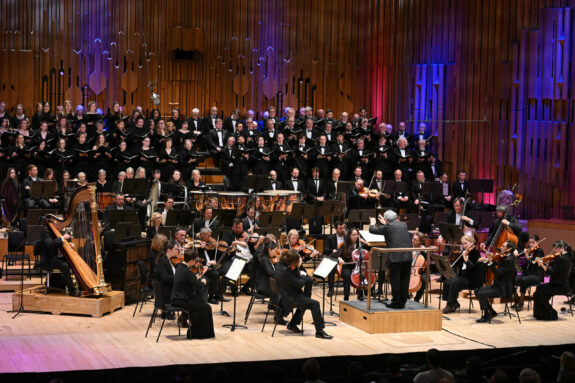
 United Kingdom Tchaikovsky, Vaughan Williams: Antoine Tamestit (viola), Julia Sitkovetsky (soprano), Ashley Riches (bass-baritone), London Symphony Chorus (chorus director: Mariana Rosas) and London Symphony Orchestra / Sir Antonio Pappano (conductor). Barbican Hall, London, 7.12.2025. (KMcD)

Tchaikovsky – Symphony No.4
Vaughan Williams – Flos Campi for Viola & Chorus; Dona nobis pacem
Sir Antonio Pappano returned to the London Symphony Orchestra in the Barbican Hall with a programme that placed Tchaikovsky’s Fourth Symphony before the interval, followed by two works by Vaughan Williams that could hardly be more different in character: the elusive inwardness of Flos Campi and the raw public protest of Dona nobis pacem. With Antoine Tamestit as viola soloist and the London Symphony Chorus joined by soprano Julia Sitkovetsky and baritone Ashley Riches, the evening was shaped as a journey from personal fate to collective conscience.
Tchaikovsky’s Fourth Symphony made an immediate and emphatic opening statement. The notorious brass fanfare, the embodiment of what the composer described as the inescapable force of fate, was delivered with searing precision and granite authority, the LSO’s brass on formidable form from the outset. Pappano set out his stall immediately with a reading that favoured tension over rhetorical display. There was little indulgence in sweeping gesture; instead, the argument was driven forward with firm grip and an unsentimental edge.
The first movement’s long span held together convincingly, its moments of lyrical release never allowed to dissipate the underlying unease. The Andantino unfolded with a quieter, more reflective air, the woodwind principals shaping their solos with natural, unforced eloquence. Pappano resisted the temptation to lean too heavily on the movement’s melancholy, keeping the line pliant and flowing. The Scherzo, with its famously athletic pizzicato writing, was dispatched with clarity and sparkle, the interplay between strings, winds and brass finely judged. In the finale, Pappano unleashed the music’s kinetic energy with controlled exuberance, the entire orchestra – and once again the brass in particular – sounding both fearless and scrupulously secure, the triumph at the close carrying just enough shadow to avoid sounding merely celebratory.
After the interval, the change of atmosphere was immediate. Vaughan Williams’s Flos Campi, inspired by the Song of Songs and scored for viola, small orchestra and wordless chorus, remains a peculiarly hard work to place. Neither concerto nor cantata, it unfolds as a sequence of brief, inward meditations. Pappano approached it as a continuous flow rather than a set of disconnected panels, allowing its modal harmonies and shifting textures to speak with quiet assurance.
Antoine Tamestit proved a compelling presence at the centre of the work. His playing combined warmth of tone with a focused, inward intensity, the viola line unfolding with a vocal quality that felt entirely natural in this context. The London Symphony Chorus, integrated discreetly into the overall sound, sang with refined blend and impressive restraint, their sound hovering around the instrumental texture rather than projecting outward. The result was a performance that favoured atmosphere over overt statement, allowing the work’s enigmatic character to remain intact.
Where Flos Campi turns inward, Dona nobis pacem addresses the world head-on. Written in 1936, as war once again loomed over Europe, it remains one of Vaughan Williams’s most uncompromising responses to human conflict. The initial plea for peace was sober rather than overtly emotive, though Sitkovetsky’s exposed opening entry carried an edge of strain and unsettled intonation that momentarily jarred against the stillness of the choral writing. That restraint only heightened the shock of the central sections, where the orchestra dug sharply into the rhythmic writing and the brass tore through the texture with raw force.
Riches brought weight and clarity to the baritone solos, his delivery firm but never hectoring, shaping Walt Whitman’s lines with focused authority. Sitkovetsky, once past her uneasy opening, settled into the score with greater security, her brighter tone cutting cleanly through the choral fabric. The chorus, under their director Mariana Rosas, excelled in the long, exposed lines of the Whitman settings, combining clarity of diction with sustained intensity and impressive control across the work’s broad dynamic range.
Pappano sustained the long arc of Dona nobis pacem with unerring command. The return to the opening plea for peace at the close of the work did not offer easy comfort. Instead, it felt worn, hard-won and painfully unresolved, the silence that followed charged with meaning.
Across the evening, the programming proved more than a simple sequence of orchestral showpieces. Tchaikovsky’s struggle with fate, Vaughan Williams’s inward mysticism and his public outcry against war formed a coherent emotional trajectory. The LSO played throughout with authority and refinement, with every section contributing at the highest level, while the London Symphony Chorus, under Rosas’s direction, brought both precision and weight to the second half.
At the centre of it all was Pappano, conducting with a balance of urgency and restraint that allowed each work to speak in its own voice while still contributing to a larger narrative. It was an evening that demonstrated how thoughtfully shaped programming, allied to high-calibre performance, can resonate for a long time after the final notes have faded.
Keith McDonnell
Featured Image: Violist Antoine Tamestit and London Symphony Chorus and Orchestra conducted by Sir Antonio Pappano © Mark Allan