
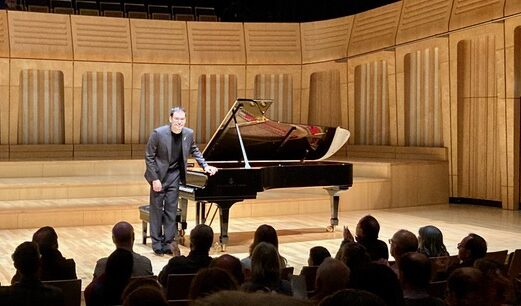
 United Kingdom Schubert, Chopin, Liszt: Alim Beisembayev (piano). Royal Welsh College of Music and Drama, Cardiff, 29.3.2026. (LJ)
Schubert – Moments Musicaux, D780 (1823-28)
Chopin – Fantaisie in F minor, Op.49 (1841)
Liszt – Sonata in B minor (1853)
Alim Beisembayev erupted onto the world stage winning First Prize at The Leeds International Piano Competition in 2021 and then stepping in for an unwell Ben Grosvenor with just two days’ notice to play Rachmaninov’s Second Piano Concerto at the 2023 BBC Proms. His debut recording Liszt: Transcendental Études came out in 2022 with Warner Classics, receiving widespread critical acclaim. At Cardiff’s Royal Welsh College of Music and Drama (RWCMD), Beisembayev continued to turn heads with his performance of works by Schubert, Chopin, and Liszt for the Steinway International Piano Series. Pleasingly, this Sunday morning concert attracted a good number of local music afficionados.
All three pieces performed during this concert were composed within a twenty-five-year period during the first half of the nineteenth century. During this time, Romanticism was entering its late period with Delacroix painting Liberty Leading the People (1830) and Alexandre Dumas writing The Count of Monte Cristo (1844-46). Romanticism’s influence across Europe was significant and, importantly, the genre was morphing into a darker form. Fittingly, Schubert’s Moments Musicaux, D780 (completed in 1828), Chopin’s Fantaisie in F minor, Op.49 (1841), and Liszt’s Sonata in B minor (1853) each share moments of introspection and boldness that offer a distinct contrast to some of the more pastoral sensibilities associated with earlier Romantic work.
Liszt once said of Schubert: ‘Such is the spell of your emotional world that it very nearly blinds us to the greatness of your craftmanship.’ In the Moments Musicaux this combination of profound emotional depth and technical craft can be demanding for any pianist.
Of the six late-Schubert pieces, Beisembayev’s performance of the fourth (Moderato in C-sharp minor) was most memorable. He captured the contrapuntal texture of the movement and played the melodic lines with a softness and lightness (thanks to excellent use of the left pedal) that evoked Scarlatti’s keyboard sonatas. In his interpretation of the sixth movement (Allegretto in Aflat major), Beisembayev channelled the utter Schubert-ness of it all. The movement is lyrical, contemplative, melancholic. Above all, it has a song-like quality. This was evoked beautifully by Beisembayev whose pacing was not too slow, allowing for an inner peace to rise out of the sense of suffering.
Across the six movements, commitment and imagination could be felt behind each note and phrase. Whilst Beisembayev played with incredible attention to detail, he did not lose sight of each piece’s overarching theme. This level of playing was extremely impressive.
Chopin’s Fantaisie in F minor is a single-movement work, which he composed when he was 31 years old. At the time, Chopin was staying with Georges Sand at her country estate in Nohant, south of Bourges, where he could escape the hubbub of Paris life. The Fantaisie begins with a solemn marching theme before diving into a passionate section filled with triplets and octaves, which has a greater sense of agency and might. It concludes via a march-like codetta theme. As a whole, the piece, like some of Chopin’s ballades, allows scope for improvisation and stretches the sonata form on which it was based. Here, Beisembayev was in complete control of his sound. His interpretation was original, with a heightened sense of drama and introspection – key elements of this work and representative of Chopin’s tendency to write pieces that contain a range of metres, keys, and tempi.
Liszt’s own reputation as a pianist has not been surpassed, with Brahms declaring: ‘Whoever has not heard Liszt cannot even speak of piano playing.’ How we must all wonder what it would have been like to hear Liszt move through the transformations of the three opening themes of his Sonata in B minor.
Performing Liszt’s Sonata demands confidence and a degree of bravery. It is 30 minutes of music that exposes the soloist through its technically difficult passages. Playing the sonata requires both a transcendental approach to the music and a steely focus from the off, with the sinister fragmentary opening notes and so-called ‘Gypsy’ scale. When introducing the sonata for his masterclass at the Royal Academy of Music in 2020, Brendel called it ‘the greatest piano sonata ever written after Beethoven and Schubert’.
Beisembayev, playing slowly into the keys for those opening notes, created a soft, almost timpani-like sound. Later, this sinister ember sparked into roaring flames. He was particularly skilful when foreshadowing the coda in Liszt’s sonata. Here, Liszt revisits the opening Lento assai motive, the ‘hammer-blow’ theme, and introduces a final stretto of octave passages before ending in B major. Throughout the piece, Beisembayev hinted at what would be a hard-won moment of repose, extracting tension and maximising the rich complexities within the score.
At twenty-nine minutes, Beisembayev played the sonata on the faster side. This worked well with his artful manipulation of tensions through his percussive left hand and gaping pauses. Technically, Beisembayev was brilliant. His left hand was steady, even at speed, and his control was evident in his perfect tempo.
Upon leaving the RWCMD, I walked into the city centre; a few steps behind me, a fellow audience member whistled melodies from Liszt’s sonata the entire way. Is this not evidence of an unforgettable performance? Indeed, Beisembayev gave all in attendance a Sunday morning that would be nigh-on impossible to top. I hope that he will return to Cardiff to play for us all again, and, if I can express a preference, Schubert’s Impromptus and Scarlatti’s sonatas would be at the top of my list.
Lucy Jeffery