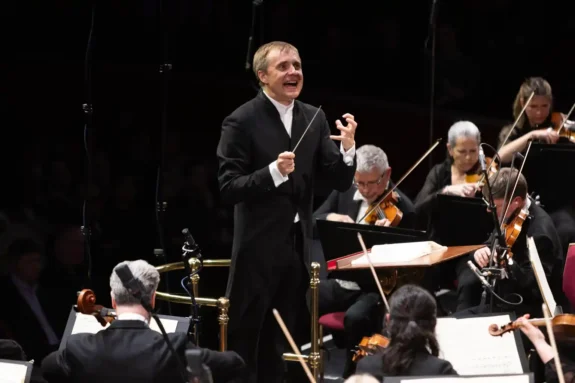
 United Kingdom Mahler: Royal Philharmonic Orchestra / Vasily Petrenko (conductor). Royal Albert Hall, London, 18.3.2026. (AV-E)
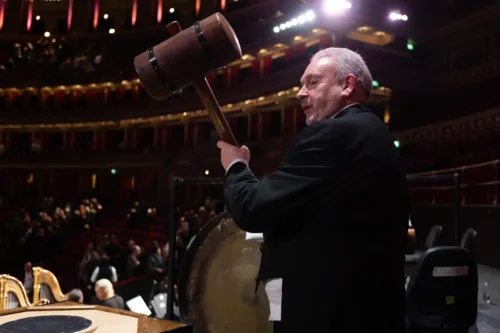
Mahler – Symphony No.6 in A minor, ‘Tragic’ (1903-4)
I was really looking forward to listening to the eminent Vasily Petrenko conduct the prestigious Royal Philharmonic Orchestra in Mahler’s Sixth Symphony only to be dreadfully let down by the vacuous acoustics of the cavernous Royal Albert Hall: demonstrably the worst venue in the world to hear this music. Despite sitting relatively close up to the stage the orchestra sounded somewhat distant whilst the strings were swamped by the brass and percussion which in turn were rather remote as well. The RAH management have been working for decades to eliminate this ‘double echo’ by hanging 85 fibreglass ‘mushrooms’ (or ‘flying saucers’) acoustic diffusers from the ceiling and yet because of the sheer colossal size of the hall it still makes it impossible to eradicate this awful after-echo effect.
Petrenko sprightly paced the Allegro energico never indulging in the customary slowing down in the quieter passages but kept things marching on which subsequently gave the ‘Alma theme’ (the soaring, romantic second subject) a sense of urgent, desperate yearning rather than the usual melancholic meandering.
Petrenko had a masterly control of his huge forces with exemplary orchestral balancing. Yet the orchestral detail was often swallowed by the mud-caked acoustic; for textures became etiolated and opaque; what should have been a rich, gritty tapestry was bleached out, leaving the inner woodwind parts shrouded in a sonic fog.
Following the hypermania of the first movement, the Andante arrived not as a mere rest, but as the emotional anchor of the performance: this was by far the most moving moment of the evening. The swooning strings played with a striving intensity that avoided even a hint of the cloying schmaltz which conductors such as Bernstein and Tennstedt tended to milk dry.
Instead of indulging in heavy vibrato, Petrenko maintained a sturdy stroll and an ambling pulse that allowed the melody to unfold with an organically ordained fashion. It was a profoundly moving reading, proving that true pathos comes from subtle restraint rather than milking emotion. The off-stage cowbells — which Mahler intended as the ‘last earthly sounds’ — adroitly added to the sense of remote, haunting isolation that the cavernous acoustic actually managed to enhance for once.
The schizophrenic Scherzo surfaced as a sharp, caustic puncture to the subterranean stillness of the Andante, systematically dismantling any lingering ‘innocence of childhood’ mythos with a forensic Freudian eeriness. This was no light-hearted romp of children at play; it was a predatory dance and a furtive fondling that unearthed the primal, repressed sexual impulses lurking beneath a deceptively ‘playful’ surface. The voices of this creepiness lay in the woodwind section, which at last emerged with a venomous, biting presence. Their cries and grunts were twisted into the nervous, emaciated lines of an Egon Schiele portrait — all jagged edges and exposed nerves and twisted bodies. There was a macabre energy in the way the bassoons and oboes cackled through the texture, their morbid mocking wit molesting the attentive audience. For me, the woodwinds were the messengers of the children crying out after being ill-treated by their ‘loving’ parents.
In the vast architecture of the final movement, the Royal Albert Hall truly began its campaign of architectural sabotage. Petrenko’s structural grip was unwavering; he navigated Mahler’s sprawling, thirty-minute narrative with perfect pacing, ensuring the tension never slackened even as the orchestration reached its most volcanic vivaciousness. The RPO’s internal balance was masterfully handled on the stage, yet the British bulldog of a building refused to let such precision stand alone.
It was not only the hammer blows to come that were to be struck twice: I also heard certain brass punctuations twice, as a sort of ‘echo encore’ like a faint repeat. Mercifully and paradoxically, the two hammer blows did not reverberate; their blunt, bone-shaking thud remained anchored to the stage, sealing their mark with a singular and terrifying finality that the cavernous acoustic failed to hijack. However, the soaring trumpet fanfares and tectonic trombone blasts were hijacked by the vapid Victorian dome. This reverberation didn’t just linger; it mocked. Every sharp, rhythmic gesture from the RPO brass was caught and flung back from the gallery at the back as a ghostly, etiolated imitation. This ‘echo encore’ created a cluttered, disorienting dialogue that Mahler never intended, effectively doubling the ‘tragic’ impact while simultaneously thinning out the transparency of the sound.
Despite this acoustic assault, the structure was held together by Petrenko’s iron-fisted control. Even as the hazardous hall attempted to drown the music in its own reflections, the sheer power and rhythmic integrity of the RPO managed to punch through the opaque mid-ground. It was a performance of immense structural brilliance, unlike the structure of the building that stubbornly insisted on having the last note. Sadly, the quiet coda was cancelled by an uncouth cough: I hope the recording engineers can edit it out as it was an act of pure vandalism: patrons should be asked to silence their contagious coughs as well as their moronic mobile phones.
As a performance of formidable power and emotional depth, Petrenko and the RPO delivered a devastatingly defiant account of Mahler’s Sixth which was truly ‘Tragic’ after its tireless wrestling with such stultifying and negating acoustics.
Alexander Verney-Elliott
Featured Image: Vasily Petrenko conducts the Royal Philharmonic Orchestra © Frances Marshall
I was there that night in the side stalls and thought the acoustics were fine. The reviewer obviously has it in for the RAH sonics and keeps and ramming it down our throats so we don’t forget it. If you don’t like it there don’t go…or sit somewhere else. Reading this article reinforces my dislike of too-clever-by-half music critics. Glad he actually liked the performance (seemingly of secondary importance) notwithstanding the assault on his ears.
The Andante is one of the most gorgeous, beautiful slow movements in all classical music. The reviewer also takes issue with great Mahlerians like Tennstedt and Bernstein treating it like ‘cloying schmaltz’. If that’s the way they chose to interpret it (certainly not cloying schmaltz) then who are you to patronize these towering figures? Thank goodness I wasn’t sitting next to you on the night.
[Edited]
Are you quite sure you were there? It is perplexing that you found the acoustics ‘fine’ from the side stalls where we were both sitting. I can only surmise that you interpreted the brass echoes at the back of the hall as an off-stage band, along with the cowbells we both heard. While Mahler was fond of such off-stage effects, one usually expects them to be notated in the score rather than reverberated in echoes off the back of the concert hall.
As for the Andante: it is indeed one of the most gorgeous slow movements in the repertoire, which is why I dislike hearing it pulverised into the pulp-kitsch of Mantovani’s ‘sentimental strings’, aided and abetted by Bernstein and Tennstedt. We are indeed lucky we weren’t sitting together; I suspect we may have fallen in love.
Tony, I totally agree with your comments. I too was in the side stalls and the acoustics were fine. Also I had the RAH tour before the concert and had the privilege of watching and listening to the RPO in rehearsal at several levels of the auditorium, the acoustics were superb. Most of the tour attendees weren’t familiar with Mahler, let alone the Mahler hammer, but were transfixed by the performance and acoustics.
I’m afraid I have to agree with Alexander Verney-Elliot. An excellent performance ruined by the cavernous acoustics of the RAH. And I had very good seats.
I’ve heard both Tennstedt and Haitink live at the Royal Festival Hall. A very dry acoustic but at least I felt the impact of the orchestra.
As a general observation, London does not have one acoustically good orchestral venue. The RAH (echoey and too big), the RFH (dry), Cadogan Hall (too small and overwhelmed by large orchestral pieces), Barbican Hall (a dual purpose venue for concerts and conferences with a muffled sound, dry and inconsistent acoustic). If you want good acoustics in the UK try Birmingham Symphony Hall or Bridgewater Hall in Manchester. Or abroad try the Vienna Musikverein or Amsterdam Concertgebouw. Then you’ll know what you’re missing.
I agree with Tony. I was sitting in left hand side stalls, area H. No echo there, but I’ve heard it previously (in Klaus Mäkelä’s Berlioz, unfortunately).
I’m sure there are better seats than the reviewer was given. Keep trying!
After doing some scientific research, I now totally believe Nick and Tony.
The Royal Albert Hall’s elliptical geometry creates highly specific acoustic focal points where sound waves converge after reflecting off the dome. Because sound travels at approximately 343 metres per second, even a marginal shift in seating position — literally a matter of two or three feet — drastically alters the arrival time of these reflections (echoes).
The entire difference between hearing and not hearing an echo often comes down to a tiny temporal window. If my coordinates placed me at the exact convergence point where the reflected wave arrived more than 50 milliseconds after the direct sound, my brain would cross the Echo Threshold and perceive a distinct, distracting ‘slap-back’.
In contrast, you guys were likely benefiting from Temporal Masking and the Haas Effect. Because you were slightly offset from that specific focal beam, the reflections reached you within the integration window, allowing your auditory cortex to fuse the sounds into a single, clear signal. It turns out acoustics at the Royal Albert Hall can be incredibly localised due to this oval shape; it’s common for sound clarity to shift significantly even within the same row.
Since I’m usually at the mercy of wherever the press tickets are allocated, I don’t get much say in the matter, but it’s fascinating to realise I was just in a specific ‘hotspot’ that the rest of you luckily missed.
It’s been a real learning curve for me — who knew a few feet could make such a difference in hearing and not hearing an echo! I’ll definitely be keeping this in mind for my future reviews.
Thank you. Alexander Verney-Elliott
A word from a fellow S&HI reviewer in the states: Yes! A few feet can make a wild difference. There is one spot in Heinz Hall in Pittsburgh that turned Sibelius’s 2nd Symphony into a trumpet concerto one time when I attended a performance there years ago conducted by Mariss Jansons. I don’t remember the exact seat, but it was at the curve of the balcony, which just happened to focus the trumpet section’s sound there as a resonance point. If I ever review anything there, I’ll have to remember that spot and avoid it like the plague, because Sibelius’s Trumpet Concerto is not nearly as good as his Symphony No.2. I’m lucky these days, because the press seats for the Cleveland Orchestra are consistently pleasing to the ears. Good luck at finding the sweet spots!
Mark in Ohio
The RAH is not my favourite venue either but, following years of experience, I usually sit in the side stalls opposite the basses. This week I was upstairs in the third row of the circle. It sounds a little distant up there but for Mahler 6 it’s fine. By the time the sounds reaches there, it’s nicely balanced. The performance was excellent! I find in certain seats in the Barbican Hall I hear staccato chords bouncing off the wall, so it’s not just the RAH.