
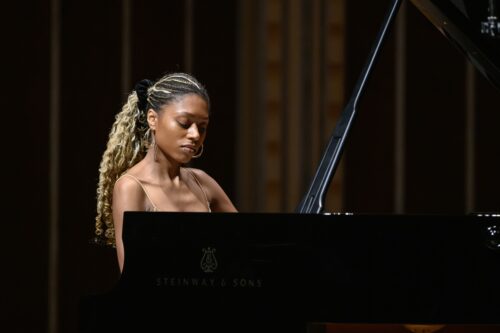
 United States Beethoven, Ravel, Tabakova: Isata Kanneh-Mason (piano). Mandel Concert Hall at Severance Music Center, Cleveland, 17.3.2026. (MSJ)
Beethoven – Piano Sonata No.14 in C-sharp minor, Op.27, No.2, ‘Moonlight’; Piano Sonata No.21 in C major, Op.53, ‘Waldstein’
Ravel – Gaspard de la Nuit
Dobrinka Tabakova – ‘Nocturne’, Halo
Encore: Prokofiev – ‘Harp’ Prelude
After her cellist brother Sheku Kanneh-Mason was incapacitated by a finger injury, Isata Kanneh-Mason retooled their planned duo recital at Severance Music Center into a solo piano showcase, with an emphasis on virtuoso works organized around the progression from nighttime into daylight. She certainly demonstrated her technical prowess, though with varying musical results.
The most potentially hackneyed work on the program was the opener, Beethoven’s famous ‘Moonlight’ Sonata, but Kanneh-Mason’s approach to it was refreshingly free of swooning mannerisms, the opening movement broadly but steadily charted. The characteristic dotted-note rhythm of the main theme was played as written, without any emotive distention, unlike the majority of pianists who play it today. This reserved approach put emphasis on the through-line of Beethoven’s music, reminding the listener why it became so famous in the first place: its harmonic ingenuity, combined with an evocative wash of sounds, brought out in Kanneh-Mason’s careful pedaling and more sophisticated than the general wash the composer indicated. The second movement had a contrasting lilt that didn’t linger, allowing the pianist to quickly launch into a hurtling finale. Kanneh-Mason’s emphasis on velocity didn’t allow for a wide dynamic range, but her reserved approach to attacks worked at that fleet speed.
The highlight of the program came in Ravel’s delightfully creepy Gaspard de la Nuit, though it didn’t get there immediately. Kanneh-Mason’s first movement, Ondine, portraying a gorgeous but malevolent water nymph, was very fine but had the disadvantage of coming just a few months after Marc-André Hamelin’s magnificent recital in the Tuesday Musical series at E.J. Thomas Hall in Akron. Hamelin, arguably the world’s most sophisticated keyboard technician, brought an extraordinary sense of touch to Ondine in that recital, almost seeming to send waves of mist out of the piano. Kanneh-Mason wasn’t quite that ethereal, never dropping to the barely audible hush that Hamelin summoned.
But it wouldn’t do to underestimate the young British pianist because her performance caught fire – a controlled, smoldering fire – in the second movement, Le Gibet, portraying a hanging body silhouetted by the final flares of a setting sun. Whereas Hamelin’s approach to this movement was subdued and kept restlessly pressing forward, Kanneh-Mason played it more psychologically, making the repeated tolling bell note a nagging and needling gesture, but one that was utterly unable to rush the implacable pace. The buildup of tension was palpable, even managing to reduce a wintertime Cleveland audience to spellbound silence. That proved a perfect setup for the final movement, Scarbo, a picture of a demonic imp who proved as witty as wicked. Kanneh-Mason’s tempo was hellbent, leaving even Hamelin behind in the dust. She brought the last major climax right to the edge of explosive volume, cutting off phrases in the closing pages in a way that made the pauses almost unbearable. Then, with a wink, Scarbo was gone, and the ovation was explosive.
In the second half of the program, we heard two works by the young Bulgarian/British composer-pianist Dobrinka Tabakova, starting with a brief but appealing nocturne from 2008 that brought minimalist patterns to the traditional, early-romantic genre piece. It was followed by Tabakova’s three-movement Halo (1999) which continued the program’s gradual shift from darkness to daytime. The first movement made extensive use of harmonics, where the pianist would silently depress some keys on the lower end of the keyboard, then strike staccato notes or chords higher up, which caused the harmonics (high sympathetic resonances) of the lower notes to ring out. The same effect was heard last season in the strange and haunting piano sonata by Geirr Tveitt played by Lief Ove Andsnes. The effect here was to create a bright, shimmering halo of sound, followed by an evocation of blinding sunshine in the second movement. The third movement settled into a peaceful glow, with a brief callback to the opening harmonics at the end. The piece was well-received by the audience.
The program’s official closer was Beethoven’s brilliant ‘Waldstein’ Sonata, but Kanneh-Mason’s emphasis was almost relentlessly on the virtuoso aspects, missing the work’s true stature. The first movement, for instance, is marked Allegro con brio (‘fast, with vigor’), not presto (‘extremely fast’), but Kanneh-Mason’s tempo was close to the upper end of what is playable. As a result, the emphasis was on fingerwork, missing the sheer joy of harmonic alchemy that Beethoven finds in these combinations of chords and scales. The slow movement was better, capturing a singing line that pulled the music onward to the connected finale.
Alas, this movement proved to be another exercise in fast note-spinning. It is marked by Beethoven Allegretto moderato. The first word eases back the term allegro to ‘somewhat fast,’ and then the composer further modifies it with moderato, which means exactly what it sounds like. When played spaciously, it is one of the most wondrous and enchanting things anyone ever wrote. Kanneh-Mason instead chirped right into a sprightly tempo, evidently only interested in showing how fast she could play the wide-ranging ripples of the accompaniment. This tempo also prevented the use of as much sustaining pedal as Beethoven calls for (though no performance on a modern concert grand can leave the sustaining pedal down the way the composer directed, an effect which only works on a period fortepiano or an Erard grand). Kanneh-Mason’s tempo was so quick that there was little room for acceleration in the prestissimo coda. Though the sonata is sometimes known in France as ‘L’aurore’ – the dawn sonata – the performance was far too ‘high noon’ the whole way through.
The vast majority of the audience, however, was quite pleased and brought Kanneh-Mason back for an encore, a delightful performance of Prokofiev’s ‘Harp’ Prelude which she played with charm and élan.
Mark Sebastian Jordan