
 United Kingdom Cambridge Music Festival 2026 – Ligeti Piano Studies: Danny Driver (piano). Fitzwilliam College Auditorium, Cambridge, 10.3.2026. (CC)
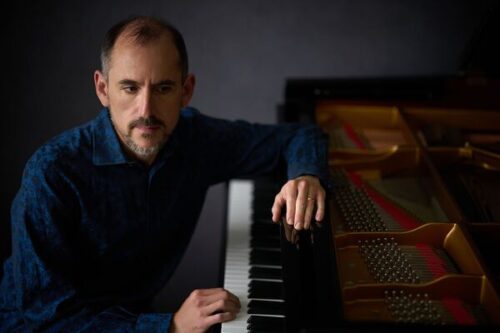
Ligeti – Études pour piano, Books 2 & 3: White on White (Book 3); Galamb Borong, Fém, Der Zauberlehrling (all Book 2), Désordre, Cordes-à-vide, Touches Bloquées, Fanfares, Arc-en-ciel, Automne à Varsovie (Book 1); Pour Irina (Book 3), Entrelacs, L’escalier du diable (both Book 2); Musica ricercata
Already the Cambridge Music Festival has featured a complete Bach 48 from Boris Giltburg at Trinity College Chapel (February 20), a concert exploring Arabic tradition alongside English folk (February 24, Pembroke College), and Ute Lemper’s Berlin Cabaret (Corn Exchange). Now it was the turn of pianist Danny Driver, presenting Ligeti Études alongside Musica ricercata at Fitzwilliam College. The Festival will continue with the Takács Quartet in Haydn, Beethoven and Clarice Assad at West Road on March 23, and closes with the Colin Currie Quartet in music by Reich, Julia Wolfe and Andy Akiho at West Road on March 27. A few pieces by Assad have previously impressed – the trumpet concerto Bohemian Queen, and The Book of Spells – so the Takács Quartet concert most certainly appeals …
It was heart-warming to see a capacity audience at Fitzwilliam for an all-Ligeti event, and real enthusiasm for his music. That enthusiasm shone from Danny Driver, too, who introduced the music (not overlapping too much with Joanna Wyld’s excellent programme notes). Long the territory of Pierre-Laurent Aimard, for whom several of the Études were written, Driver brings his own signature to the music, often softer. And yet Driver can rise to challenges of technique (L’escalier du diable in particular) and himself can offer real power (the piano at Fitzwilliam did sometimes seem to struggle to keep up in this regard!).
If one was new to the Ligeti Études (or indeed, Ligeti), Driver’s introductions were perfect; but they held much of use for the seasoned listener, too, with core traits identified (differing sets of material for each hand, sometimes complementary; or a tendency for the music to spiral out of control, and so on). The opening ‘chorale’ of White on White from Book 3 was at once touching and an acknowledgement of his spareness of much of the third and final book (which Ligeti never completed, alas). The music of this Étude shifts to toccata suddenly (unfortunately, some definition in the lower part of the keyboard was lost; the instrument, I suspect, not the performer). The piece does contrast nicely with Galamb Borong from Book 2 (the title translates from Indonesian as ‘melancholic pigeon’). Plenty of cross-handed playing here, but most importantly, Driver caught the gamelan aspect to perfection, not to mention the idea of ‘clouds’ of notes.
Fém means ‘metal’ in Hungarian; the Étude follows on from Galamb Borong in the original sequence. Driver presented this as the ‘scherzo’ of the set, more active and unpredictable than in his Hyperion recording, and even more jittery, enabling the post-Scriabin chords that follow to emerge with maximal expression. Skipping Vertige, this set of studies ended with Ligeti’s sorcerer’s apprentice (Die Zauberlehrling), a study in stuttering repeated notes, perhaps a Rückblick to the Baroque (Scarlatti Sonata in D minor, K.141/L.422?).
Written between 1951 and 1953, Musica ricercata takes us to early Ligeti. Again, Driver explained the music well, including of course the core concept that it starts from a concentration on two notes, and adds a note per movement. In fact, the first piece is mainly on one note with the second added right at the end. A nice metaphorical raised eyebrow from Driver in performance, too, when the second note finally appeared. One feels the freedom to move from the founding note in the second piece, very evenly delivered before the more helter-skelter Allegro con spirito third, spiky and with a hint of fanfares, before the off-kilter waltz appears, like a malfunctioning foreground organ. Perhaps the most powerful movement was the fifth (Rubato. Lamentoso), barren and yet full of ‘teasings’ one might hear in late Ligeti. Certainly the jaunty sixth contrasts with the extraordinary seventh, where Driver’s super-even left-hand sounded against a poignant, post-Bartók high-hand cantabile. Open intervals brought a bright and breezy eighth before the extraordinary ‘In Memoriam’ to Bartók of the ninth, which spoke of a desolation extending far beyond its couple of minutes duration. The bell tolled, deep in the piano; extraordinary trills later could, in one sense, be heard to anticipate the Balinese Étude (which was composed later: we had heard that Étude earlier in the recital), but which also operate as a sonority in their own right. Driver’s sense of the primal was on show in the tenth before the extraordinary beauty of the Omaggio a Girolamo Frescobaldi (after the latter’s ‘Recercar cromatico post il Credo’ from the 1635 Fiori musicali). It is an extraordinary tribute; under Driver’s fingers a wonderful unfolding couched in a sea of tranquillity.
Post-interval, the complete first book of Études. The first, ‘Désordre’, references Couperin in its title; fascinating to hear Ligeti’s ‘voice’ fully formed (his first book dates from 1984) against the earlier Musica ricercata, the last piano sounds we heard on this particular evening. ‘Désordre’ is also a musical representation of mathematical theory; the performance itself was masterful. The second piece, Cordes à vide, seemed to imply that the Impressionists were also in Ligeti’s mind. A shift to the technique of silently holding down a key so that when ‘sounded’ images as a ‘stutter’ in a discourse occurs in Touches Bloquées. Sudden Lisztian octaves pepper the music before Fanfares, surely one of Ligeti’s most famous piano pieces, offers ‘spirals’ of ascents against the more forceful fanfares themselves. Driver’s legato left-hand was notable, before the beauty of Arc-en-ciel (Rainbow) appeared, which includes some remarkably jazzy harmonies. Finally for Book 1, Automne à Varsovie, inspired as much by Ockeghem (the overlapping descending lines in the mensuration canons of Missa prolationum) as by Chopin. Driver’s descending lines positively wept while his fast repeated notes spoke of unstoppable force, a thrumming replete with potential energy
With zero trace of ‘Ligeti fatigue’ from either performer or audience, on to three Études that acted as a kind of ‘summation’. And Pour Irina (dedicated to Irina Kataeva, Aimard’s first wife) acted as a sort of link back to White on White in the simplicity of its opening. Gentle music that rotates, really, or appears to, before Entrelacs (the title meaning ‘interlacing’ but also carrying an implied between – ‘entre’ – lakes – ‘lacs’), from Book 2 found Driver delivering supremely even oscillations.
There have been some challenging studies written for piano over time, and right up there with them is L’escalier du diable from Book 2, a wild rush of scales that threaten to fall off the top of the keyboard. Driver’s performance was not the most infernal I have heard, more of a toccata for a – somewhat well-behaved – demon, but an impressive crowning of the evening nevertheless.
And what an evening. Driver’s resonance with this music is deep indeed.
Colin Clarke