 United Kingdom Bizet, Carmen: Soloists, Chorus and Orchestra of the Opera International Kyiv, Ukraine / Vasyl Vasylenko (conductor). Cliffs Pavilion, Southend-on-Sea, Essex, 18.4.2026. (JPr)

As I reminded readers in 2024 there have been many notable achievements for award-winning producer Ellen Kent since 1983 when she started producing theatre, ballet and opera. Of course, one of the most significant ones (for her and her Senbla partners) – because of the recent difficult times for the people of Ukraine – is her promotion since 2002 of Ukrainian opera companies. She is quoted in the very informative souvenir brochure as saying how they have been given ‘the highest profile throughout the UK. We have taken the Ukrainian National Operas of Odessa and Kharkiv many times to the Royal Albert Hall and to many important venues in the UK such as the Manchester Opera House. Most recently, we toured the Ukrainian Opera and Ballet Theatre Kyiv in the UK and Ireland in Spring 2023 which was a huge success, and the Ukrainian National Anthem was proudly played after every performance.’ However, 33 successful years on Ellen Kent has announced that this current tour of Carmen, La traviata and Madam Butterfly – which began in Brighton in January and ends on 13 May in Wolverhampton – is her ‘Farewell’.
And what a way for Kent to leave the touring opera scene, with a Carmen – which I had enjoyed two years ago – exceeding all my expectations on seeing and hearing it again at Southend’s Cliffs Pavilion.
The origins of Bizet’s opera go back to Andalusia in 1830 when the French author Prosper Mérimée heard an anecdote – apparently from the Countess of Montijo (whose daughter, Eugénie, later became France’s Empress) – about a gypsy girl killed by a jealous lover. After years of travelling in Spain, as well as encountering and reading about gypsies, Mérimée published his novella Carmen in 1845. In it a Spanish soldier Don José is passionately in love with the gypsy Carmen – possibly (as the programme suggests) ‘the original “femme fatale”’ – and deserts his regiment to join her in a life of crime. Because Carmen seems incapable of staying faithful to him, Don José kills her and while awaiting his execution for his crime recounts his story to the novel’s narrator. Mérimée’s Carmen is therefore a woman who exploits her sexuality and allure to further her own ends. She cannot afford perfume and wears heavily scented flowers. Carmen is faithful to her own people and cannot tolerate Don José’s possessive love for her. She loves her freedom above anything else and faces death boldly, totally resigned to her fate, bringing her story to a tragic end.
It is not clear why Bizet chose Carmen as the subject for an opera: he had never been to Spain and knew little of its music. The management of the Opéra-Comique in Paris (where it was to be put on) objected to its assorted gypsies, prostitutes, thieves and cut-throats. It was left to Bizet’s librettists, Henri Meilhac and Ludovic Halévy, to adapt Mérimée’s tale and make it more suitable for the times. They added Micaëla to symbolise the innocence of Don José’s village and as someone who tries to make him see sense. Meilhac and Halévy also included the bullfighter Escamillo as the type of man Carmen seemingly cannot resist. The 1875 premiere was not a success and the press were hostile, but from this inauspicious start Bizet’s Carmen has gained enormous popularity over the years.
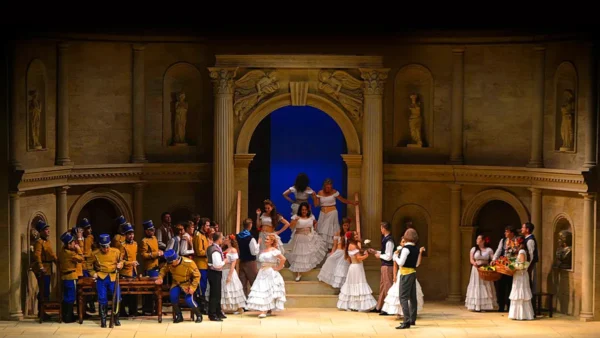
I suggested in 2024 how ‘Ellen Kent’s Carmen staging provides a thoroughly enjoyable night at the opera for audiences […] It is a good, honest, entertaining attempt at doing all it needs to do – tell the story clearly, allow the singers to do their best and make good use of the space available.’ The same very much applies in 2026 and there has been an excellent improvement in the sets we see. With a painted backdrop of a wooded valley with a Spanish Castillo in the distance, some two-dimensional sets now allude to sun-drenched Andalusia for the Seville town square and cigarette factory (Act I), Lillias Pastia’s inn (Act II) and outside the bullring (Act IV) with a more crepuscular setting for the third-act mountain hideout of the smugglers. The costumes are very colourful for the cigarette girls, townspeople of Seville, Escamillo and the bullfighters; as well as some typical for soldiers and gypsies of the original story’s early-1800s.
It was poignant once again have everyone stand for the Ukrainian National Anthem at the end of this Carmen; it was a moment of collective support for that country’s ongoing struggles and, in particular, solidarity after the terrorist incident in Kyiv on the very day of this performance. Under a banner of the Opera International Kyiv, Ukraine, a polyglot cast of principals and valiant small chorus and orchestra – all more than adequate to their task – did Carmen proud. From the first notes of the very famous prelude, conductor Vasyl Vasylenko (artistic director of the Opera and Ballet Theatre Kyiv) whipped his musicians through the score to find as much Spanish sunshine and other vivid colours as they could muster for the riveting drama. Together they did it with considerably more enthusiasm than you might expect now the tour is in its third month!
I have watched innumerable performances of Carmen over fifty years, and you can believe me when I say that Armenian tenor Hovhannes Andreasyan and Russian soprano Mariia Davydova were as good a Don José and Carmen as many I have seen. There was great chemistry between the pair – not always a given – and Andreasyan clearly shows someone at his wit’s end over his infatuation for Carmen. His Act II ‘La fleur que tu m’avais jetée’ was well-controlled and impassioned and he really came into his own as all his character’s pent-up anger is released and he despatches Carmen at the end of the opera. Davydova (who sang in 2024 using the name Irina Sproglis) was once again an outstanding, world-class Carmen; totally self-confident, sensual, seductive and manipulative when toying with Don José’s affection. The passion Davydova’s Carmen brought to her duets with Andreasyan’s Don José rang true and her vivacious, smoky-hued mezzo-soprano voice was so mightily impressive one more time.
Moldovan Iurie Gisca – who looks uncannily like the late movie star Charles Bronson – brought swaggering machismo once again to Escamillo. He had the vocal power and projection to pin the Cliffs Pavilion audience’s ears back for his rabble-rousing Toreador Song (‘Votre toast’) and it was a masterclass for any singer of this role. Korean Elena Dee’s Micaëla was something of a ‘shrinking violet’ compared to the more brazen Carmen and her voice was rather uneven despite some well-placed notes. Hovhannes Nersesyan was a stolid Zuniga, Don José’s lieutenant, whilst Anastasiia Blokha and Liuciia Dun caught the eye and ear as Frasquita and Mercédès, particularly during the Act II Smugglers’ Quintet and the reading of the cards in Act III (though they were a little underpowered elsewhere). As before, there was more full-throated singing from a small chorus doing wonders filling in as the townsfolk, soldiers, flamenco dancers, battling cigarette factory girls, Escamillo’s supporters and gypsies. Filling in the crowd scenes were the eager local students of The Pauline Quirke Academy of Performing Arts Wickford.
If you are new to Carmen, or like me have seen it many times, you will find what Ellen Kent presents as very musically satisfying; as those in the Cliffs Pavilion certainly did when they gave it a spontaneous standing ovation.
Jim Pritchard
For more about Ellen Kent’s Carmen, La traviata and Madama Butterfly on tour click here.
Featured Image: A scene from Opera International Kyiv, Ukraine’s Carmen in a previous staging
Creatives:
Director – Ellen Kent
Company manager and Stage director – Victor Donos
Lighting designer/Operator – Valeriu Cucarschi
Chorus mistress – Kateryna Kondratenko-Savienkova
Cast:
Carmen – Mariia Davydova
Don José – Hovhannes Andreasyan
Escamillo – Iurie Gisca
Micaëla – Elena Dee
Zuniga – Hovhannes Nersesyan
Moralès / Le Dancaïre – Vitalii Cebotari
Frasquita – Anastasiia Blokha
Mercédès – Liuciia Dun
Le Remendado – Ruslan Pacatovici