
 United States Various, ‘Density 2036’: Claire Chase (flute), Jacob Felix Heule (live sound). San Francisco Performances, Herbst Theatre, San Francisco, 18.4.2026. (HS)
Annea Lockwood (arr. Claire Chase) – Solo for flute and environmental sound from Elwha!
Susie Ibarra (arr. Chase) – Sunbird
Marcos Balter – Solo suite from Pan
Pauline Oliveros (arr. Chase) – Thirteen Changes
Terry Riley – Pulsing Lifters (with Sarah Cahill/piano); Solo suite from The Holy Liftoff
Edgard Varèse’s Density 21.5, his four-minute 1936 exercise in atonal showing-off of everything a solo flute could do, inspired contemporary flutist Claire Chase to launch her current project, ‘Density 2036’. Her recital for San Francisco Performances offered a range of pieces from composers commissioned under that flag, and these contemporary works proved to be infinitely more complex and rewarding than Varese’s austerity.
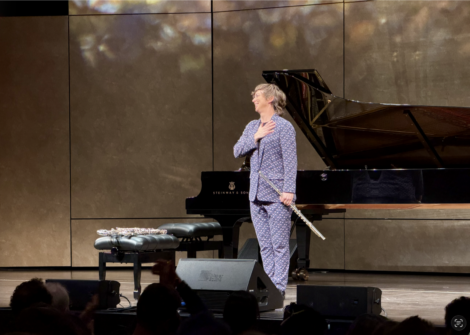
As bold and revolutionary as the Varese piece can still seem, the extra layers Chase explored in Herbst Theatre created a soundworld of endless dimensions. She was the only musician on the stage for the two-hour concert (except in a brief work by Terry Riley for flute and piano), but these pieces opened up a delicious range of possibilities, thanks in part to electronic amplification of amazing depth and precision. A head microphone (like the ones worn by actors in stage plays) could pick up her flute playing and, in between pieces, allow her to speak about them without having to reach for a hand mic.
Credit Jacob Felix Heule (himself a percussionist) for artistically managing computers and sound systems that added extra depth to Chase’s solo lines. The audio enhancements included deftly applied reverb and echo to create layers of harmonies. At times the audio reflected sounds of nature and, at other times, tracks that Chase pre-recorded harmonized with her solos on flutes.
Yes, flutes, plural. Chase selected specific instruments at different times from an array next to her on stage, choosing among standard flutes, an alto flute, a piccolo and even, at one point, an ocarina. For the most part, the music soared with beautiful harmonies, warm textures and long filigrees of melody, interspersed with moments in which extended techniques created percussive and other non-standard sounds. She even whistled occasionally above the mouthpiece.
Of the six pieces on the program, all of which were extraordinary in their own way, two jumped out for me. One was Thirteen Changes by the Brazilian-born composer Pauline Oliveros, a baker’s dozen sampler of brief impressions generated by short poems. Written in 1984, the piece reminded me of Debussy’s impressionistic piano portraits of places and things, not at all in the French style, of course, but impressive in creating a picture with a few notes. Chase changed colors using every one of her instruments, including the ocarina in ‘a singing bowl of steaming soup’ and a finger-size, pipe-like flute for the final ‘aura of a black bird’ which took advantage of electronic echo at the fading finish.
Along the way, her alto flute intertwined with a recording of her playing sustained bass flute in ‘standing naked in the moonlight’. The piccolo enticingly portrayed ‘rotating molecules’. Chittering sounds of the flute danced with ‘rollicking monkeys landing on Mars’ and the highly rhythmic music for ‘elephants mating in a secret grove’ drew smiles.
Terry Riley’s The Holy Liftoff, which concluded the program, offered a delectable exercise in contrapuntal writing and ever-shifting harmonies. At 90, Riley is still composing with freshness. He wrote Liftoff from 2022 to 2024 for huge numbers of musicians, some of which could be heard in the pre-recorded material during a 20-minute solo suite of three movements. A 5-beat meter at an Andante pace featured Riley’s signature layering of melodies to create a range of harmonies. The second part explored slow-moving chants against low drones, which grew into a kaleidoscope of harmonies at the end.
Preceding that, pianist Sarah Cahill provided support for Riley’s Pulsing Lifters, a brief but enticing piece that started off joyfully before turning pensive and delving into deeper harmonies.
The program opened with two charmers. The first, three segments from Elwha! by the New Zealand-born Annea Lockwood, was inspired by one of the first and largest ecosystem restoration projects in a U.S. National Park. The music follows the rhythms and sounds of the river in Washington’s Olympic Peninsula, transmuted into melodies played against sounds of the river. The piece began with the alto flute’s lowest range resembling a quiet foghorn against the recorded river sounds, then developed into something reminiscent of free jazz. Chase’s active body language added to the effect.
Sunbird by the avant-garde jazz drummer Susie Ibarra placed drum rhythms against recorded flute music that seemed to be responding to what Chase was playing.
The most challenging music was the first of three extracts from Marcos Balter’s Pan, an evening-long opus of nine tableaux on the life of the Greek satyr demi-god. The first, which depicted Pan’s death by flaying, found Chase screaming out in pain between excruciatingly vivid exclamations from her flute. The second, ‘Chasing Echo’, came as a relief, the music hauntingly searching as she walked around the silent piano. The third, ‘Wordless Apology’, spun out duets with her pre-recorded lovely, sustained tones.
It would be easy to focus on the sheer virtuosity necessary to execute such an evocative range of music. The miracle of Claire Chase is how vividly she can capture what the music is all about, whether it is a horrifying scream or a ravishing sonority, to make an audience gape in awe. To do this in a two-hour recital of contemporary music that is not a series of sonatas is a gift to be treasured.
Harvey Steiman