 Austria Elena Tschernischova’s Giselle: Dancers of Vienna State Ballet, Orchestra of the Vienna State Opera / Luciano Di Martino (conductor). Broadcast live from the Vienna State Opera (directed by Anna Gettel), 26.4.2026. (JPr)
This was billed as ‘Elena Tchernichova’s Giselle’ which perhaps suggested the late Kirov dancer’s version would be something different from the norm. Tchernichova arrived in Vienna via the American Ballet Theatre and was director of the Vienna State Opera Ballet from 1991 to 93. I understand that one of those she coached as Giselle in her time there was Alessandra Ferri who is the ballet’s current director; and apparently she has now coached this performance’s Giselle, Laura Fernandez Gromova, Vienna’s relatively new principal.
Wagner famously said ‘Kinder, macht Neues! Neues! und abermals Neues!’ but ‘do something new’ is the province of opera, whilst ballet has been rehashing the same steps for over a century in sets that are often decades old. And still we watch! And still we enjoy what we see, as I mostly did again watching this Giselle. Is it much different from Mary Skeaping’s 1971 Giselle which is frequently revived by English National Ballet or Sir Peter Wright’s 1986 version for The Royal Ballet that I saw as recently as March (review here)? The answer of course is no, but I would suggest the storytelling is better in those two than Tchernichova’s.
Giselle has a very simple story which most will be familiar with and was unchanged here. The young peasant girl Giselle – with a weak heart and love of dancing – falls in love with Albrecht, a nobleman already engaged and who is hiding his true identity from her. When she discovers the truth, Giselle goes mad and dies. Against her own will, she joins the Wilis, vengeful spirits of jilted brides who condemn the now repentant Albrecht and seek to force him to dance until he dies of exhaustion. However, Giselle’s love lasts beyond the grave, and she dances with him until dawn when the Wilis lose their power over him.
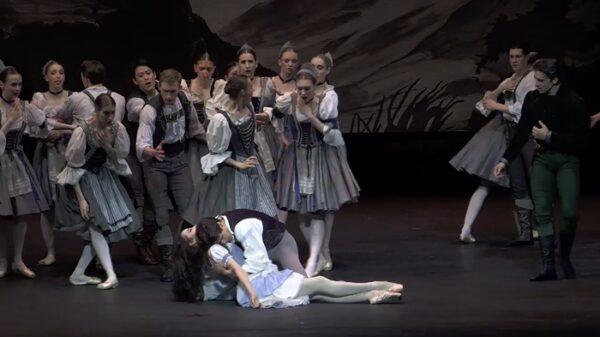
Ingolf Bruun’s set for Act I is a Rhineland valley straight out of a painting by Caspar David Friedrich, it all very gloomy and the village has just two dwellings, one for Giselle and her mother on one side and a hut on the other. Some benches, a couple of stools and a table is basically all the stage furniture we get to see. Costumes are equally muted, generally grey or a pale blue with dirndls and lederhosen for the villagers. The first real splash of colour is the entry of Albrecht’s haughty riding crop-wielding betrothed, Bathilda (Elena Bottaro), in a red velvet-looking creation appearing very much like Austria’s ‘Sisi’, Empress Elisabeth. The Act II forest at midnight is almost totally dark with just a cross at the front and the Wilis wear diaphanous wedding dresses and are very briefly veiled.
I have seen Giselles with more villagers (and not just those involved in the wine harvest), a bigger royal hunting party, and even more Wilis. Albrecht enters with his friend Wilfred who attempts to dissuade Albrecht in his droit de seigneur pursuit of Giselle. Oddly Albrecht has no sword, meaning that the swarthy gamekeeper Hilarion (Alessandro Cavallo), who is genuinely in love with Giselle, keeps leaving the stage to find it somewhere before using it to reveal who Albrecht actually is. Franziska Wallner-Hollinek’s Berthe is Giselle’s suitably concerned mother though her somewhat truncated mime does not make any real impact. The villagers entertain Giselle, Albrecht and Berthe with some hand-clapping exuberance and there is a splendidly danced pas de quatre (Margarita Fernandes, Václav Lamparter, Sinthia Liz and Rinaldo Venuti) to some additional music from 19th-century German composer Friedrich Burgmüller.
I was impressed by the commitment and technical perfection of much of the dancing I saw in the cast led by the young Laura Fernandez Gromova. She gets familiar solos expressing her joie de vivre as well as coy duets with Albrecht – flirtatious or tender – which highlight the connection and chemistry between the two characters as well as the two dancers. Gromova displays Giselle’s emotional journey through her expressive eyes and face. Her Giselle is clearly unwell with her death through a broken heart at the end of Act I being anticipated more than sometimes it is. Giselle charms Bathilde who gifts her the extravagant necklace she is wearing. Oddly Giselle removes it to dance then puts it back on for her slightly OTT mad scene where she does not stab herself and just gets increasingly delirious until she collapses in a distraught Albrecht’s arms.
Gromova’s partner, the extremely talented António Casalinho, dances superbly and has a stunning leap and lands extremely softly. Clearly a cad in Act I, his remorse over Giselle’s fate is plain to see in Act II. There are no entrechats six to impress us with in that second act but simply two diagonals of brisés, so at the end I do wish Casalinho’s Albrecht had looked more exhausted when he finally hit the floor.
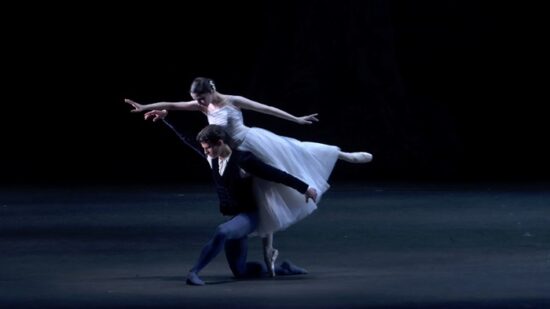
I thought the long-limbed Rosa Pierro was more languid than spectral in her opening solo as Myrtha, the Queen of the Wilis, and otherwise was neither authoritative nor imperious enough. In their soft white tulle as the Wilis, the impeccably drilled corps de ballet added to the ghostly ambiance as they moved in perfect unison. The leading Wilis, Moyna and Zulma, were embodied convincingly by Natalya Butchko and Sinthia Liz (who had caught the eye in the Act I pas de quatre). Gromova makes a rather rushed entrance from behind the cross and excelled in this act dancing with clarity, precision, softness and a dreamlike lyrical elegance where her arms looked as if they had been caught on a breeze. At the end Giselle is cradled in Albrecht’s arms before she hands him what looks like a daisy similar to the ‘he loves me, he loves me not’ one we see in Act I before disappearing to leave him centre stage and inconsolable.
As heard though loudspeakers the Giselle score was given an energetic and ravishing account by the outstanding Orchestra of the Vienna State Opera conducted by the Italian-German Luciano Di Martino who brought out, as appropriate, all the effervescence or hauntingly beautiful detail in the music; as well as proving particular sensitive to the needs of his dancers especially when balances were involved.
Jim Pritchard
Featured Image: Giselle end of Act I: [front] Laura Fernandez Gromova (Giselle), António Casalinho (Count Albrecht) and Alessandro Cavallo (Hilarion)
Cast:
Giselle – Laura Fernandez Gromova
Count Albrecht – António Casalinho
Hilarion – Alessandro Cavallo
Berthe – Franziska Wallner-Hollinek
Wilfrid – Trevor Hayden
The Duke of Courland – Eno Peci
Bathilde – Elena Bottaro
Pas de quatre – Margarita Fernandes, Václav Lamparter, Sinthia Liz, Rinaldo Venuti
Myrtha – Rosa Pierro
Moyna – Natalya Butchko
Zulma – Sinthia Liz
Creatives:
Libretto – Théophile Gautier, Jules-Henri Vernoy de Saint-Georges and Jean Coralli
(after Heinrich Heine)
Choreography and Staging – Elena Tschernischova
Music – Adolphe Adam (with music for the pas de quatre by Friedrich Burgmüller)
Sets – Ingolf Bruun
Costumes – Clarisse Praun-Maylunas
Coaching – Julio Bocca, Alessandra Ferri
Rehearsed by Pino Alosa, Lukas Gaudernak, Barbora Kohoutková, Marcelo Gomes,
Louisa Rachedi