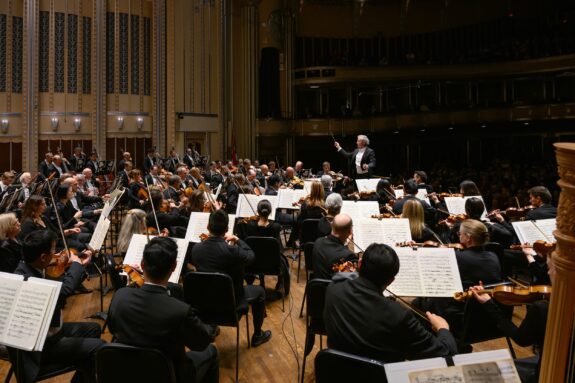
 United States Prokofiev, Neuwirth, Wagner: Jörg Widmann (clarinet), Cleveland Orchestra / Franz Welser-Möst (conductor). Mandel Concert Hall at Severance Music Center, Cleveland, 7.5.2026. (MSJ)
Prokofiev – Symphony No.1 in D major, Op.25, ‘Classical’
Neuwirth – Zones of Blue (Rhapsody for Clarinet and Orchestra)
Wagner – Excerpts from Götterdämmerung
Some concerts are a carefully thought-out succession of works. And some are not. This concert would appear to be of the latter variety, best summed up as three pieces with nothing in common. But the performances were all sterling, even if the content might not appeal equally to every listener.
First up was Prokofiev’s ‘Classical’ Symphony, which was being recorded live to finish up Franz Welser-Möst’s ongoing Prokofiev symphony cycle. True to that project, the conductor’s concept of this early, wryly neoclassical symphony feels more symphonic than most performances which emphasize the brittle side of the charming piece. Welser-Möst was content to soften the bright glare and moderate the tempos. Last season, we heard a sharply-characterized performance from Osmo Vänskä (substituting for Welser-Möst who had been dealing with health issues). As brilliant as that performance was, it was enjoyable to hear Welser-Möst’s kinder, softer approach. His fast tempos were moderate, allowing room for the players to realize Prokofiev’s detailed figurations, and the flowing tempo for the slow movement helped considerably to focus it. There was not much difference in the pace between the initial appearance of the Gavotte and its reprise, but the relaxed Finale allowed the woodwinds to play their chatter instead of just approximating it, which is the inevitable result of a headlong tempo. This elegant performance will fit handsomely with the already recorded and released elements of the cycle.
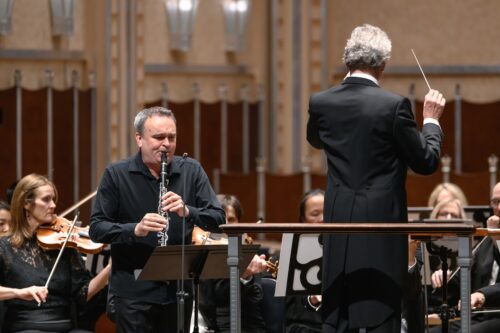
Jörg Widmann, heard last week as composer and conductor, returned this week as soloist in Olga Neuwirth’s Zones of Blue, a twenty-minute Rhapsody for Clarinet and Orchestra co-commissioned by the Cleveland Orchestra and the Bavarian Radio Symphony and receiving its US premiere here. Written for Widmann, the piece opened with one of Widmann’s trademark sounds in his own works, breath blown through the instrument without engaging the reed. From that arresting start a macabre soundscape grew, fueled in places by references to jazz or jazz influences such as a near-quote of the opening clarinet skirl from Gershwin’s Rhapsody in Blue.
The program noted that Neuwirth’s work, though written for Widmann, functions as an elegy for the composer’s father, the jazz pianist and composer Harald Neuwirth. In practice, the piece felt more nightmarish than elegiac, the solo part a veritable catalogue of experimental clarinet techniques. To be sure, that impression was intensified by its placement following such a genial performance of the Prokofiev. While the experimental element was interesting at first, the piece didn’t seem to progress beyond that, with the rather predictable deployment of the jazz elements as dark, feverish disruptions becoming tiresome. Widmann brought as much sheer enthusiasm to this as he did to last week’s concert, carrying the piece a long way. Ultimately, though, I found my attention wandering, something that never happened in the previous Neuwirth piece played here, the excellent Masaot/Clocks without Hands, which seemed a fresher take on Neuwirth’s usual angst.
Erasing the bitterness of the Neuwirth was a noble synthesis of orchestral excerpts from Richard Wagner’s final opera in the Ring of the Nibelung tetralogy. No arranger was credited in the program, but the forty-minute selection was certainly owned by Welser-Möst, starting with the Dawn sequence and continuing into a noble but nimble traversal of Siegfried’s Rhine Journey, with commanding horn calls offstage and on by principal Nathaniel Silberschlag. This seamlessly segued into Siegfried’s Death and the searing Funeral Music. Here, the conductor carefully gauged the level at which the brass instruments could darkly blaze without burning down Valhalla prematurely, as it were. This allowed enough expressive energy to make the closing Immolation Scene feel moving and epic, the culmination of the opera instead of an anticlimax. The orchestra’s sound was a remarkable balance of sumptuousness and poise, the kind of thing we will have one more season to treasure before Welser-Möst moves on from Cleveland, and the likes of which we may rarely encounter again.
Mark Sebastian Jordan
Featured Image: Franz Welser-Möst leads the Cleveland Orchestra in excerpts from Wagner’s Götterdämmerung © Yevhen Gulenko/TCO
Legend has it that Birgit Nillson was less than thrilled with her tenor in a Ring production. Apparently, she felt he fell short on emotion and inspiration. In the final scene of Siegfried when he awakens Brünnhilde from a death sleep, she, in an attempt to get some reaction from the tenor portraying Siegfried, held a sign stating: Surprise, I’m alive. That sums up my reaction to FWM’s Wagner on Saturday. Talk about balanced, lush, technical assured playing until the Valkyries fly home, I was bored.
I thought that the Neuwirth was the best thing on the program. The Prokofiev 1 was fine, but had a few moments where crisp articulation gave way to mush. I go back further than Vänskä which was also an adequate performance to ones conducted by Masur and others. Overall I give this concert a Yawn.
JP for S&H: I believe there is a similar anecdote about the sleeping Brünnhilde involving legendary Wagner tenor Alberto Remedios.