
The BRSO in 2026-2027
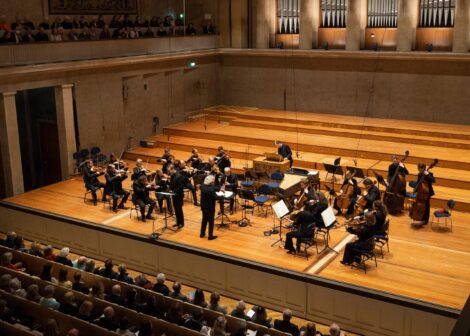
The Bavarian Radio Symphony Orchestra opens its 2026/27 season under the continued leadership of Chief Conductor Sir Simon Rattle, who marks his fourth year at the helm of one of the world’s great orchestras. The season’s overarching theme is Hoffnung — Hope — a concept explored across the programming through essays, musician testimonials, and above all through the music itself. For more information click here.
The season also anticipates the 200th anniversary of Beethoven’s death in 2027, celebrated with a dedicated string quartet cycle performed by orchestra members. The appointment of Tabaré Perlas as new Manager from April 2026, succeeding Nikolaus Pont, brings fresh leadership to the institution whilst maintaining the artistic ambition that has characterised recent seasons.
The season was presented at a press conference whose atmosphere was notably warm and convivial — a reminder of how deeply Rattle has settled into Munich life, and how genuinely the musicians of the BRSO have embraced him in return.
On the long-running question of the new concert hall, Rattle expressed cautious but genuine optimism following a recent meeting with Bavarian Minister Markus Blume. Without overpromising, he conveyed the sense that the political will may at last be shifting in a more encouraging direction.
Rattle also spoke about the programs and the range of works. He also mentioned the inclusion of a work by Laura Bowler The white book recommended by Barbara Hannigan in the season’s programming, describing a decision made with characteristic swiftness once he encountered the quality of the piece.
The press conference also brought a moment of genuine warmth around the announcement that 2026/27 is the final season of Susanne Vongries as head of the BR Chorus. Vongries has led the chorus with exceptional skill and commitment over many years, and the tributes paid to her were heartfelt. Rattle’s own comment was perfectly pitched: ‘She was so tough’ — delivered with a smile and the deepest respect.
The season opens in September 2026 with a series of performances of Beethoven’s Symphony No.9 in d minor, paired with Bach’s cantata O Ewigkeit, du Donnerwort BWV 20, conducted by Rattle and featuring Lucy Crowe, Tim Mead, Andrew Staples and Konstantin Krimmel as soloists, with the Chor des Bayerischen Rundfunks. Performances take place at the Herkulessaal on 24 and 25 September, with a guest concert at the Dom St Stephan in Passau on 26 September.
The first subscription concert of Abo A on 1–2 October is an all-Stravinsky programme — Symphony of Psalms, Le roi des étoiles, Chant funèbre and Le sacre du printemps — conducted by Rattle with the BR Chor, an ambitious opening statement that sets the tone for a season rich in twentieth-century repertoire. The season finale of Abo A in June 2027 pairs Barber’s Piano Concerto Op.38 and Shostakovich’s Symphony No.4 in C minor with Yuja Wang as soloist, again under Rattle.
Among the most eagerly anticipated events of the season is the concert performance of Debussy’s Pelléas et Mélisande in February 2027, with Magdalena Kožená as Mélisande, Anne Sofie von Otter as Geneviève, Julien Behr as Pelléas, Simon Keenlyside as Golaud and Franz-Josef Selig as Arkel — a cast of exceptional distinction.
Rattle has made the concert performance of opera a signature strand of his Munich tenure, following acclaimed readings of Wagner’s Siegfried, Mozart’s Idomeneo and Berg’s Wozzeck with the orchestra in recent seasons. Pelléas et Mélisande has not been heard at the BRSO for over fifty years, and Rattle’s long and celebrated association with Debussy’s opera — one of his most admired readings — makes this one of the unmissable events of the Munich musical year.
May 2027 brings two performances of Mahler’s Symphony No.10 in F-sharp major in the Deryck Cooke completion, a work Rattle has championed throughout his career. With this reading, Rattle continues what has become a de facto Mahler symphony cycle during his Munich tenure, systematically exploring the composer’s orchestral output with an orchestra that has a deep and distinguished history with this repertoire stretching back to the Jansons era.
In April, the musica viva series presents a portrait concert of George Benjamin, featuring the concert performance of his opera Picture a Day Like This with Anna Prohaska, Marianne Crebassa and Pierre-Laurent Aimard, conducted by Rattle — one of the most significant contemporary opera events of the Munich season.
Beyond its appearances with the BRSO and the Münchner Rundfunkorchester, the Chor des Bayerischen Rundfunks — celebrating its eightieth anniversary in 2026 — maintains an ambitious five-concert subscription series of its own at the Prinzregententheater, under the artistic direction of Peter Dijkstra. The season opens on 24 October 2026 with ‘Aus der Tiefe’, a programme of music by Arvo Pärt, Alfred Schnittke and Henryk Górecki that places the three Eastern European composers in searching dialogue with one another. November brings the Sacred Concert of Duke Ellington, with the legendary hr-Bigband and a world premiere by the Bavarian jazz composer Christian Elsässer. Howard Arman conducts Bach’s Christmas Oratorio (Cantatas 1, 2, 3 and 6) with the Camerata Salzburg and Julian Prégardien as Evangelist on 12 December. The fourth subscription concert on 13 February 2027 is a Late Renaissance journey centred on Gesualdo, with Il Giardino Armonico and Giovanni Antonini directing works by Cavalieri, Gabrieli, Luzzaschi, Fontanelli and Monteverdi alongside the Tenebrae Responsories. The series closes on 10 April with Joby Talbot’s Path of Miracles — a demanding a cappella pilgrimage along the Camino de Santiago, paired with Allegri’s Miserere. The season also includes a ‘Chor-Abo plus’ concert on 19 February 2027 at the Herkulessaal, in which Thomas Adès himself conducts and plays the piano, giving the world premiere of his new choral work Abendlieder alongside Brahms’s Liebeslieder-Walzer Op.52, with Kirill Gerstein as co-pianist. This is choral programming of genuine breadth and distinction, entirely independent of the orchestral season.
The guest conductor roster is of the highest calibre, with several notable debuts alongside returning favourites. Making their first appearances with the orchestra are the Finnish conductor Stanislav Kochanovsky, who leads a programme featuring Britten’s Nocturne Op.60 and Tchaikovsky’s Symphony No.1 in G minor (‘Winter Daydreams’) with tenor Allan Clayton, and the Japanese conductor Kazuki Yamada, who directs Rachmaninov’s Symphony No.2 in E minor Op.27 and Prokofiev’s Piano Concerto No.2 in G minor Op.16 with Anna Vinnitskaya in Abo A. Bar Avni makes her BRSO debut conducting the finals of the ARD International Music Competition in September.
Among returning guests, Klaus Mäkelä appears in Abo D conducting Brahms’s Symphony No.1 in C minor Op.68 alongside the Britten Violin Concerto No.1 Op.15 with Janine Jansen. Karina Canellakis leads the orchestra in Rachmaninov’s Symphonic Dances Op.45 and Bartók’s Concerto for Orchestra. Jakub Hrůša conducts Beethoven’s Symphony No.2 in D major Op.36 in one programme, and Elgar’s Violin Concerto in B minor Op.61 paired with Walton’s Symphony No.1 in B-flat minor with Nikolaj Znaider in another. Daniel Harding conducts Tchaikovsky’s The Nutcracker Act II and a new piano concerto by Korean composer Donghoon Shin with Seong-Jin Cho as soloist. Franz Welser-Möst, one of the pre-eminent Bruckner conductors of our time, leads Bruckner’s Symphony No.8 in C minor. Iván Fischer conducts two programmes, including Robert Schumann’s Symphony No.3 in E-flat major Op.97 with Kirill Gerstein in Brahms’s Piano Concerto No.2 in B-flat major Op.83. Riccardo Chailly returns after a long absence with an all-Stravinsky programme framing Rachmaninov’s Symphony No.1 in d minor Op.13. Herbert Blomstedt, who maintains his remarkable career well into his tenth decade, conducts Bruckner’s Symphony No.5 in B-flat major in a special concert — an event certain to attract wide attention.
Among the soloists, Isabelle Faust appears in Berg’s Violin Concerto (‘To the Memory of an Angel’) alongside Schubert’s Symphony No.8 in C major (‘Great’) under Rattle; Stephen Hough plays Rachmaninov’s Piano Concerto No.3 in D minor Op.30 in the opening Abo S concert; and Antoine Tamestit performs a new Viola Concerto by Francesco Filidei paired with Beethoven’s Symphony No.3 in E-flat major Op.55 (‘Eroica’), a programme also taken to Vienna’s Musikverein and on a European tour to Amsterdam, Dortmund and Cologne. The pianist Víkingur Ólafsson makes his BRSO debut in Adams’s new piano concerto After the Fall under Edward Gardner, himself returning in what promises to be one of the most interesting programmes of the Abo B series.
A major highlight of the season is an extensive Asian tour from 12 to 27 November 2026, taking the orchestra and Rattle to Seoul, Kaohsiung, Taichung, Taipei, Nishinomiya, Kawasaki and Tokyo — including multiple evenings at Suntory Hall. The tour programme draws on the season’s core repertoire: Mahler’s Symphony No.2 in C minor (‘Resurrection’), Rachmaninov’s Third, Schubert’s Symphony No.8 in C major (‘Great’), Stravinsky’s Le sacre du printemps, the Berg Violin Concerto and Beethoven’s Piano Concerto No.4 in G major Op.58, with soloists including Isabelle Faust and Krystian Zimerman.
In anticipation of the Beethoven bicentenary in 2027, orchestra members perform all seventeen of Beethoven’s string quartets across six concerts at the TonHalle in the Werksviertel-Mitte, a venue whose acoustic has proved particularly suited to chamber music. The cycle, titled BRSO Beet4oven, begins in February 2027, with the remaining three concerts extending into the 2027/28 season, and represents one of the most ambitious chamber music undertakings by an orchestra ensemble in recent Munich memory.
The contemporary music series musica viva presents an exceptionally rich season, opening with a programme of seven newly commissioned works on the days of Creation alongside Saariaho’s Trumpet Concerto Hush and Leifs’s Geysir, conducted by Matthias Pintscher. Further highlights include a double Rihm portrait conducted by Riccardo Chailly, and a final concert conducted by Brad Lubman — making his musica viva debut — featuring works by Liza Lim, Milica Djordjević and Minas Borboudakis. Three guest concerts bring the Lucerne Festival Contemporary Orchestra under Jörg Widmann, a staged Histoire du Soldat from Salzburg with Georg Baselitz’s marionettes and Isabelle Faust among the instrumentalists, and a Nō theatre programme from Tokyo.
The Watch This Space series, designed to present musicians in unconventional settings in the Werksviertel-Mitte, features cellist Julia Hagen with BRSO cellists, and flautist Henrik Wiese with BRSO Academy members.
Now celebrating its 25th anniversary, the BRSO Academy has trained over 200 musicians, nineteen of whom are currently members of the orchestra. In May 2027, the Academy gives a full concert under Rattle at the Herkulessaal, featuring Varèse, Hindemith, Milhaud and a concert performance of de Falla’s El retablo de Maese Pedro.
With a season that balances core symphonic repertoire of the highest quality with significant contemporary commissions, a continuing Mahler cycle approaching its conclusion, rare operatic programming in the finest concert performance tradition, and an ambitious international touring schedule, the BRSO under Sir Simon Rattle continues to affirm its position among the very finest orchestras in the world.
The orchestra’s long wait for a permanent home in Munich’s Werksviertel may be entering a more hopeful phase: Rattle’s recent conversation with Minister Blume has given grounds, apparently, for genuine if cautious optimism.
In the meantime, the present season demonstrates, once again, that the absence of a dedicated hall has done nothing to diminish the artistic ambition — or the achievement — of one of Europe’s great musical institutions.
Antoine Lévy-Leboyer