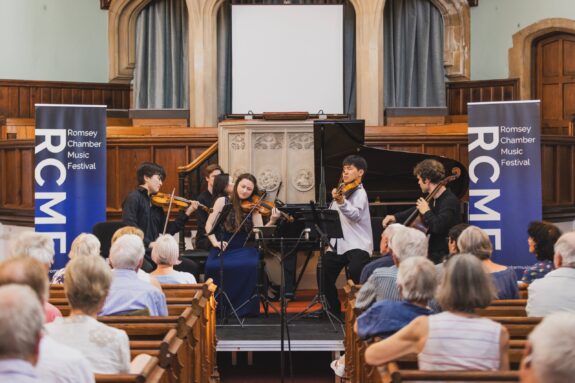
 United Kingdom Higdon, Enescu, Bartók: Emma Roijackers, Luke Hsu, Ruslan Talas, Laura Rickard (violins), Kyungsik Shin (viola), Lydia Hillerudh, Rainer Crosett (cellos), Joanna Lam, Ziteng Fan (piano). URC Church, Romsey, 30.5.2026. (CK)
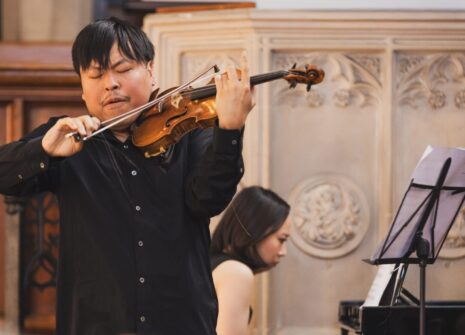
Higdon – Fiery Red
Enescu – Violin Sonata No.3 in A minor, ‘dans le caractère populaire roumain’
Bartók – Piano Quintet in C major
The American composer Jennifer Higdon is becoming better known this side of the Atlantic. I heard – and enjoyed – her Blue Cathedral almost twenty years ago, played by the Charlotte Symphony Orchestra; this work, and her Percussion Concerto, have been heard in recent BBC Proms seasons. She is fascinated by colour and the significances it shares with music: so credit to Laura Rickard and RCMF for giving us the opportunity to hear Fiery Red, a movement (presumably the Scherzo) from a piano trio. Fire and flame, fast and furious: it made quite an impact, bringing exciting and aggressive playing from Emma Roijackers and Lydia Hillerudh, and a virtuoso turn by Joanna Lam on the piano. With this fire there was no dying down: it ended abruptly, leaving me keen to hear it again – and, indeed, the whole work.
Enescu’s Violin Sonata proved to be a winning example of what RCMF is so good at: a superb performance of a substantial work unknown to most – perhaps all – in the audience. It is also a work that suits Luke Hsu’s talent to a tee. In his introduction he explained that Enescu’s writing for both instruments requires them to imitate the sounds and techniques of their Romanian folk musical equivalents: violin/fiddle, piano/cimbalom. The opening bars immediately established the music’s Eastern European flavour (with the emphasis on Eastern): the music had a mercurial character too, brooding one moment, springing playfully into life the next.
The Andante began, as its full title indicated, misterioso. Night music: haunting sounds on Luke’s violin as the piano repeated a single note. It became animated, passionate, in a faster central section, Luke’s playing agile, cat-like, swooping and sliding; a little frightening, almost, before returning to its veiled, mysterious opening. The concluding Allegro con brio brought us out of the shadows: cheerful, folk-inflected, Ziteng Fan and Luke Hsu alert to all its quicksilver changes of mood. It was a fantasia, demanding jaw-dropping dexterity from both players; the end was thrilling, Ziteng pounding away at the bottom of the keyboard, a final flourish from Luke. Fabulous!
It was interesting also to hear Bartók’s early Piano Quintet: in four movements, and longer (45 minutes) than its better-known forebears by Robert Schumann and Brahms. Brahms is very much part of the aural picture, and Richard Strauss even more so (the young Bartók had recently finished his tone poem Kossuth, scored for an Ein Heldenleben-sized orchestra). It began gorgeously, with playing of passion and amplitude from all five players (Ruslan Talas, Laura Rickard, Kyungsik Shin, Rainer Crosett, Ziteng Fan).
As Laura noted in the programme book, the work is also a first fruit of Bartók’s discovery of Hungarian folk music. In the Vivace, for example, the strings relax into a melody of Straussian sweetness before accelerating into motor rhythms typical of the mature composer; and there is a rhythmic tension that points to the future. The Adagio begins with an ominous rising phrase in the strings, developed by the piano into an angular and slightly sinister theme leading to an intensely wrought passage; then a lovely, veiled idea blossoms into Romantic opulence before the mists rise again. We may feel that the scales have tipped back a little towards Brahms and Strauss… A mysterious little march leads into the finale: a folk-inspired whirligig, a brisk fugal section launched by the piano, and a headlong – almost martial – conclusion.
The work is longer than it need be; its interest lies not so much in its intrinsic quality as in its significance as a transitional work. The fine quintet of players delivered it superbly, with personality, fire and discipline; I am very pleased to have heard it, but it is the Enescu (and the Higdon) that I am keen to hear again.
Schubert: The Goethe Quartet (Luke Hsu, Laura Rickard [violins], Marthe Husum [viola], Rainer Crosett [cello]). URC Church, Romsey, 30.5.2026.
Schubert – String Quartet No.15 in G major
After barely an hour’s break Laura and Rainer were back on stage with their comrades in the Goethe Quartet to perform, arguably, Schubert’s greatest string quartet. It is certainly the most demanding, lasting almost an hour; there is nothing comfortably Biedermeier about its energy, its battle between major and minor. As Richard Fleischman has written about the three great quartets, ‘These late quartets do not wallow. They grapple.’
The passion and intensity of the Goethes’ playing in Schubert’s epic G major Quartet was, in my experience, unparalleled. I was considering describing this astonishing performance as Schubert red in tooth and claw; but there was much more to it than that. And there, if they will forgive me, I will leave it. A plodding movement-by-movement commentary on such an all-encompassing experience would be to do it a disservice.
Chris Kettle
Featured Image: Bartók Piano Quintet in C major at the RCMF2026 © IOA Photography