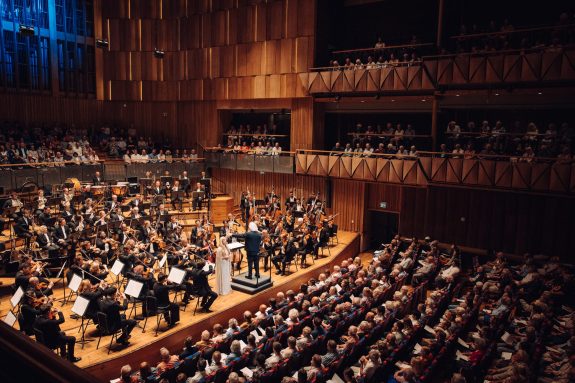
 United Kingdom Gerhard, R. Strauss, Mahler: Lucy Crowe (soprano), London Symphony Orchestra / Sir Simon Rattle (conductor). Bristol Beacon, 29.5.2026. (CK)
Roberto Gerhard – Symphony No.3, ‘Collages’
R. Strauss – Four Last Songs
Mahler – Symphony No.4
A sold-out Bristol Beacon greeted Sir Simon Rattle and the London Symphony Orchestra on their second visit since the hall’s refurbishment: maybe for Richard Strauss, maybe for Mahler, probably for the silver-mopped man himself. He did not let us down.
Where many septuagenarian maestros content themselves with recycling canonical and familiar masterworks, Sir Simon continues to tease and expand our ears, often by including a piece that isn’t often played, but should be: on his previous Bristol visit, Roy Harris’s Third Symphony; here, Roberto Gerhard’s Third. I like what I have heard of Gerhard’s music, mostly in broadcasts well before the millennium; but this was my first encounter with him in the concert hall.
In the current climate of reaction against Schoenberg/Boulez didacticism it is good to hear, and to thoroughly enjoy, an atonal work that sounds interesting, alive, and doesn’t take itself too seriously. The LSO, of course, has this kind of music for breakfast: it held no terrors for them.
Inspired by a sunrise seen during a transatlantic flight, and loosely charting the passage of a day, the symphony presents a rainbow of colours (an arc of ‘phones and ‘spiels around the back) and a pre-recorded tape, inspired, apparently, by the plane’s jet engines: machine sounds mixed with lightness and wit. A mighty crescendo followed by insect activity on pizzicato strings; tiny points of light on harp and piccolo; ravishing string chords; an electronic aviary on the tape; a sense of weightlessness, of being suspended in space. It was an exhilarating journey, the music resolving into spare sounds suggesting vast distances beneath a held note on violins, and a great, blinding…sunset? It felt more like a sunrise.
I must confess to some misgivings about hearing a soprano soloist sing Strauss’s Four Last Songs and the finale of Mahler’s Fourth in the same concert: they are so far apart in character and vocal technique. Lucy Crowe began with Frühling, as has become the norm: it is the shortest of the four songs, but it is also the busiest for the singer, demanding agility as well as purity of tone, and she did not always sound in full command of the resources the song requires. By the time we reached Beim Schlafengehen she was singing with lovely line and tone, and a bell-like high note on tausend in the last line. Im Abendrot was beautifully done. Rattle and the LSO provided sensitive but not over-indulgent accompaniment throughout, with tender solos from first horn and violin.
Since his move to Munich as Chief Conductor of the Bavarian Radio Symphony Orchestra in 2023 Sir Simon Rattle has received ecstatic reviews for his performances and recordings of Mahler symphonies, transcending even his acclaimed earlier recordings, most of them with the City of Birmingham Symphony Orchestra. I heard outstanding performances of the Second and Ninth Symphonies at the BBC Proms during his spell in charge of the LSO: so it was exciting to hear him conduct them, here in Bristol, in the Fourth – the smallest of the symphonies in scale, and, on the face of it, the simplest and sunniest: but not necessarily the easiest to bring off.
Sir Simon knew exactly where he was going. In the past he has attracted a good deal of criticism for being over-interventionist, toying with detail at the expense of the bigger picture: there was none of that here. The opening movement unfolded naturally, and gorgeously, the music seeming to bask in Austrian sunshine without sacrificing its momentum, its schwung: there was time to enjoy countless details, to peer into unsuspected and delightful corners. I remember Alfred Brendel, asked about working with Rattle, saying ‘He radiates joy’: that was very much the case here.
The LSO were on their toes in the second movement, perhaps the lightest and least frightening of Mahler’s ironic scherzos; and they brought their most rapt playing to the Ruhevoll slow movement. Rattle guided it with a sure hand from the easeful pizzicatos on the lower strings, through every subtle change of tempo and mood, to the swinging open of the gates of Paradise and beyond. And to cap a fine performance, Lucy Crowe was excellent – close to perfect – in the Sehr behaglich finale.
We are used to seeing the orchestra leader coming onstage for this symphony with two violins and tucking the one he will use in the second movement (tuned up a tone) beside or beneath his chair. The LSO leader’s second violin on this occasion must have been very valuable, possibly temperamental, and used to five-star treatment: for in front of the leader’s seat was what I can only describe as a pale blue upholstered stool – a small pouffe, really – on which he reverently laid the instrument in question. Rattle clocked it as he walked to the podium; I was sorry not to be able to read his facial expression as he did so.
Chris Kettle
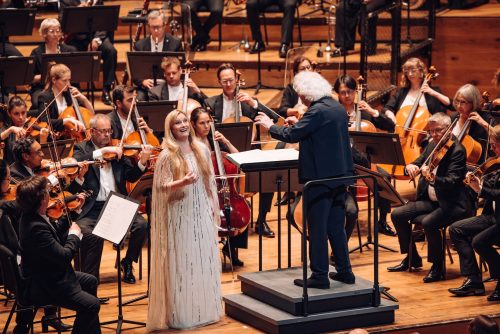
Featured Image: Soprano Lucy Crowe and the LSO conducted by Sir Simon Rattle © Soul Media/Jessie Myers