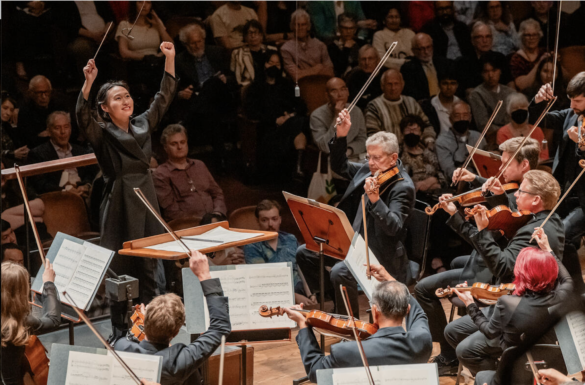
 United States Various: Maria Dueñas (violin), San Francisco Symphony / Tianyi Lu (conductor). Davies Symphony Hall, San Francisco, 12.6.2026. (HS)
Iman Habibi – Zhiân
Korngold – Violin Concerto in D major
Encore: Vecsey – Valse triste
Rimsky-Korsakov – Scheherazade
If the future of symphonic performances lies with women conductors, San Francisco Symphony events in the past two weeks make a strong case for optimism. Last week saw the first concert under Elim Chan, designated as the SFS’s music director beginning in 2027, in a terrific program that culminated in a technicolor performance of Debussy’s La mer. This week introduced Tianyi Lu to San Francisco audiences in an evening that culminated with an explosive performance of Rimsky-Korsakov’s Scheherazade, a piece that explores a wide range of sonorities and relies heavily on a conductor’s sense of timing, balance and tempo.
Both women have roots in China – Lu in Shanghai, Chan in Hong Kong – and both live in the West now. And they’re talkative: they opened their concerts by sharing personal anecdotes to connect with audiences.
Lu emigrated with her family to New Zealand when she was 5 years old and began her conducting career there. She spoke of her first visit to San Francisco as a teenager with her high school orchestra on a tour of the United States. Now in her mid-30s, she has a command of the orchestra in front of her that yielded a polished, invigorated performance of new and familiar music in her San Francisco program.
First up, the new work: Zhiân, a 13-minute tone poem by the Iranian-Canadian composer Iman Habibi, inspired by the struggles of Iranians against the oppression imposed by the nation’s current leadership. It premiered in 2023 with Andris Nelsons conducting the Boston Symphony, and Lu conducted it earlier this year with the City of Birmingham Symphony and Utah Symphony.
With a storyteller’s eye and ear, the composer builds tension and release, finally arriving with a moment that feels like triumph. The title derives from ‘Zhen, Zhiân, Âzâdi’ (Woman, Life, Freedom), which became the main slogan of protests. The conductor’s familiarity with the music made the structure and flow feel natural as the moods shifted in this orchestra’s first performance of it. Textures were dense but sounded with clarity, and the arc of the music was inspiring, with various stretches of the music depending upon a welcome variety of sections and instrumental combinations.
In this sense, the piece shared aspects of Rimsky-Korsakov’s oh-so-familiar Scheherazade which traces various stories told by the main character of One Thousand and One Nights. In her introductory comments, Lu noted that, like Zhiân, it centers on a woman resourceful enough to stave off death at the hands of an evil Persian sultan.
It takes a conductor with imagination and precision to bring Rimsky-Korsakov’s music for Scheherazade’s stories to life with freshness and conviction, and there was nothing routine in this performance. Each principal in the orchestra was featured in more than a dozen solos and sonic combinations of instruments, and their renditions were delivered with individuality and personality. For her part, as a storyteller herself, Lu pulled it all together with an ear for timing and tone.
Among the standouts was concertmaster Alexander Barantschik, whose lithe approach to the title character’s recurring theme was especially alluring. The entire woodwind section found dozens of different textures and sonorities, among them Catherine Payne’s piccolo lines topping so many melodic outbursts, flutist Yubeen Kim’s flourishes, Carey Bell’s clarinet wails and Stephen Paulson’s soulful bassoon interruptions. The colors and crisp articulations of Mark Inouye’s trumpet and the grumblings of the low brass and strings added their colors with panache, as did harpist Catherine Siochi’s perfectly timed glissandos.
If Lu’s tempos in the early movements felt a bit deliberate, the contrast with the finale’s onrush was notable. Lu was especially good in tying together the intimate interludes and the full-orchestral buildups to climaxes, making it all of a piece.
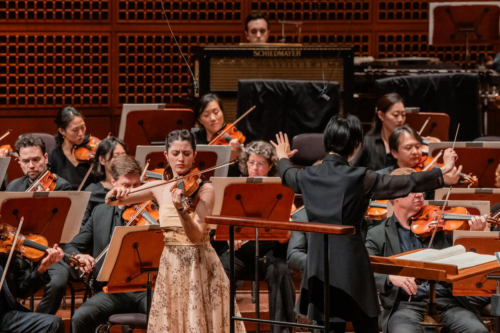
Between the two unashamedly Romantic tone poems came Erich Wolfgang Korngold’s Violin Concerto. In a refreshing change from the usual, the 23-year-old Spanish violinist María Dueñas resisted wallowing in this composer’s plush musical palette. She focused instead on clarity and precision, especially in the many ventures into the instrument’s highest range. For her part, Lu shaped a similar path through the highly perfumed harmonies and swaying rhythms.
The concerto, premiered in 1947 by Jascha Heifitz and the St. Louis Symphony, exploited the composer’s own movie themes. Already famous in Europe for the score for his opera Die tote Stadt, Korngold spent the years around World War II in Hollywood, where he quickly made a reputation for writing expressive film scores. The opening Moderato quoted melodies from Another Dawn and Juarez, and the central Romance used material from Anthony Adverse (that score won him an Oscar). The finale, based on a theme from The Prince and the Pauper, challenged the soloist with virtuosic writing, in particular the breathless race through the Allegro assai vivace finale. It felt like a fleet dance.
Dueñas’s encore was Valse triste, a miniature by Ferenc Vecsey, a violinist and composer who also preferred heart-on-sleeve Romantic music to the dissonance that was more expected in the first half of the 20th century. The simplicity and warmth were lovely.
Harvey Steiman
Featured Image: Conductor Tianyi Lu and the San Francisco Symphony cap Scheherazade with a flourish © Anthony Patoc