 United Kingdom Garsington Opera 2026 [3] – Monteverdi, Il ritorno d’Ulisse: Soloists, The English Concert / Laurence Cummings (conductor). Garsington Opera at Wormsley, 12.6.2026/ (CR)
Having collaborated in Monteverdi’s Orfeo at Garsington Opera in 2022 (so vividly does it remain in the mind that it hardly seems to have been as much as four years ago – review here) the same group of director, designer, conductor, and principal male singer reconvene at this festival for an equally magical production of the composer’s next opera, Il ritorno d’Ulisse (1640). John Caird conceives it as a sequel to Orfeo (1607) insofar as Ulysses yearns and searches for his wife, Penelope during his long homecoming after the Trojan War, as Orpheus laments Euridice after her death. Caird draws the connection here with the earlier opera by using much the same set and calling the audience’s attention from the grounds – at large before the performance and in the auditorium once seated – by prefacing the score with the famous fanfare from Orfeo.
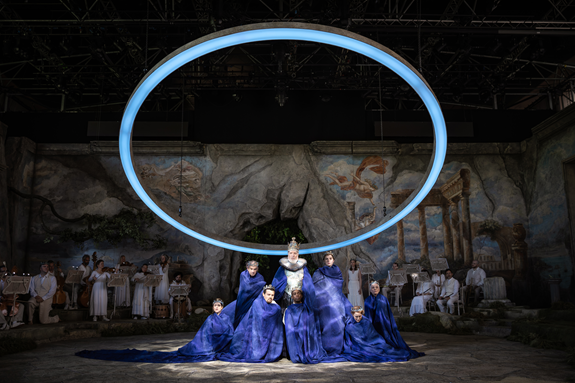
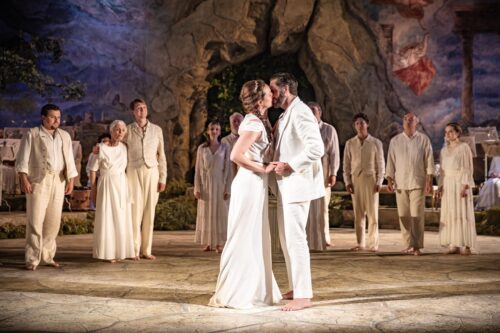
The set strips back the profuse vegetation and foliage utilised in Orfeo, although it is still placed within an essentially Arcadian landscape of lawns and rocks, against a frescoed architectural backdrop like a villa (perhaps calling to mind the courtly settings in which the earliest operas were performed, such as Orfeo at Mantua’s Ducal Palace, even if Il ritorno itself was actually premiered in one of the public opera houses at Venice). The action is centred on the round space at the middle of the stage, corresponding exactly to the orchestra of a Greek amphitheatre. For the most part it is in this place that the narrative among the solo principals unfolds with a Classical sobriety. Their acting responds with subtle gestures to the libretto’s rhetorical interplay of emotions and ideas, bringing just the right preponderance of showing over telling in Aristotelian dramaturgical theory. In this creative discussion of Renaissance philosophical and intellectual ideas, it is like a refined dramatisation of the sort of lightly worn, erudite discourse encouraged by Castiglione in his highly influential manual for humanist civic life, The Courtier (the opera is, of course, largely set at the court of Ulysses and Penelope on Ithaca).
The circle of the stage space is echoed by the illumined ring hovering above, a motif taken over by Caird from Orfeo, though not used here as dynamically or symbolically. But this production is essentially one of astutely, thematically realised contrasts or dialogues between two more or less equal principles, just as the drama pits many dualities against each other. It structures the three-act opera into the now standard division of two parts, whereby Telemaco’s discovery of his father at the end of the first pre-empts his revelation to Penelope at the climactic close of the second. The calmly Classical choreography and Greek-inspired costume of the small scale scenes contrast with the more Baroque theatricality of the more public or grandiose ones, such as the masked figures of Time, Fortune, and Love in courtly 17th-century dress during the Prologue; the crowned personification of Neptune and his attendants; Jupiter escorted by the giant wings of his eagle; Telemaco’s arrival in a mimed chariot; or the wanton, arrogant suitors and Iro as something like Edwardian fops. These vivid, colourful interludes remind us that the opera’s premiere took place at the time of the Venetian carnival season.
The English Concert is ranged around the central space, with the two continuo groups at extreme sides, resulting in an antiphonal effect. But as they are spread around, rather than concentrated in one place, they make for more discreet support that doesn’t dominate the singers, though they still perform with alacrity under Laurence Cummings’s lively conducting from the combined harpsichord and organ. The solo concertato instruments stand out all the more when they emerge from the basic sonic background, and the rumbustious pounding chords of the farcical duel between Ulysses and the glutton Iro can’t help but register as a comic mock-up of Monteverdi’s earlier dramatic cantata Combattimento di Tancredi e Clorinda.
Having taken the part of Orpheus four years ago Ed Lyon is now an equally mesmerising Ulysses in his virtuosic combination of inward musing and outward projection of grief, all encompassed within a well-rounded voice. The unsettled vehemence into which his first monologue is searingly shaped contrasts with the masterful, poignant poise of Cecelia Hall’s delivery, as Penelope, opening Act I. She develops a more convivial, ironic demeanour in the contest with the suitors, belying the descriptions of Penelope as cold-hearted and immovable. James Gilchrist’s earnest shepherd Eumete brings gravitas to the humble figure who brokers the meeting of Telemaco and Penelope with Ulysses after twenty years.
Stuart Jackson brings a commendably studied comic purpose – decidedly not caricature – as the court hanger-on Iro, heralding one monologue with an impressive messa di voce which incites some sympathy for the role. The other suitors are characterfully depicted by Alberto Miguélez Rouco, James Creswell, and Benjamin Hulett, the last two of whom also provide commanding accounts of the gods Neptune and Jupiter respectively, in their tussle over Ulysses’s fate, framed in the libretto as a dialogue between (pagan) retributive justice and (Christian) merciful graciousness. Miguélez Rouco first appears in the Prologue as a wiry-toned depiction of Human Frailty, buffeted by Thomas D Hopkinson’s imperious Time and Jessica Cale’s preening Fortune. Claire Lees is a more coaxing Love, a facet she combines with more fiery insistence as the goddess Minerva who guides Ulysses, while Cale becomes a touch more shrill as Juno. There are dignified, playful performances by Rowan Pierce and Innocent Masuku as the enamoured servants Melanto and Eurimaco – not cast as the saucy downstairs characters of later comic operas – and by Fiona Kimm as Ericlea, also not yet the lascivious old nurse in drag of Poppea, the operas of Cavalli and so on.
The performance is rounded off with a reprise of the same epilogue as used in Garsington’s Orfeo – a movingly sedate a cappella rendition of ‘Che dar più vi poss’io’ (SV99) from Monteverdi’s Fifth Book of madrigals.
In its fine balance between comedy and seriousness, and unforced enunciation of the music, this production remains true to the solemn spirit of the original, whose fusion of dramatic elements and deep expressivity is equalled but probably not surpassed in the whole subsequent history of opera, not even by Mozart or Wagner. Garsington will complete the trilogy of Monteverdi operas with L’incoronazione di Poppea in 2028 – perhaps serving as akin to the more comic satyr play to conclude this elongated Dionysian festival of early operatic masterpieces.
Curtis Rogers
Production:
Director – John Caird
Set designer – Robert Jones
Lighting designer – Paul Bryant
Choreographer – Arielle Smith
Cast:
Penelope – Cecelia Hall
Ulisse – Ed Lyon
Telemaco – Dafydd Jones
Ericlea – Fiona Kimm
Eumete – James Gilchrist
Iro – Stuart Jackson
Melanto – Rowan Pierce
Eurimaco – Innocent Masuku
Minerva / Amore – Claire Lees
Giunone / La Fortuna – Jessica Cale
Pisandro / L’Humana fragilità – Alberto Miguélez Rouco
Giove / Anfinomo – Benjamin Hulett
Nettuno / Antinoo – James Creswell
Tempo – Thomas D Hopkinson
Nereidi, Sirene, Feaci and Naiadi – Alysia Hanshaw, Thomas D Hopinkson, Will Prior and James Micklethwaite
Attended performance on 23rd. Sensational.