 Ireland Julia Wolfe, Rachmaninov, John Adams: Nicolas Namoradze (piano), National Symphony Chorus Ireland (chorus director: David Young), National Symphony Orchestra Ireland / Samy Rachid (conductor). National Concert Hall, Dublin, 18.6.2026. (RB)
Julia Wolfe – Pretty (Irish Premiere)
Rachmaninov – Piano Concerto No. 2 in C Minor Op 18
John Adams – Harmonium
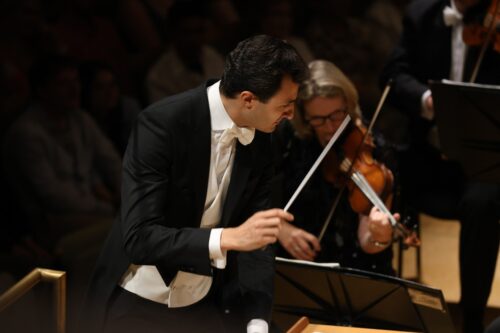
The National Symphony Orchestra Ireland (NSOI) were joined by guest conductor, Samy Rachid, for this season finale concert. Two defining works by contemporary Pulitzer Prize-winning US composers opened and closed the concert. Georgian pianist, Nicolas Namoradze, was the soloist in Rachmaninov’s Second Piano Concerto.
Julia Wolfe is celebrated for her gritty, high-energy compositions that blend classical orchestration with the raw power of rock and roll and folk music. She frequently uses her work to confront social, political and historical narratives. Her work, Pretty, was commissioned by a group of orchestras including the Berlin Philharmonic which hosted the world premiere in June 2023. Wolfe’s inspiration behind the piece stemmed from a desire to dismantle and reframe the social implications of the work ‘pretty’. She described Pretty as ‘a raucous celebration – embracing the grit of fiddling, the relentlessness of work rhythms, and inspired by the distortion and reverberation of rock and roll’.
I was not familiar with this piece before the concert, but I enjoyed this performance from Rachid and the NSOI. The orchestra brought an upbeat, riotous energy and dynamism to the performance. The strings produced an aggressive, edgy sound while the percussion created a rhythmic industrial motor to help drive the piece forward and added raucous effects. Rachid ensured the orchestra were able to navigate their way through the repetitive blocks of sound and he coaxed suitable unruly effects and uncouth climaxes from the NSOI. This was a bright, energetic performance and a strong opening to the concert.
Nicolas Namoradze came to international attention in 2018 after winning the Honens International Piano Competition. He is known as a visionary, innovative pianist and has released several recordings to critical acclaim. I am afraid I had major reservations with his performance of Rachmaninov’s Second Piano Concerto. The work opened well enough with Namoradze providing weight and depth of sound in the opening bell-like chords. The NSOI’s strings captured the moody melancholic quality in the long opening melody while Namoradze played rapid turbulent arpeggios underneath. The rapid fingerwork which followed from Namoradze was not accurate and he relegated the material to the background rather than bringing out the brilliance of the writing. He approached the lyrical second subject in an overly intimate and inward looking way rather than allowing Rachmaninov’s big Romantic melody to soar and bloom. Some of the subsequent playing was good and Rachid ensured there was tight coordination between orchestra and soloist, although Namoradze’s performance was patchy and inconsistent.
The Adagio sostenuto was the most successful of the three movements. Namoradze approached the melodic material in a sensitive and cultivated way and his exchanges with the NSOI’s woodwind were deftly handled. I was less convinced by his cadenza as some of the piano’s racing semiquavers did not cut through in the way they should. The third movement opened well with Rachid and the NSOI paving the way for the piano’s big virtuoso entry: yet Namoradze was not technically secure and some of the phrasing sounded odd. He seemed more comfortable with the lyrical second theme but again this was very inward self-communing playing, and he did not capture the grand Romantic sweep of the music. There were some memorable exchanges later in the movement and exciting playing in the coda. Overall, however, this was a mannered, unconvincing performance from Namoradze.
The National Symphony Chorus Ireland (NSCI) joined the conductor and orchestra for John Adams’s Harmonium. Adams was commissioned to write the piece in the late 1970s by the San Francisco Symphony. The work was premiered in April 1981 and was an instant success. It marked the point when Adams broke away from the rigid repetitive structures of early minimalism and embraced a more emotional Romantic style. It is in three movements, each of which sets poems by either John Donne or Emily Dickinson. The poems deal with the intense overlapping themes of human love, divine longing and the transition into death. The title refers to a human ‘harmonium’ in this case a giant breathing organ of voices.
There was much to admire in this performance from Rachid and the assembled orchestral and choral forces. The quiet murmuring from the NCSI at the start of the first movement built incrementally into a powerful wall of sound. The diction was excellent and Rachid ensured there was a good balance between the choir and orchestra. The modulation on the words, ‘My Love’ was particularly beautiful. In the second movement, Rachid and the NSOI did an excellent job portraying the carriage ride depicted in Emily Dickinson’s poem and the complex rhythms were well handled. The choir injected an eerie sense of calm into the vocal lines reflecting the poem’s acceptance of mortality. Rachid unleashed the full power of the NSOI in the energised finale and there was some very fine playing from brass and percussion. The choir sang with ecstatic fervour, and did an excellent job negotiating Adams’s very high vocal writing. Some of the diction was lost but it is admittedly very difficult to project over an orchestra playing at full throttle while singing in high tessitura. In the final moments, the music subsided and the choir and orchestra combined to produce gorgeous colours and sonorities.
Overall, this concert featured some very fine playing and singing to finish a first-rate season.
Robert Beattie
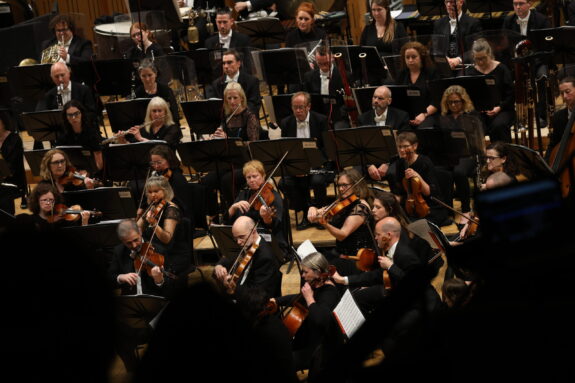
Featured Image: The NSOI during their season finale © NCH/Caoimhe O’Carroll