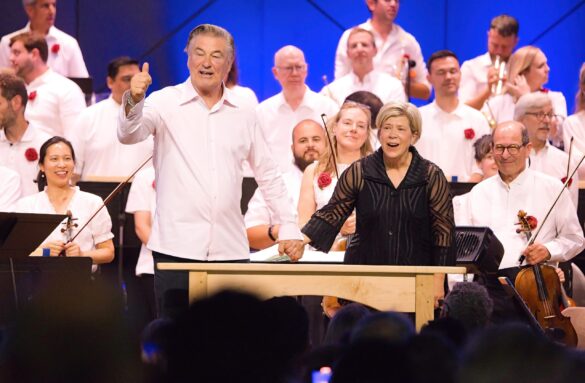
 United States Tanglewood 2026 [1] – Glass, John Williams, Copland: Zachary James (baritone), Alec Baldwin (narrator), Boston Symphony Orchestra / Karen Kamensek (conductor). Koussevitzky Music Shed, Lenox, 5.7.2026. (ES-S)
Glass – Symphony No.15, Lincoln for Solo Baritone and Orchestra
John Williams – Music from Lincoln
Copland – Lincoln Portrait
At Tanglewood, the Boston Symphony Orchestra offered an unusually charged prologue to its summer season. Presented in the context of the United States’s 250th anniversary, the program was built entirely around Abraham Lincoln, pairing two established musical portraits – John Williams’s suite drawn from his score for Steven Spielberg’s Lincoln and Copland’s Lincoln Portrait – with the world premiere of Philip Glass’s Symphony No.15, Lincoln. The new work arrived in the Berkshires with a public history already attached: Glass had withdrawn it from its planned first performance by the National Symphony Orchestra at the Kennedy Center in Washington earlier this year, turning a commemorative score into something closer to a civic statement before a note was played.
Glass framed the withdrawal as a symbolic act. The fact that he had been a Kennedy Center honoree in 2018 sharpened the point: he described the work as ‘a portrait of Abraham Lincoln’ and argued that the institution’s current values were ‘in direct conflict with the message of the Symphony’. Glass’s statement gave the Tanglewood performance an unavoidable extra layer. This was not only the delayed emergence of a new symphony by a major American composer; it came loaded with questions about collective memory, institutional authority and the way Lincoln is invoked as a national emblem.
The symphony itself, lasting about 35 minutes and divided into eight sections, sets Lincoln’s own words, selected as much for their continuing resonance in the present-day United States as for their place in a biographical portrait: the 1838 Lyceum Address, autobiographical fragments, reflections on slavery, the end of the Civil War and the 1861 Farewell Address. Baritone Zachary James projected Lincoln’s words with grave authority in a powerful performance of a part whose vocal writing often lay closer to heightened declamation than to sustained song. Karen Kamensek, a longtime Glass interpreter, drew disciplined and lucid playing from the BSO, giving the score as much contour and momentum as its repetitive structures allowed.
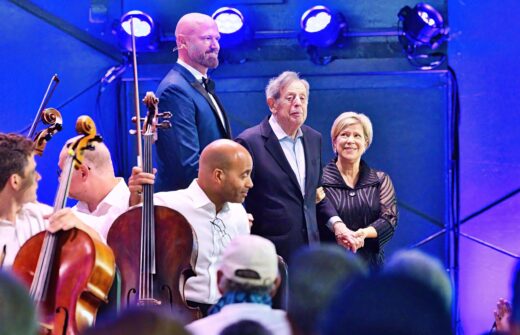
The music, composed between 2021 and 2023 in Glass’s familiar late idiom, seemed designed less to generate dramatic argument of its own than to frame and intensify Lincoln’s language. Still, its motoric patterns returned with such regularity, and its contrasts of texture, rhythm and orchestral color remained so restrained, that the score only intermittently gave the words the cumulative force they seemed to seek. The warmly sustained ovation, acknowledged by a visibly frail Glass after he made his way onto the stage, seemed to honor not only the new work but also the composer’s presence, his place in modern American music and the significance of the occasion.
The program’s coherence was not restricted to explicit references to Lincoln’s words and public persona. Heard together, the three scores traced a recognizable American musical idiom: clear tonal centers, processional pacing, broad orchestral gestures and an alternation between private lament and collective address. Copland’s Lincoln Portrait makes that language explicit, folding Lincoln’s words into an orchestral fabric colored by popular American tunes of the nineteenth century. Williams’s suite, drawn from a film score, belongs to a later branch of the same tradition, with its burnished strings, noble brass and open-air lyricism. Glass stood at a greater distance from that lineage, but his repeated figures and slowly shifting harmonies created their own ceremonial frame for Lincoln’s words.
From the first bars of ‘The People’s House’, Williams’s four-movement suite evoked a soundscape indebted to Copland, though filtered through the polish and emotional immediacy of film music. Kamensek refused to treat it as mere cinematic pageantry. The BSO gave the score warmth and breadth but its most persuasive passages came from the careful integration of soloistic detail into the larger orchestral fabric: Elizabeth Klein’s pastoral flute, Alexander Velinzon’s animated, fiddle-like violin in the ‘Getting Out the Vote’ dance, Blaise Déjardin’s inward cello and Thomas Rolfs’s noble trumpet in ‘With Malice Toward None’. These emerged not as display episodes but as individualized voices within the score’s expansive orchestral design, giving the music a human scale and tempering its solemnity with something more fragile.
Flute and trumpet were heard again at the opening of Copland’s Lincoln Portrait, now absorbed into the composer’s language of American civic rhetoric. Kamensek kept the score from hardening into a monument: the brass had firmness, the orchestral textures stayed clean and the rhythms retained enough lift to preserve the music’s plainspoken directness. Alec Baldwin’s narration, inevitably marked by the recognizability of his voice, brought theatrical assurance without tipping Lincoln’s words into melodrama. At its best, the performance allowed Copland’s 1942 wartime score to register not like patriotic décor but like a slightly exposed act of public address – earnest, unvarnished and disarmingly direct.
Edward Sava-Segal
Featured Image: Narrator Alec Baldwin and conductor Karen Kamensek © Hilary Scott