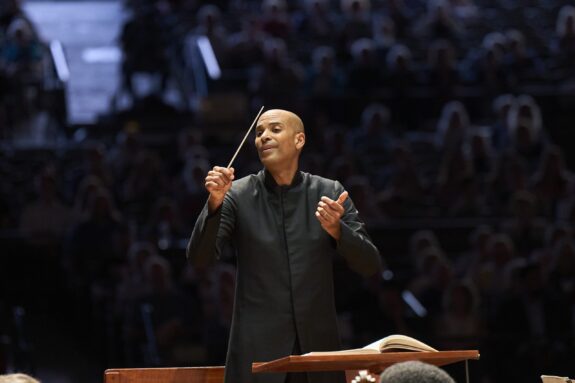
 United States Blossom Music Festival 2026 [4] – Various: Mark Kosower (cello), The Cleveland Orchestra / Kevin John Edusei (conductor). Blossom Music Center, Cuyahoga Falls, 25.7.2026. (MSJ)
Kodály – Dances of Galánta
Martinů – Cello Concerto No.1
Rachmaninoff – Symphonic Dances, Op.45
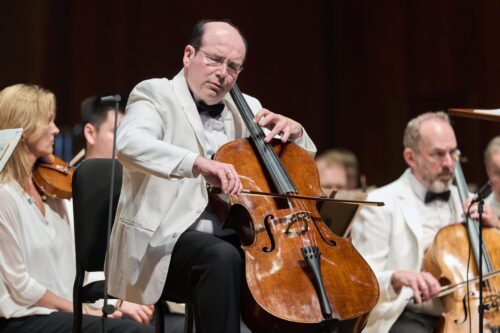
The Cleveland Orchestra’s principal cello, Mark Kosower, has proved to be an outstanding guide through the byways of the cello repertoire in recent years, again and again pointing out works that should receive more attention. He has given entrancing performances of concertos by Walton, Dutilleux and Gulda, so it was no surprise that he would strike gold with Bohuslav Martinů’s Cello Concerto No.1, a work belatedly receiving its first Cleveland Orchestra performance. The Czech-born composer was enamored of baroque concertante textures, so there was a risk in doing this work in the lively acoustic of the Blossom Music Center’s pavilion, but Kosower’s ferocious articulation kept even the most intricate lines vivid and clean.
It was particularly welcome as the Cleveland Orchestra is having a moment with Martinů these days, having experienced Jakub Hrůsa’s blazing rendition of Martinů’s Third Symphony earlier this year and with the return of Martinů’s Second (originally premiered by this orchestra) due in September under Franz Welser-Möst. It is a true celebration of a composer who absolutely deserves the attention. The concerto, written in 1930 but later revised, starts off with an arresting, almost jazzy theme, which Kosower leaned into eagerly. The orchestral part is just as intricate and involved as the solo line, and guest conductor Kevin John Edusei kept textures leanly sorted, offering energy without ever smothering the cello. The slow movement began quietly but with an edgy intensity that erupted in the middle of the movement with a percussion-led climax, following a searching solo cadenza from Kosower. The energetic finale looked back once at that anguished slow cadenza before zipping to an exhilarating end. One can hardly wait to hear what treasure Kosower will bring us next.
Edusei opened the evening with the delightful Dances of Galánta, one of Zoltán Kodály’s most popular works, full of Slovakian folk color. It was interesting to note just how much the orchestra’s sound could have been a portrait of Edusei himself, lean, balletic and elegant. The conductor encouraged the woodwinds to bloom in the delicate middle section of the work while letting the strings show their athleticism in the closing dance.
Likewise athletic was the concert-closing performance of Sergei Rachmaninoff’s final orchestral work, Symphonic Dances. It is odd that for so long Rachmaninoff had a reputation for lush, overripe romanticism. That is really because his middle-period works seemed rather soft-centered in sloppy performances though the composer’s own renditions prove that his piano concertos have a classical reserve. But one of the reasons for that mistaken impression was the composer’s determination to bury his explosive Symphony No.1 which had suffered a disastrous first performance. It turns out that the work was, in fact, much more ferocious than his more careful middle-period pieces (masterworks though they are). But the world has only slowly been waking up to the glowering darkness of Rachmaninoff, starting with the reconstruction of his First Symphony from surviving orchestral parts after his death.
And why go on at length about Rachmaninoff’s First Symphony? Because even though it was unknown to the public when the composer wrote and premiered Symphonic Dances in the early 1940s, he quotes it in a magical passage near the end of the first movement. It is clear that Rachmaninoff is looking over his life in this music and remembering with painful joy the early symphony which one critic described as ‘music for the inmates of an insane asylum in hell’. Rachmaninoff was thinking of dark, final things in this music, just as he had been wrestling with demons in his Symphony No.1 all those years before. For all practical consideration, this work is Rachmaninoff’s Fourth in all but name. And it was his last work.
In this piece, Rachmaninoff goes from the nervous energy of the first dance, complete with a melancholy interlude and the magical quote passage. The second movement is a sinister danse macabre and the finale is a march into holy battle with quotations of sacred hymns battling the fatalistic quote of the Dies irae judgement day chant. The ending is apocalyptic, with the tam-tam roaring out over everything. Edusei rightly let it ring out at the end, even as enthusiastic applause erupted from the large crowd in the pavilion and on the lawn.
As in the Kodály, Edusei favored fleet tempos – arguably a hair too fleet in the first dance – and lean textures which worked effectively in the reverberant pavilion. A slightly more controlled pace in the first dance would have allowed a fraction of a second longer for the heavy chords to roll through the pavilion but even as it was, the effect was dramatic. He swayed the tempo in the second dance to achieve expressive moments. Numerous solos animated the performance thrillingly, especially violinist Elizabeth Fayette who joined the orchestra as first associate concertmaster a few weeks ago and was serving as concertmaster for the first time in this performance. Her playing of the second-movement solo balanced a feverish delirium with uncanny foreboding, intensifying the mood compellingly.
As a whole, the performance was quite good though it did not erase memories of the scorching performance downtown almost two years ago, when Elim Chan seemed to lead the race to become the orchestra’s next music director. Since then, most candidates have left the race, except for Santtu-Matias Rouvali whom one classical gossip blog has declared the victor (without confirmation from the orchestra). Many guests, however, await further examination this summer and in the following season.
Mark Sebastian Jordan
Featured Image: Kevin John Edusei conducts the Cleveland Orchestra © Roger Mastroianni/TCO