 United Kingdom Various: Dénes Várjon (piano), Veronika Eberle (violin), Adrian Brendel (cello). Wigmore Hall, London, 11 & 12.7.2026. (AK)
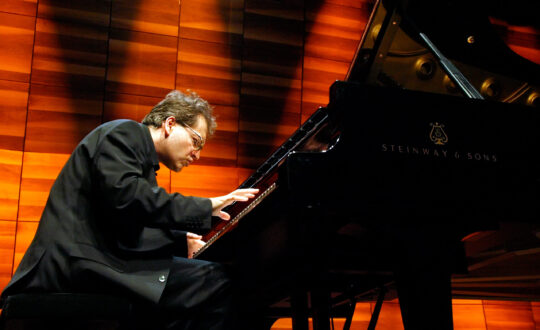
The weather was very hot, Wimbledon and the World Cup were strong rivals, but there was still a focused and devoted audience at both of Dénes Várjon’s Wigmore Hall recitals. Credit is due partly to the venue which is capable of offering comfort in whatever circumstance.
Várjon paired with violinist Veronika Eberle for the first concert (11th July) and with cellist Adrian Brendel for the second (!2th July). These string players are very different in style, yet pianist Várjon’s expertise secured good ensemble work on both occasions.
Eberle is the younger of the two string players but her maturity is ageless. An excellent player and fully focused musician, nevertheless even her exquisite playing was not enough to convince about the merits of the Schubert and Busoni pieces on her programme.
The early Schubert, written when the composer was nineteen years old, is full of pleasant melodies with much repetition. Arguably, it is a good opening number for any concert and I appreciated the care with which the performers tackled the composer’s harmonic changes.
The Busoni sonata was a challenge all round. On first hearing it felt like Busoni could not make up his mind what kind of a piece he wanted to compose. However, Eberle’s dedication and mastery of her instrument – fully supported by Várjon – presented the composition at its best.
The peak of the concert was Bartók’s sonata. Not only for me but for the audience too. Their applause was long, significant and meaningful; it was clear that we reached a different level of the concert. It is no surprise that Hungarian Dénes Várjon has full understanding and mastery of the piece; he is well steeped in Bartók’s language. However, I was surprised by Eberle’s full identification with the composition. Her disciplined passion, immaculate technique as well as her ability to produce deeply moving cantabile playing served Bartók well. It is of note that Eberle never forces her bow onto the strings, she allows her Stradivarius violin to be a partner in the performance.
Cellist Adrian Brendel is – at least on the account of this concert – very different from Eberle in performance style (although they play together from time to time). Furthermore, he is very different from his pianist father (Alfred Brendel) whom I first heard, in the late 1960s, when he played the piano part in Beethoven’s Choral Fantasy with Daniel Barenboim conducting the English Chamber Orchestra. In the subsequent decades I witnessed the pianist Brendel’s performing style on many occasions.
At his Wigmore Hall concert with Várjon, Adrian Brendel showed delight in performing, as well as in the pieces he performed. However, I was uncomfortable with his playing of the Beethoven and Brahms sonatas. To my ears and eyes, he was over dominant, tackling his instrument rather aggressively from time to time.
Brendel came to his own when, after the interval, we reached the Kurtág section. He spoke at length and movingly about Kurtág with whom he studied. (Várjon also spoke about his studies with Kurtág). Then they performed nine Kurtág pieces for solo piano and solo cello alternately. Brendel’s respect for Kurtág was not only expressed by his introductory words but by his cello playing too. He sang beautifully on his instrument, well equipped for the technical difficulties. Várjon’s Kurtág performances were breathtaking, in particular of the two pieces composed only for the left hand.
The final piece on the concert, Ernő Dohnányi’s Cello Sonata, evidently benefitted from the Kurtág interlude: excellent contributions from both players, in spite of a very difficult piano part.
The Hungarian second half of the concert (Kurtág, Dohnányi), including the beautifully played Liszt encore (Romance), made the audience particularly happy. ‘I loved the Kurtág’ was heard mentioned by several audience members on their way out from the auditorium.
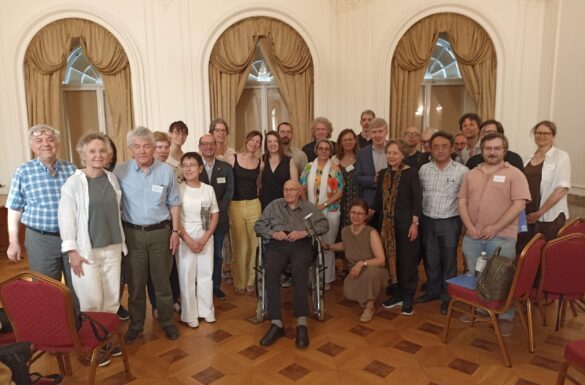
Composer Kurtág is extraordinary in every dimension. Age 100 years and five months, he is still active. He was at the Kurtág conference which I attended three weeks ago in Budapest. The closing concert included a world premiere of his song – ‘My Dear Friends’ – composed to a poem by Attila József. Kurtág listened in the first row of the hall during the concert, afterwards he posed for a photo with participants of the conference. Historical moments!
Agnes Kory
Featured Image: Kurtag on 20th June 2026 at the Institute of Musicology Budapest
11.7
Schubert – Violin Sonata (Sonatina) in D, D384
Busoni – Violin Sonata No.2 in E minor, Op.36a
Bartók – Violin Sonata No.1, BB84
Encore: Schubert – Violin Sonata in A, D574 ‘Duo’, III. Andantino
12.7
Beethoven – Cello Sonata in G minor, Op.5 No.2
Brahms – Cello Sonata No.1 in E minor, Op.38
Kurtág – Játékok VI: Les Adieux (in Janáčeks Manier); The Sayings of Péter Bornemisza, Op.7: Az hit…; Játékok V: Preludium és korál (Prelude and Chorale); Signs, Games and Messages; Pilinszky János: Gérard de Nerval; Trois in memoriam: No.1 A la mémoire de György Szoltsányi (Left Hand); Signs, Games and Messages: Népdalféle (Im Volkston); Trois in memoriam: No.2 Hommage tardif à Karskaya; Signs, Games and Messages: Árnyak; Trois in memoriam: No.3 In memoriam Maurice Fleuret (Left Hand)
Ernő Dohnányi – Cello Sonata in B-flat minor, Op.8
Encore: Liszt – Romance oubliée, S132