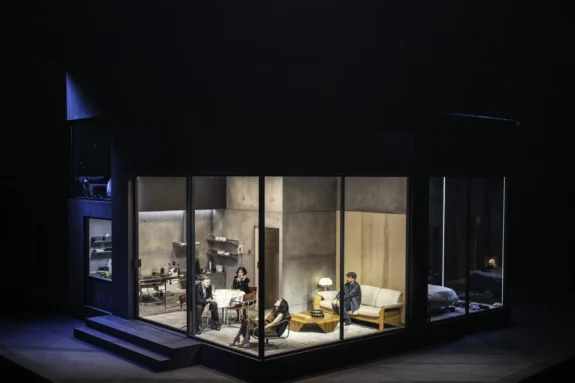
 United Kingdom Simon Stone’s The Oresteia: The Bridge Theatre, London, 15.7.2026. (JH) ****
Shakespeare was criticised by the French classical dramatists for mixing comic and tragic elements in his plays. 18th-century English and German critics later defended this as the hallmark of a genius unconstrained by rigid classical rules.
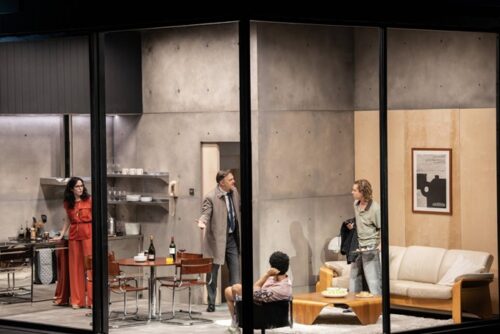
Simon Stone’s modern reimagining of Aeschylus’s Oresteia adopts a similarly audacious approach. Set within a sleek modernist glass house, complete with amplified dialogue and handheld microphones, the production deliberately creates an atmosphere of unease, noise and emotional dislocation. The action moves restlessly between 2016, 2019, 2023 and 2026, abandoning chronological order in favour of a kaleidoscopic, almost cinematic narrative. The play is witty, satirical and frequently very funny despite the shocking violence of the second act. For me, the experience resembled a roller coaster: intellectually stimulating and theatrically exhilarating over its 3½ hour running time, while also creating a distinctly Brechtian sense of alienation.
At the heart of the drama lies the death of Isabel, Stone’s Iphigenia. She commits suicide beneath a train in 2016 but remains absent for the entire play, appearing only in its closing moments. Her death nevertheless becomes the catalyst for everything that follows. Instead of the cursed House of Atreus, Stone presents the Middleton family, founders of a successful electronics company whose technology, publicly promoted for humanitarian medical purposes, is secretly deployed in weapons systems linked to conflicts involving Putin’s Russia in Syria and Afghanistan. Isabel is reimagined less as Iphigenia than as a contemporary Antigone: an idealistic activist protesting against the military exploitation of her family’s technology.
The first act opens in 2016 with preparations for the 21st birthday party of Isabel and her twin sister Alice, Stone’s Electra figure. Much of the opening has the flavour of a sharp contemporary family sitcom. Generational tensions are skilfully drawn between the emotionally reserved patriarch Christopher Middleton (Agamemnon), superbly played by David Morrissey, his more expressive American wife Montie (Clytemnestra), and their children Alice (Electra) and Augie (Orestes). Isabel herself remains unseen.
Beneath the domestic comedy, however, darker currents quickly emerge. Christopher admits to his brother that he has misappropriated around £1 million from the company, while the brothers’ overriding concern is preserving both the business and the family’s reputation. Christopher is urged to bring Isabel under control before events spiral beyond recovery.
The action then jumps to 2026, where a traumatised and catatonic Augie confesses to an Inspector Clouseau-like detective that he has murdered his mother.
The second act begins in 2023 with Montie waking from a disturbing dream, discovering her murdered lover Jerome (Aegisthus) in the bathroom and confronting the blood-soaked Augie before he kills her. The narrative then rewinds to 2019, when Christopher, divorced from Montie and accompanied by his compassionate new partner Chandra (Cassandra), attends a dinner party hosted by Montie and her lover Jerome. Gradually it becomes clear that the evening has been orchestrated as the prelude to Christopher’s murder for his part in the death of Isabel.
The third act, largely seen through Augie’s perspective, ventures beyond the confines of the glass house and moves rapidly across the different time periods, gradually filling in the narrative gaps. Returning from Afghanistan, Augie discovers, with the help of Alice and Chandra, that Christopher’s death was murder rather than the suicide staged by Montie and Jerome. Blaming Christopher for Isabel’s death, Montie ultimately killed him. Augie’s subsequent psychological collapse, matricide and confinement in a psychiatric hospital unfold alongside a ghostly visitation from Christopher. The drama culminates with Isabel’s first appearance in 2016 at a press conference at which Christopher publicly denounces her triggering her decision to walk quietly off the stage and throw herself under a train.
The performances are uniformly strong. Augie is a particularly demanding role, requiring Tom Glynn-Carney to navigate multiple timelines while portraying profound psychological disintegration. David Morrissey brings gravitas and quiet authority to Christopher, presenting him as a conventional, emotionally restrained patriarch whose flaws are gradually exposed. Rakhee Thakrar gives Chandra warmth and humanity, providing one of the production’s few emotional anchors. Mary-Louise Parker is less well served by the fractured chronology, which limits the gradual accumulation of emotional intensity that Montie’s role demands. Rosie Sheehy gives Alice convincing depth as the overlooked and increasingly disillusioned twin, while Archie Madekwe brings wit and charm to Lorenzo, Jerome’s son. Lloyd Hutchinson displays impeccable comic timing in the dual roles of Christopher’s brother and the hapless detective.
This is a dazzlingly intelligent production that privileges wit, ideas and theatrical invention over emotional immersion. Some audiences may find its fractured chronology distancing, but there is no denying its ambition, originality or technical assurance. It is a glittering reinterpretation of Aeschylus that rewards concentration and was warmly received by the Bridge Theatre audience.
Jane Havergal
Featured Image: Simon Stone’s The Oresteia © Johan Persson
The Oresteia is produced by London Theatre Company and Wouter van Ransbeek at The Bridge Theatre, 3 Potters Fields Park, London SE1 2SG, for a run that began on 3 July and ends on 19 September 2026. For further information click here.
Cast:
Montie – Mary-Louise Parker
Christopher – David Morrissey
Augie – Tome Glynn-Carney
Alice – Rosie Sheehy
Melville / Lester – Lloyd Hutchinson
Jerome – John MacMillan
Lorenzo – Archie Madekwe
Jenny / Letitia – Alyth Ross
Chandra – Rakhee Thakrar
Creatives:
Writer and Director – Simon Stone (after Aeschylus)
Set designer – Lizzie Clachan
Lighting designer – Nick Schlieper
Costume designer – Emma White
Sound designer – Peter Rice
Composer – Katrina Rose