 France Offenbach, Robinson Crusoé: Soloists, accentus, Les Musiciens du Louvre / Mark Minkowski (conductor). Théâtre des Champs-Élysées, Paris, 14.12.2025. (SRT)

Mark Minkowski and Laurent Pelly know their Offenbach. Over the years they have collaborated on several of his operettas, so this Robinson Crusoé is just the latest in a long line, albeit with a plunge into significantly less familiar repertoire.
Pelly doesn’t really do ‘straight’, at least not in any of his productions that I have seen. He is good at finding the fun in even the most serious of pieces, and he likes to deflate sacred cows (can you do that to a sacred cow?…) any time he gets the opportunity, so there was never any chance that this Robinson Crusoé would end up on an actual desert island. Some elements of Pelly’s iconoclastic take worked very well. His trademark visual style reminds me of a children’s TV show, with small clusters of set and furniture huddled together in a big open space, which worked very well for the Crusoes’ Bristol home in Act 1. He also went full-on slapstick for the cannibals, who work on a production line turning body parts into fast food.
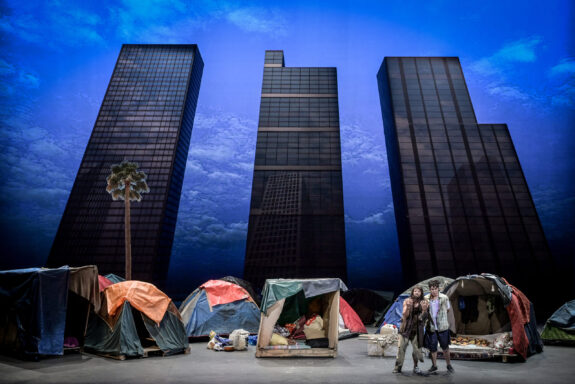
Other elements worked less well, however. The head-hunters come on dressed as a tribe of Donald Trumps, for reasons that I confess eluded me. The crowd loved it, but it felt like a cheap laugh to win over the liberal Paris audience. Furthermore, Robinson ends up in an urban tent city rather than a desert island, one that looks rather like a migrant camp, though if that was an attempt to make a political point then it fell flat.
Pelly’s great strength is at directing the characters, however, which he did to great effect with the comic pairing of Suzanne and Toby, who bounded around with endless energy, and sang brilliantly, too. Marc Mauillon’s tenor was light and flexible, as was Emma Fekete’s coloratura. Hers was thrown into all the more relief, because not only was Julie Fuchs unwell but her understudy was too. Jennifer Courcier had to be rushed to Paris (and the opening of the show was delayed so as to accommodate the arrival of her train) to sing the part from the orchestra pit while Fuchs acted on stage. These things are always unfortunate, and they made the best out of a tricky situation, though Courcier’s coloratura was often difficult to hear due to the lack of balance from the pit.
No such complaints about Sahy Ratia in the title role, his light, vigorous tenor proving every bit as appealing as his jokey stage presence. I read that this production was originally conceived with Lawrence Brownlee in the title role, and it would have suited his voice very well, but it is a tribute to how much Ratia owned the part that I never once regretted Brownlee’s absence. Every bit as good was Adèle Charvet’s Friday, a rich, exciting mezzo-soprano voice with oodles of stage presence to boot. Laurent Naouri barked his way convincingly through his brief scene as Robinson’s father.
But the musical stars of the evening were Les Musiciens du Louvre who, led with unfailing focus by Minkowski, played Offenbach’s lovely score with equal parts oomph and zing, particularly in the chuckling faster sections which Minkowski took at an admirably punchy tempo. When you hear playing like this, you can see why Minkowski and Pelly get on: their playful nature and iconoclastic taste are mirror images of one another.
Simon Thompson
Featured Image: Laurent Pelly’s production of Robinson Crusoé © Vincent Pontet
Production:
Director – Laurent Pelly
Designer – Chantal Thomas
Lighting – Michel Le Borgne
Dramaturgy – Agathe Melinand
Chorus director – Louis Gal
Cast:
Robinson – Sahy Ratia
Edwige – Julie Fuchs (stage)/Jennifer Courcier (singing)
Vendredi – Adèle Charvet
Sir William Crusoé – Laurent Naouri
Toby – Marc Mauillon
Jim Cocks – Rodolphe Briand
Suzanne – Emma Fekete
Deborah – Julie Pasturaud