 United States ‘WinterFest 2026’ [3] – Dvořák, Brahms: Musicians of the Lyrica program. Lyrica Boston, Lincoln, Massachusetts, 11.1.2026. (LV)

Dvořák – String Quartet No.13 in G major, Op.106
Brahms – String Quintet in F minor (reconstructed from Op.34 and Op.34a by Terry King)
The third and final concert of Lyrica Boston’s ‘WinterFest 2026’ brought the festival’s central preoccupation into sharpest focus: what happens when demanding repertoire is given time, trust and a culture of serious listening. Lyrica Boston, founded as a chamber-music laboratory rather than a presenting organization in the conventional sense, has long been defined by its emphasis on process – extended rehearsal, close listening and shared responsibility across ensembles. With Dvořák’s late G-major Quartet and Brahms’s F-minor Piano Quintet in its reconstructed form for five strings – the same two-cello configuration as in Schubert’s C-major Quintet, which clearly stands behind it as a model – the evening placed exceptional demands on ensemble stamina, clarity of thought and the willingness to commit fully, even when the music resists easy coherence.
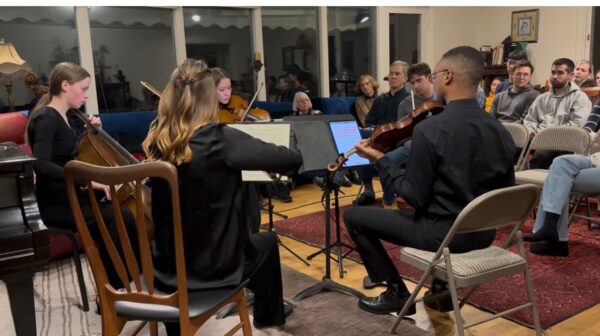
Dvořák’s final String Quartet is among the most difficult of the great quartets to bring off, even for seasoned professional ensembles. Its length, density and constant rebalancing of texture test not only technique but judgment. Played here by violinists Matthew Adams and Addie Oracion, violist Lana Kim and cellist Maggie Slap, the performance reflected a week-long process: rather than forcing unanimity, the players allowed the music’s complexity to breathe, trusting its long spans.
From the outset, first violinist Adams provided a stabilizing presence. Throughout the quartet’s nearly forty minutes, his tone remained serene and centered, and at moments when Dvořák’s dense contrapuntal textures threatened to overwhelm, his beautifully pure line acted as a guide out of the thicket. The slow movement found a darker, more inward tone, Lana Kim’s viola lending warmth and grain to the ensemble’s blended sound. The Molto vivace then came alive with buoyant energy, its Trio unfolding ‘like a dream’, Maggie Slap’s cello arpeggios sweeping upward with an ease that felt airborne, before the Finale balanced restraint and fire without tipping into excess.
Brahms’s String Quintet in F minor, presented in Terry King’s reconstruction of the composer’s abandoned early version of the Piano Quintet Op.34, was approached with fearless commitment by violinists Thompson Wang and May Tang, violist Aleksandre Roderick-Lorenz and cellists Hannah Sohn and Zac Fung. Tang’s spoken introduction framed the work as both speculation and an act of recovery, and the players responded by tearing into the music with striking clarity of purpose.
Without the piano’s weight, the writing sounded leaner and more exposed, and every line – every note – mattered. The opening movement surged forward with feverish intensity, the ensemble articulating Brahms’s dense textures with remarkable transparency. Midway through the recapitulation, a snapped cello C-string failed to derail Zac Fung who kept the musical line intact until one of his colleagues in the audience rushed his own cello to the stage. The damaged C-string was replaced and Fung’s instrument returned within roughly two minutes, the interruption heightening rather than breaking the sense of risk. Floating melodic passages carried depth and warmth, especially in the viola, where Aleksandre Roderick-Lorenz produced a richly burnished color that anchored the inner voices.
The slow movement unfolded with unforced lyricism, its beauty sharpened by the absence of keyboard sonority, allowing the strings to speak with intimate urgency. The Scherzo was attacked with vigor, the ensemble showing complete command of what might be called the Brahmsian bow stroke – weighty, elastic and rhythmically alive. In the Finale, the Allegro burst into motion with a moment of particular magic: Hannah Sohn’s opening cello line, buoyant, singing and with wonderful poise, recalled the irrepressible forward sweep of the last movement of Schubert’s Grand Duo for two pianos, Op.140, setting the tone for what followed. The Trio was drenched in beauty, the players relishing the physicality of sound production, and their drive to the finish line in the Finale was fueled by sheer accumulated energy.
King’s reconstruction is one of several attempts to recover Brahms’s original string version, and in performance it proved especially convincing – idiomatic in its string writing and persuasive in its voicing and sound. It is primarily based on the two-piano sonata version of the Quintet, listed as Op.34b in the official Brahms catalogue, a source closer to Brahms’s original conception than the work’s eventual final form, and it includes two bars in the first movement omitted from that version. Heard at this level, the work deserves to enter the active repertoire, not least because it meaningfully expands the relatively small body of string quintet literature for two cellos. That the reconstruction comes from Terry King – author of the definitive biography of his teacher Gregor Piatigorsky and a genuine inheritor of the Romantic tradition – only deepens its authority. Once published, this performance itself (which will be posted online) could serve as a compelling demonstration of the reconstruction’s musical and historical legitimacy.
Laurence Vittes
Featured Image: Matthew Adams, Addie Oracion, Lana Kim and Maggie Slap play Dvorak’s String Quartet © Laura Bossert