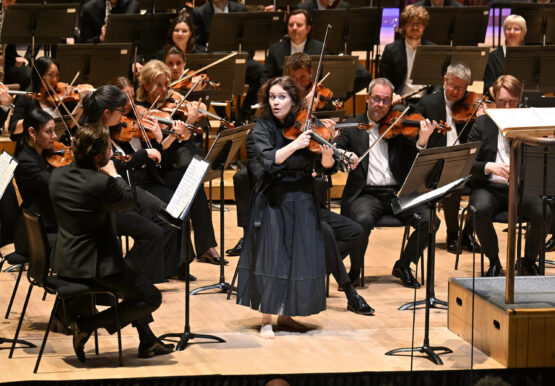
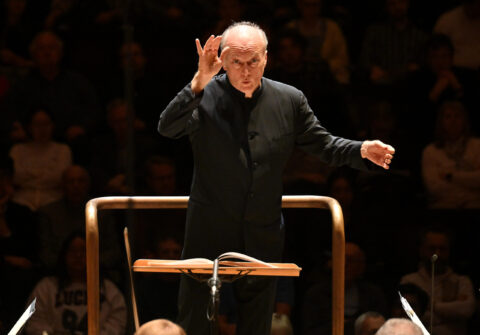
 United Kingdom Berg, Debussy, Rachmaninov: Patricia Kopatchinskaja (violin), London Symphony Orchestra / Gianandrea Noseda (conductor). Barbican Hall, London, 26.2.2026. (AV-E)
Debussy – Nuages & Fetes from Three Nocturnes (1899)
Berg – Violin Concerto (1935)
Rachmaninov – Symphony No.1 in D minor, Op.13 (1943)
This was a perfectly balanced London Symphony Orchestra programme and flawlessly played and conducted throughout starting with an evocative rendition of Nuages & Fetes from Three Nocturnes by Claude Debussy.
In Nuages, the winds and strings achieved a rare sensory feat: the vibration of vapour. From the opening measure, the woodwinds moved beyond the mechanical act of performance; they didn’t merely play the notes so much as exhale them, releasing a sonic mist that seemed to saturate the very air of the hall as a slow-motion suspension of subterranean sounds where the boundaries between breath and music dissolved into an atmospheric drift into the mists of being.
In Fêtes, there was a conflagration of distant dancing of lights and sparking of atoms. In the phantom procession, when the central march emerged, the muted trumpets achieved a mirage-like luminosity and did not sound like brass instruments, but like a haunting of light approaching from the horizon. This was a ‘conflagration’ that didn’t burn; it shimmered with a cold, electric heat that made the air feel thin and dangerously vibrant.
This concert represented the conclusion of Patricia Kopatchinskaja’s ‘LSO Artist Portrait’ series. Kopatchinskaja is somewhat of an international phenomenon amongst contemporary violinists and renowned for her theatrical ‘performance art’ interpretations of the modern classics where her ‘acting’ and ‘playing’ become a unified total art work.
Kopatchinskaja is celebrated for her highly acclaimed performances of Berg’s Violin Concerto. Composed in 1935, the work was dedicated ‘To the Memory of an Angel’ — a reference to Manon Gropius, the daughter of Alma Mahler and Walter Gropius, who died of polio at age 18.
Kopatchinskaja walked on barefoot playing a Corinthian folk melody, A bird in a Plum Tree has Awakened Me, with orchestra playing without conductor, leading straight into Berg’s Violin Concerto.
I have never heard it played with such a wide dynamic range of styles, tones, colours and expressions; or to paraphrase that awful old Heineken advert: she ‘refreshes the parts other violinists cannot reach.’
Yet her ‘performance art’ was devoid of superficial theatrics: for it was ‘lived’ rather than ‘played’ where she was no longer ‘playing’ the violin but actually ‘being’ the violin; and she transcended all banal binaries by sounding: elegantly-inelegant, civilly-uncivil, tastefully-tasteless, stylishly-unstylish, gracefully-graceless, politely-impolite, commonly-uncommon. At the same time, she was ‘acting out’: grimacing and smiling at her fellow players, whom, throughout, offered her razor-sharp support being acutely attentive to both the soundworld of Berg and the soundworld of the kaleidoscopic Kopatchinskaja: what an angelic revelation it all was and the appreciative audience applauded as if breaking a dodecaphonic spell.
Her deeply moving encore was Es ist genug, a German Lutheran hymn with text by Franz Joachim Burmeister written in 1662, with the melody written by JS Bach as the closing chorale of his cantata O Ewigkeit du Donnerwort, BWV 60
The LSO has had a long established ‘Rachmaninov Tradition’ from André Previn and Gennady Rozhdestvensky to Valery Gergiev and Gianandrea Noseda, who tonight gave us what I can only describe a ‘paradigm performance’ of the composer’s tragic First Symphony.
The first time that I had been introduced to his music was in 1968 when the current affairs programme Panorama used the opening fanfare of the Allegro con fuoco finale as its theme tune.
In the Grave—Allegro non troppo, the opening snarling brass aptly conjured up the menacing mood of this melancholic movement. This initial ‘snarl’ introduced the Dies irae inspired theme that served as a recurring ‘Fate’ motif throughout the entire symphony where menace and melancholia are always intertwined and were expressed as such by conductor and orchestra alike.
The Allegro animato provided us with a ghostly, skittering contrast to the first movement’s heavy melodramas, functioning as a ‘fantastic scherzo’ that felt both agile and agitated, again meticulously conducted and atmospherically played. The orchestration here was skittish and transparent, with shifting harmonic currents where fallen fragments of the Dies irae periodically surface like stabbing ‘shudders’.
In the Larghetto a meandering melancholic brooding displaced the menacing misery with nostalgic memories of beings long past with the heart-felt strings melting our heartstrings. The opening Allegro con fuoco – or that Panorama fanfare theme – erupted with predatory gusto with its march functioning less as a victorious celebration and more as ironclad terrorist attack.
The shrapnel-like brass cut into us with jagged, incendiary fanfares, transforming the symphony’s core four-note ‘snarl’ into a manic call to arms. This was Rachmaninov at his most belligerent and beguiling, with Noseda driving the rhythm with a feverish, unstoppable momentum that felt like a dread-filled deliverance toward an apocalyptic reckoning.
The broad pacing of the finale’s climatic tam-tam stroke – which marks a ‘moment of catastrophe’ near the end of the last movement, just before the final coda – was excellently executed with acute precision and allowed to fade gradually away into oblivion – just as Ashkenazy and the Concertgebouw Orchestra performed it; while Maazel with the Berlin Philharmonic rushes the tam-tam clash ruining the sensation of desolation which the ‘fading out’ requires.
The concluding tam-tam and timpani were overwhelming as were those slightly separated final two thuds. This is arguably one of the greatest endings of any symphony bar none. The packed out audience went wild after being treated to such exhilarating devastation.
Alexander Verney-Elliott
Featured Image: Violinist Patricia Kopatchinskaja performing with the LSO © Mark Allan