
 United States Various: Lang Lang (piano), Vienna Philharmonic / Andris Nelsons (conductor). Stern Auditorium, Carnegie Hall, New York, 27.2.2026. (ES-S)
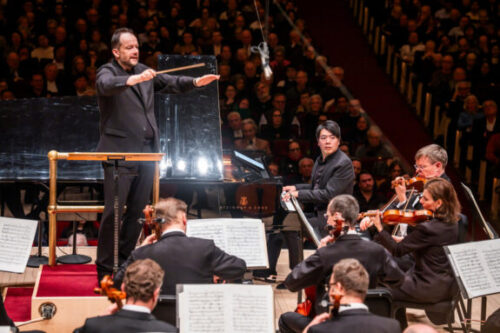
Bartók – Piano Concerto No.3
Encore: Liszt – Consolations, S.172 No.2 in E major
Mahler – Symphony No.1 in D major
Encore: Suppé – Leichte Kavallerie Overture
The Vienna Philharmonic’s annual Carnegie Hall residency marked the return of Andris Nelsons to the podium, renewing a partnership not heard in New York since their appearances during the 2014 ‘Vienna, City of Dreams’ festival. The programs were anchored in core Austro-German and East European repertoire: no French or Italian detours and only a single 21st-century work, but instead the symphonic literature this ensemble commands with particular authority.
The first evening centered on Bartók and Mahler, two composers who, in very different ways, reshaped the Central European symphonic inheritance. One work distilled late-style lyricism into concentrated, rhythmically subtle expression: the other projected youthful ambition across a vast orchestral canvas. Both demand structural clarity and a firm sense of direction, a standard not consistently met.
Béla Bartók’s Piano Concerto No.3, composed in the final months of his life, is often described as his most lyrical concerto. Yet its lyricism is never sentimental; it rests on tensile rhythm, sharply profiled folk inflections and a chamber-like reciprocity between piano and orchestra. The soloist is frequently first among equals rather than dominant protagonist, and the music derives its apparent simplicity and vitality from rhythmic lift and asymmetry.
Lang Lang approached the concerto from an inward angle. The opening Allegretto unfolded with careful shaping and cultivated tone, but the Hungarian syncopations – those spring-loaded accents that give the movement its lift – were softened into something smoother and less sharply defined. Phrases leaned toward expressive warmth rather than rhythmic propulsion. In a concerto that thrives on muscular buoyancy, the dance impulse felt cushioned, and the relationship between soloist and orchestra seemed carefully managed. Exchanges with winds and brass were precise, but the dialogue never felt entirely natural. Bartók’s writing here can sparkle with earthy wit or bite with percussive clarity; this reading favored polish over edge.
The Adagio religioso proved more persuasive. Here Lang Lang’s reflective restraint aligned naturally with the music’s contemplative character. The chorale unfolded with luminous clarity, and the central night music – with its insect murmurs and distant bird calls – shimmered delicately. Alongside its Beethovenian gravity, a fleeting Debussyan translucence colored the orchestral palette. The Vienna Philharmonic’s transparent strings and finely shaded woodwinds sustained an atmosphere of suspended stillness, allowing the movement’s quiet radiance to emerge without heaviness.
In the Allegro vivace, the rhythmic snap and folk-derived angularity again felt muted. The finale’s vitality – which can erupt with rustic energy and sharply etched counterpoint – remained polished and contained. The performance never lost control though it rarely risked abandon.
Lang Lang responded to the enthusiastic ovation with Liszt’s Consolation No.2. When a noticeable number of listeners did not return after the interval, it was hard not to conclude that, for many, the soloist had been the evening’s principal attraction. The encore itself was shaped with tenderness and control, the sound undeniably beautiful, yet a certain sense of artifice lingered.
Andris Nelsons’s Mahler interpretations have yielded mixed results over the years. His penchant for exacting detail can, at times, obscure the broader architectural sweep. In the First Symphony, that tension between finely shaped moments and long-range momentum was again apparent.
The opening emerged with admirable transparency. String harmonics hovered delicately, distant fanfares were cleanly placed and the woodwinds etched Mahler’s avian calls with character. If Bartók’s night music earlier in the evening suggested intimate interiority, Mahler’s natural imagery expands outward – from private murmur to panoramic dawn. Nelsons drew out the textures with patient care, shaping the atmosphere of awakening with deliberation. The sense of wonder – of a world gradually stirring into life – remained curiously contained. The movement seemed to meander through beautifully rendered episodes, its cumulative inevitability proving elusive.
The second-movement Ländler carried weight and polish. The Vienna Philharmonic dug into the dance rhythms with admirable unanimity, and the strings produced a rich, grounded sonority. The rustic impulse, however, felt carefully framed, its rough humor notably tempered. The Trio’s lyricism was lovingly sustained, but the contrast between earthiness and grace remained understated.
The same tendency to smooth the edges was evident in the klezmer intrusion of the third movement whose grotesque character felt subdued. Mahler’s parody can sound unsettling, even abrasive; here the irony, though present, was not sufficiently pointed. By contrast, the opening funeral march was measured and dignified, the solo double bass intoning ‘Frère Jacques’ with steady assurance. The woodwinds responded with finely shaded color, but the movement’s abrupt juxtapositions never quite achieved the uneasy tension that gives the music its peculiar bite.
Nelsons sought greater dramatic sweep in the finale, driving the orchestra forward with palpable intensity. There were passages of impressive sonority, particularly in the brass, yet climactic entries were not always cleanly aligned, and ensemble cohesion occasionally loosened under pressure. The repeated surges toward resolution carried comparable weight, diminishing their cumulative impact in a performance that did not fully ignite.
The encore – Franz von Suppé’s Leichte Kavallerie Overture – did so. The rendition was full of character and extroverted in spirit. Musically, it was minor fare but, in retrospect, one might have wished such immediacy had animated the larger canvases that preceded it.
Edward Sava-Segal