
 United States ‘Composer Portraits’ – Lisa Bielawa: Lisa Bielawa (soprano), Contemporaneous / David Bloom (conductor). Miller Theater at Columbia University, 26.2.2026. (DS)
Bielawa – Incessabili Voce, Balloon Variations, Graffiti dell’amante
Composer Lisa Bielawa doesn’t want you to just sit back and listen. At her recent Miller Theater ‘Composer Portrait’, the theme of interaction abounded. I found myself singing and, at another point, voting. Bielawa makes music for people, and she explained it this way in an on-stage interview with Miller Theater Executive Director Melissa Smey: ‘I want to find ways [for you] to be active, joyful and safe – to raise the vitality of your experience’. Perhaps her real secret is that every work seems to emanate from a personal place of artistic joy and sheer intelligence.
To begin the evening, she performed Incessabili Voce with the players of the ensemble Contemporaneous. Lieder, musical theater and old sacred song all found a happy marriage in this tantalizing and poetic work which weaves together three texts – the Latin ‘Te Deum’, a passage from Xenophon’s Anabasis and a portion of Heinrich Heine’s The North Sea from the second cycle. Bielawa’s compositional techniques realized a unique form of slippage between words, gestures and sounds that felt freshly genre-bending, even for 2026.
We didn’t get to participate (just yet), but Bielawa modeled for us what musical engagement should look like in her interactions with the instrumentalists. Standing at front center stage, she started out in a solemn soloist position then gradually transformed into a moving minstrel or merry master-class pedagogue. One moment leaning next to a musician then bending over another one, she belted out punctuated notes, wailed phrases or released swooning yelps.
Next in line was the world premiere of Balloon Variations. A theme and variations, it doubled as the sketch for Bielawa’s upcoming comic opera about an 18th-century French singer who was the first woman to fly in a balloon. The woman had (of course) been singing an aria during the momentous event. This all-instrumental piece was charmingly reminiscent of 1960s whimsical French film music by the likes of Jacques Tati. And Bielawa’s take on comic material challenged each musician to take on goofy, light-hearted yet demanding percussionist roles. Conductor David Bloom didn’t break character for a moment when he swung a whirly tube above his head, and violinists Josh Henderson and Finnegan Shanahan kept their fiddles under their chins while simultaneously playing guitars.
Then it was the audience’s turn. Clarinetist Gleb Kanasevich approached the edge of the stage and beckoned the audience to sing ‘ballooooon’ on cue several times, after the ensemble had run the word themselves a few times. We obliged, and one could hear the confidence to participate increase. Shrouded in a welcoming musical aura, Balloon Variations showed Bielawa’s ability to pair comic material with highly refined aesthetics and attention to crafted structures. The variations were each played as small patches of melodic turns that added up to a sweetly ironic piece. The opera will prove to be sensational
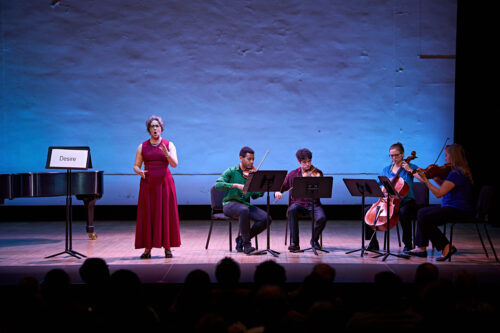
As her interview with Melissa Smey came to a close, Bielawa announced that she would need our help with the final piece. This earlier work from her repertoire – Graffiti dell’amante for soprano and quartet – requires that the audience choose the order of the movements. For the voting, Bielawa shifted large cards on a stand that read: ‘Absence’, ‘Desire’, ‘Devotion’, ‘Forgiveness’, ‘Ravishment’ and ‘Remembering’. Using these chapter titles borrowed from Roland Barthes’s A Lover’s Discourse which she matched to poetic texts of her own choosing, Bielawa transformed Barthes’s complex concept of demystifying art and its constructs of meaning into an ingenious, jargon-less experience, accessible to the ‘everyman’ listener on, of all places, the Columbia University campus.
The Miller Theater audience voted for ‘Desire’ followed by ‘Ravishment’, leading through the rest of the songs to a final ‘Remembering’. The reading flowed with mesmerizing tenderness, which further supported my reaction that this was a true chamber masterwork. Rarely at a performance is one left wanting more of the same piece, but my immediate desire was to hear it again in a new order, to uncover a new set of meanings in this kaleidoscopic work. Bielawa’s extraordinary ease at matching voice to instrumentation – both as soprano and composer – while simultaneously approaching texts with a singularly perceptive understanding surely brought a new ‘vitality’ of experience to the listener. I, for one, felt joyful to have participated.
Daniele Sahr